You met someone three weeks ago and your body already trusts them. Not your mind — your mind is still running background checks. But something deeper, something pre-verbal, has already decided this person is familiar. You can't explain it and you've stopped trying.
That feeling has a name in tarot. Several cards carry the energy of recognition that doesn't match the timeline.
The Card That Looks Like a Memory
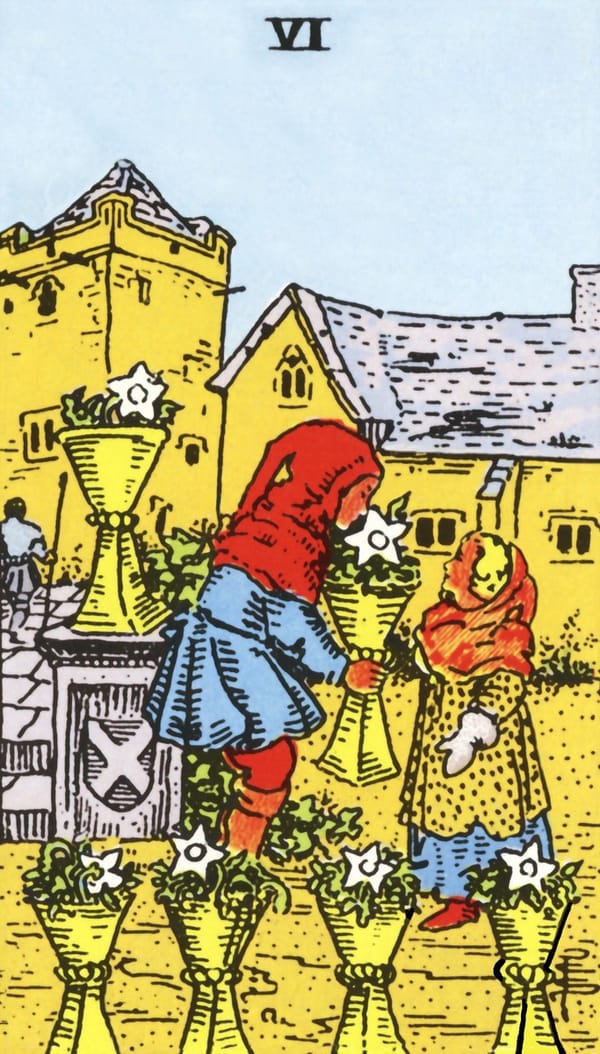
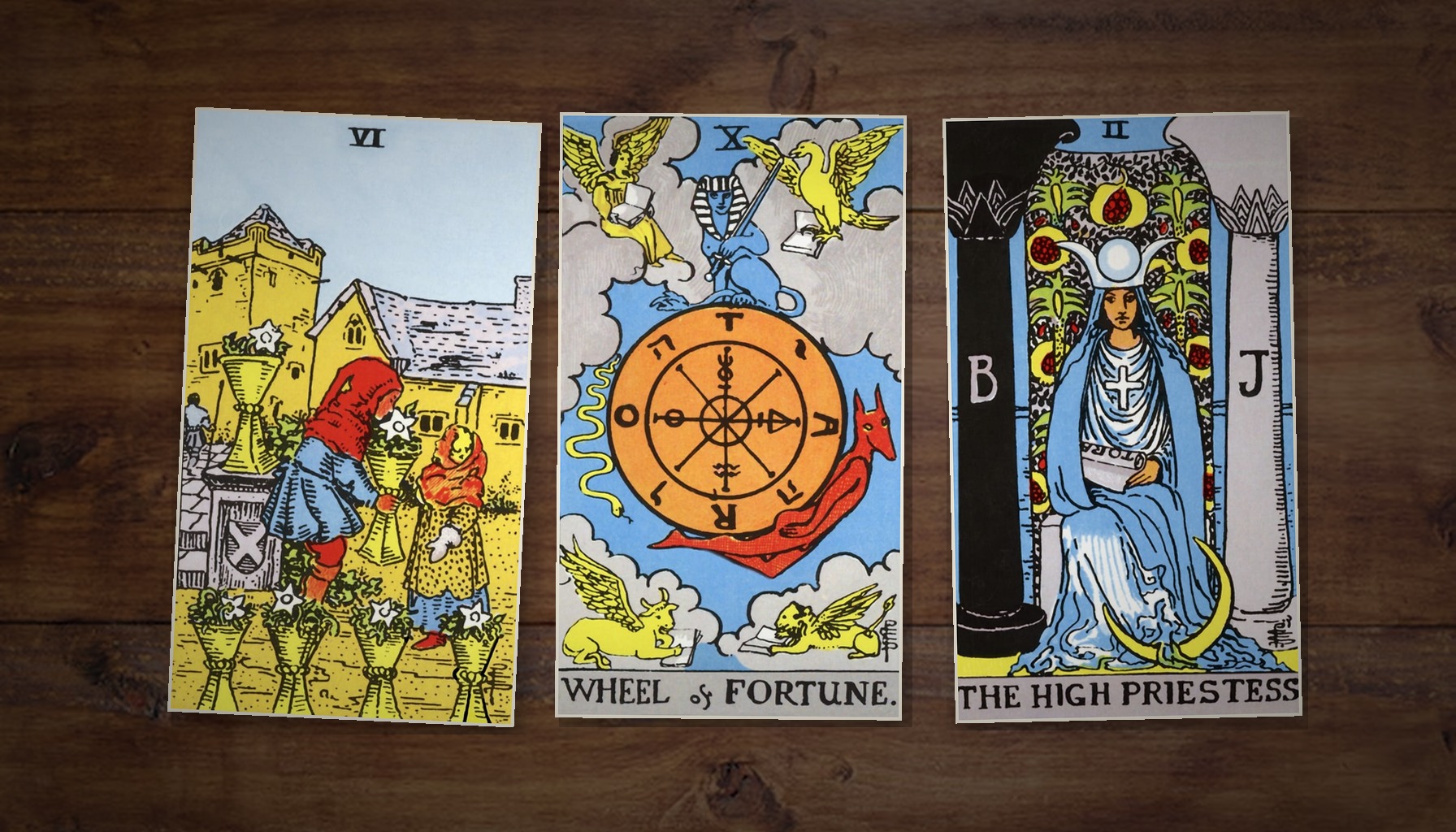
A boy in a red hood and blue tights stands in a courtyard, handing a golden cup filled with white flowers to a smaller girl. Five more cups line the stone ledge and ground around them, each brimming with the same white blooms. Behind them, an old stone building with a peaked roof. A figure walks away in the background, down a path that leads out of the frame. The whole scene feels like it happened a long time ago — the architecture, the clothing, the formal gesture of offering.
Waite described this card as "the past and memories thereof." When the Six of Cups appears in a reading about someone you've just met, it names what you're already feeling — that this isn't the first time. The flowers are white, meaning the connection is innocent at its root. Whatever history you share, it started clean.
The smaller figure receiving the cup isn't reaching for it. She's waiting. As though she expected it. That's the tell. Past life connections don't feel like discovery. They feel like return.
The Wheel That Keeps Turning
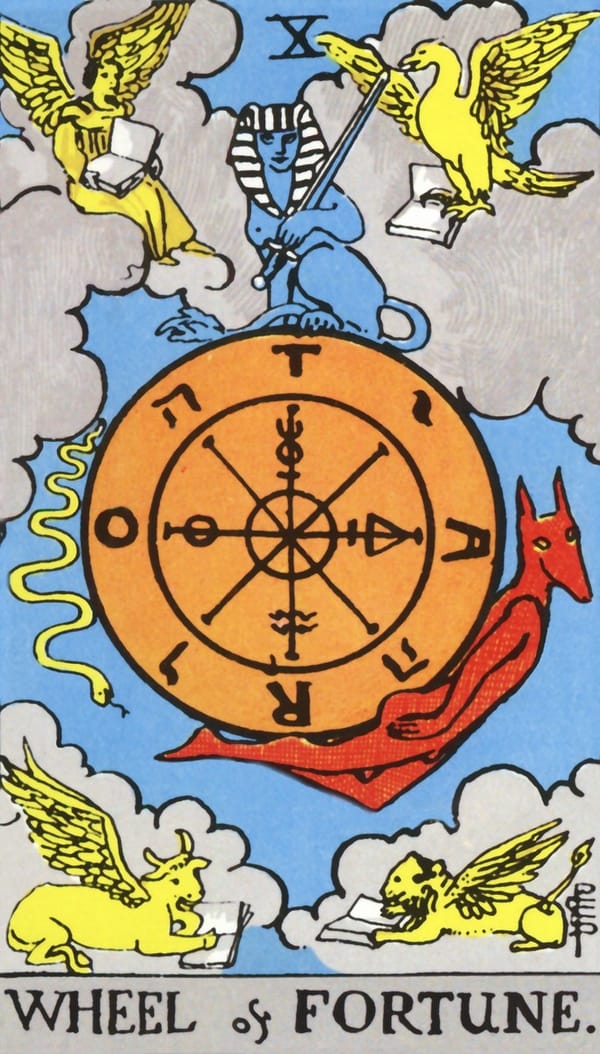
A giant wheel floats in blue sky, ringed with alchemical symbols and the letters T-A-R-O (or R-O-T-A, depending on how you read them). A sphinx sits at the top, holding a sword. A red figure — Typhon or the serpent — descends on the left. Anubis, the jackal-headed guide of souls, ascends on the right. In the four corners, winged creatures read from open books: an angel, an eagle, a lion, a bull.
The Wheel of Fortune in a connection reading says you didn't choose this person. The wheel turned and there they were. The sphinx at the top represents the fixed point — the part of the connection that doesn't change no matter how many times the wheel revolves. You've been at the bottom of this wheel with them and at the top, and somehow you keep ending up on the same spoke.
Those four creatures reading books in the corners are worth noting. They're recording. Whatever passes between you and this person is being observed by something larger than either of you. That's not a comforting thought for everyone, but it matches what past-life connections feel like — witnessed, significant, tracked.
Justice and the Debt Between You
Not every past life connection is gentle. Sometimes what you're feeling isn't warmth — it's gravity. Something unresolved pulling you toward a person you can't quite explain needing to be near.
Justice appears as a crowned figure on a stone throne, holding a raised sword in the right hand and balanced scales in the left. A purple veil hangs behind her between two grey pillars. Her expression is neutral. She's not punishing and she's not rewarding. She's measuring.
When Justice shows up in a past life reading, the connection carries a balance that needs settling. One of you owes the other something — not money, not apology, but completion. A conversation that ended mid-sentence in another context. A debt of care. Research on Jungian synchronicity offers a framework for these inexplicable convergences: meaningful coincidences that resist rational explanation but demand attention.
This doesn't mean the relationship will be difficult. It means it has a purpose beyond attraction or companionship. Once that purpose is fulfilled, the gravitational pull either softens into something lighter or releases entirely.
Death as Transformation Across Lifetimes
Death in a past life reading doesn't mean you died together (though people's imaginations go there immediately). The skeleton knight rides a white horse past a fallen king, a pleading bishop, and a child offering flowers. In the background, the sun rises between two towers.
What Death says about a past-life connection: you've already been through a major ending together. Whatever version of this relationship existed before reached its conclusion. The fallen king represents the power dynamic that ended. The bishop represents the attempt to negotiate that ending. The child — the child is what survived.
When Death appears alongside the Six of Cups, it suggests you're reconnecting after a connection that fully completed its cycle. You're not picking up where you left off. You're starting something genuinely new, with only the recognition of each other as the thread connecting past to present.
The High Priestess Knows but Won't Say
The High Priestess sits between two pillars — one black (Boaz), one white (Jachin) — with a veil of pomegranates behind her and a crescent moon at her feet. A Torah scroll rests in her lap, partially hidden by her blue robe. She's looking directly at you with an expression that says she already knows what you're going to ask.
In a past life reading, the High Priestess represents the knowledge that sits below conscious memory. You don't remember this person from before. But your subconscious does. The scroll in her lap is partially covered — the information is there but not fully accessible to your waking mind.
If you've been dismissing the familiarity as confirmation bias or projection, the High Priestess asks you to sit with it a moment longer. Not to prove it. Not to build a story around it. Just to acknowledge that some knowledge arrives through channels your rational mind doesn't control, and that's not necessarily a problem.
What to Do With This Reading
If past-life cards keep appearing in your readings about someone, resist the urge to tell them. "I think we knew each other in a past life" is a lot to put on a person you've known for three weeks, no matter how true it feels.
Instead, let the connection unfold at its own pace. The Six of Cups doesn't rush. The Wheel turns on its own schedule. If the connection has the weight these cards suggest, it will reveal itself without you narrating it into existence.
The most practical thing you can do: pay attention to what feels familiar versus what feels new. The familiar parts are the thread. The new parts are the reason you're here again. Don't mistake one for the other.