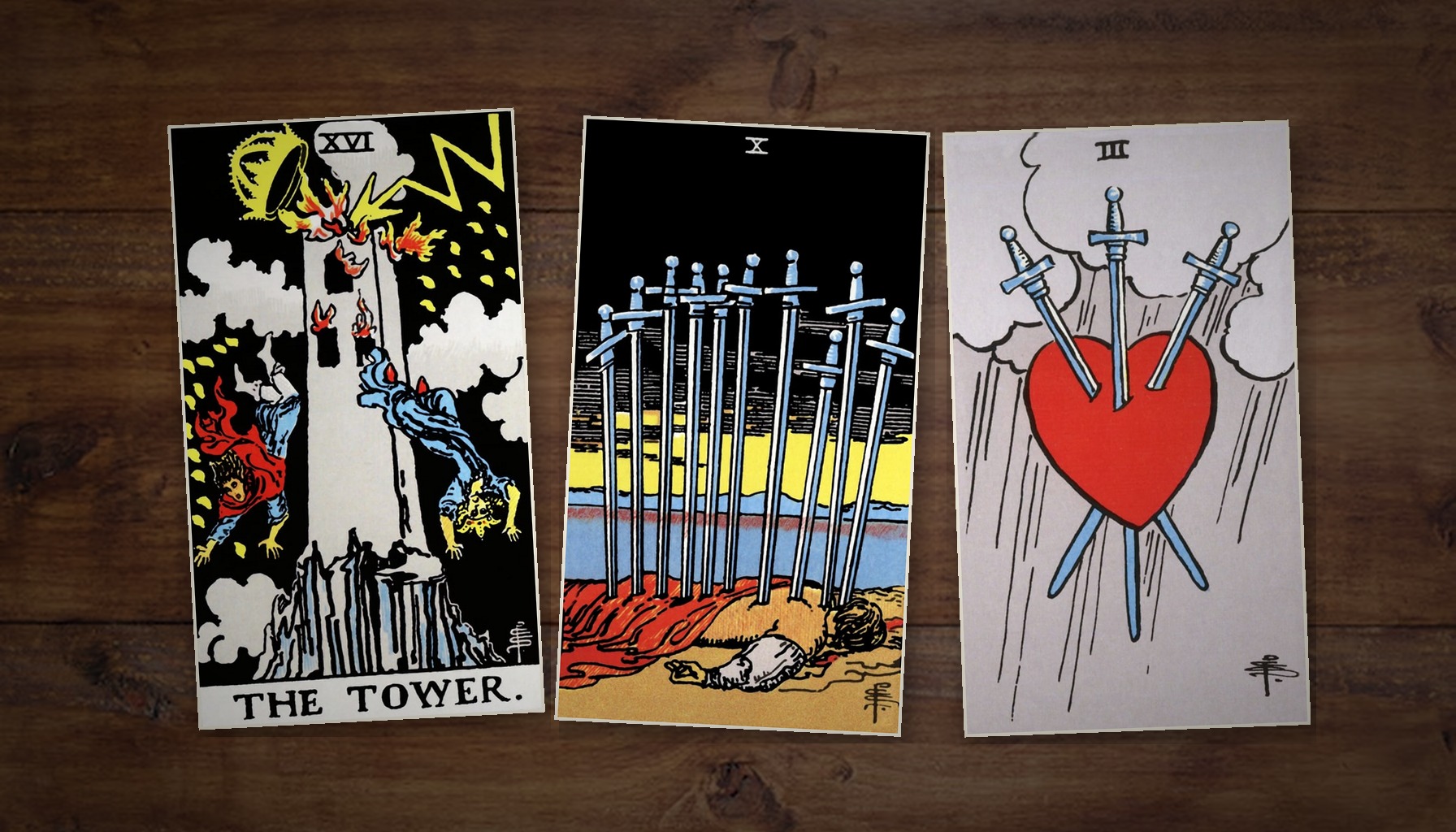
You pulled a card and your stomach dropped. The Tower. Death. Three of Swords. Ten of Swords. The image is violent or unsettling and your brain immediately started composing disaster scenarios.
Stop. Put your phone down for a second. The card is not a prophecy. Let's look at what you actually pulled.
The Ten of Swords Is Already Over
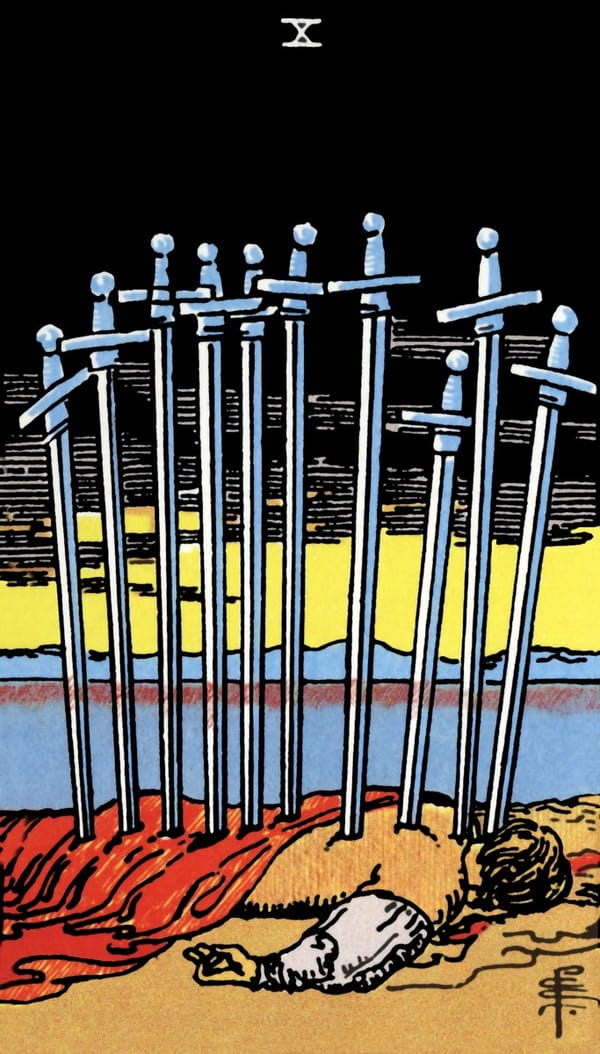
A figure lies face down on the ground. Ten swords pierce their back. Their red cloak pools around them. It looks like the worst card in the entire deck — and if you stopped there, you'd be right to panic.
But look at the sky. The bottom half of the card is dark, but the horizon is gold. Bright yellow sky stretching across the entire background, with a calm body of water and distant mountains. Dawn is arriving, or has just arrived. The darkness is behind the figure, literally.
The Ten of Swords is not a card of impending doom. It's a card of completed suffering. The ten swords are already there. All of them. Nothing worse is coming because the worst already happened. This card shows the moment after the last blow — the moment where the only possible direction is up.
If you pulled this card and panicked, the panic itself is the old pattern the card is describing. You've been in crisis mode so long that you can't recognize when the crisis is ending.
The Tower Destroys What Needed Destroying
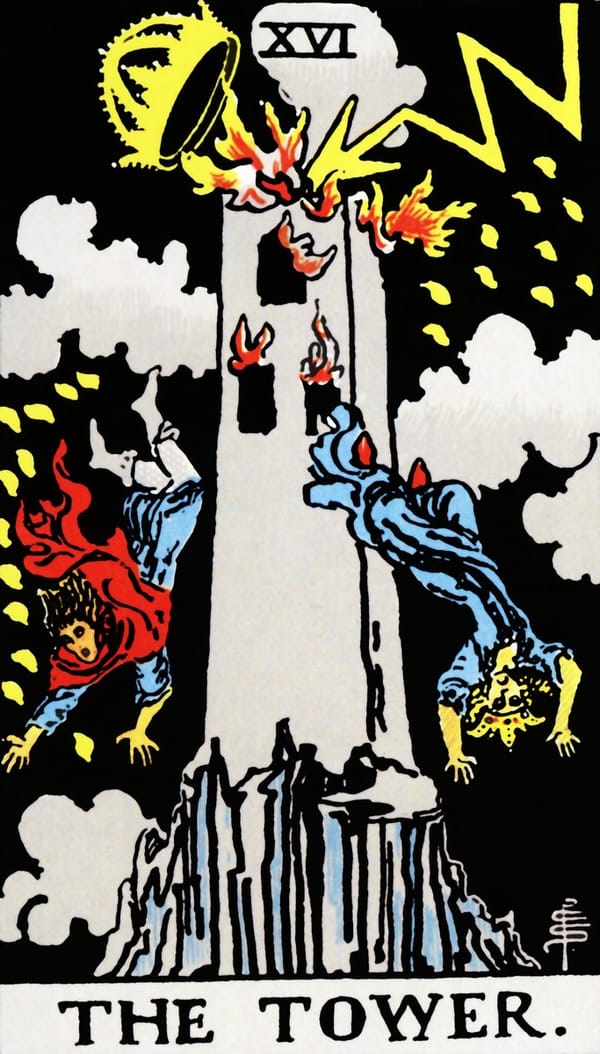
Lightning strikes a grey tower, blasting the golden crown off its top. Flames erupt from the windows. Two figures fall headfirst through the air. Drops of fire — or light — scatter across a black sky.
This card terrifies people because the imagery is violent. But look at what's being destroyed. The tower is a man-made structure built on a narrow rock. The crown at the top is artificial authority, false certainty, a version of reality that was never as stable as it looked. The lightning doesn't strike a healthy building. It strikes the one that was already compromised.
Waite called this "the ruin of the House of Life, when evil has prevailed therein." In plain terms: the thing that collapses was already rotten inside. The Tower doesn't create destruction. It reveals the destruction that was already structural.
The two falling figures are being ejected from a building they thought was safe. That ejection is traumatic. But the alternative — staying inside a tower that's on fire — is worse. The Tower in a reading means the discomfort you're about to feel is the discomfort of being saved from something you couldn't see was killing you.
Three of Swords: The Pain You Can Remove
The Three of Swords shows a red heart suspended in grey sky, pierced by three swords. Rain falls behind it. Grey clouds. It's heartbreak rendered in the simplest possible terms.
Here's what people miss: the swords are removable. They're stabbed through, yes. But they're not fused to the heart. They can be pulled out. The heart behind the swords is still whole — it's red, it's full-sized, it hasn't collapsed or broken into pieces. The swords created wounds, not destruction.
When this card appears and you feel your chest tighten, notice that the rain behind the heart will stop. Clouds move. The heart stays. Whatever this pain is — betrayal, loss, a truth that landed badly — the mechanism that holds you together is still intact underneath it.
Death Doesn't Mean Death
You know this rationally. But when Death stares at you from the spread — the skeleton knight on the white horse, the fallen king, the pleading bishop — rational knowledge doesn't help much.
So look at what else is in the card. A child offers flowers to the rider. Not in fear. In acceptance. The child is the part of you that's ready for what comes next, even though the adult part of you is still bargaining like the bishop.
And the sun. It rises between two towers in the background. Not setting — rising. Whatever ends when Death appears, it ends into something new. The card after Death in the Major Arcana sequence is Temperance — the angel of balance, patience, and integration. What follows destruction is recalibration, not emptiness.
The Devil's Chains Are Loose
The Devil card shows a large horned figure on a pedestal with two smaller naked figures chained to it. The card looks like imprisonment. But look at the chains around the figures' necks — they're oversized, loose, draped rather than locked. The figures could lift those chains over their heads and walk away. They haven't. But they could.
When The Devil appears in a difficult reading and you feel trapped, the card is actually showing you the opposite: you are not trapped. You're in a pattern that feels inescapable but isn't. The chains are loose. The exit exists. The difficulty isn't the situation — it's your belief that you can't leave it.
What to Actually Do
First: don't pull another card. The urge to reshuffle and try again is strong. Resist it. Pulling until you get a card you like is not a reading — it's a compulsion. The card you got is the card you got. One card, one question, one answer.
Second: ask what the card is describing, not predicting. Tarot reads the energy of right now, not the script of tomorrow. The Tower isn't telling you your life will collapse. It's telling you something in your life is already unstable. The Ten of Swords isn't warning you about future pain. It's naming pain you're already carrying.
Third: look at what's surviving. Every difficult card contains survival. The golden sky behind the Ten of Swords. The removable swords in the Three of Swords. The loose chains on The Devil's captives. The sunrise behind Death. The card shows you the hard part, but it also shows you what comes through.
Fourth: put the deck away. If the reading made you anxious, don't do another one today. Anxious readings produce anxious interpretations, which produce more anxious readings. That's a spiral, not a practice. Come back when your nervous system has settled. The deck isn't going anywhere.
If the anxiety is bigger than a bad card — if it's interfering with your daily life, your sleep, your ability to function — that's not a tarot problem. NAMI has resources that go where no card reading can.