
You checked their phone. Or you wanted to and stopped yourself, which somehow felt worse because now you're carrying the want to check and the shame of wanting to. Or you saw a name come up on their screen and your whole body went electric with a feeling you'd rather not admit to.
Jealousy doesn't respond to logic. You know this person is with you. You know the evidence is thin. You know you're probably overreacting. The knowing doesn't help because jealousy doesn't live where knowing lives.
The Card That Wins and Loses at the Same Time
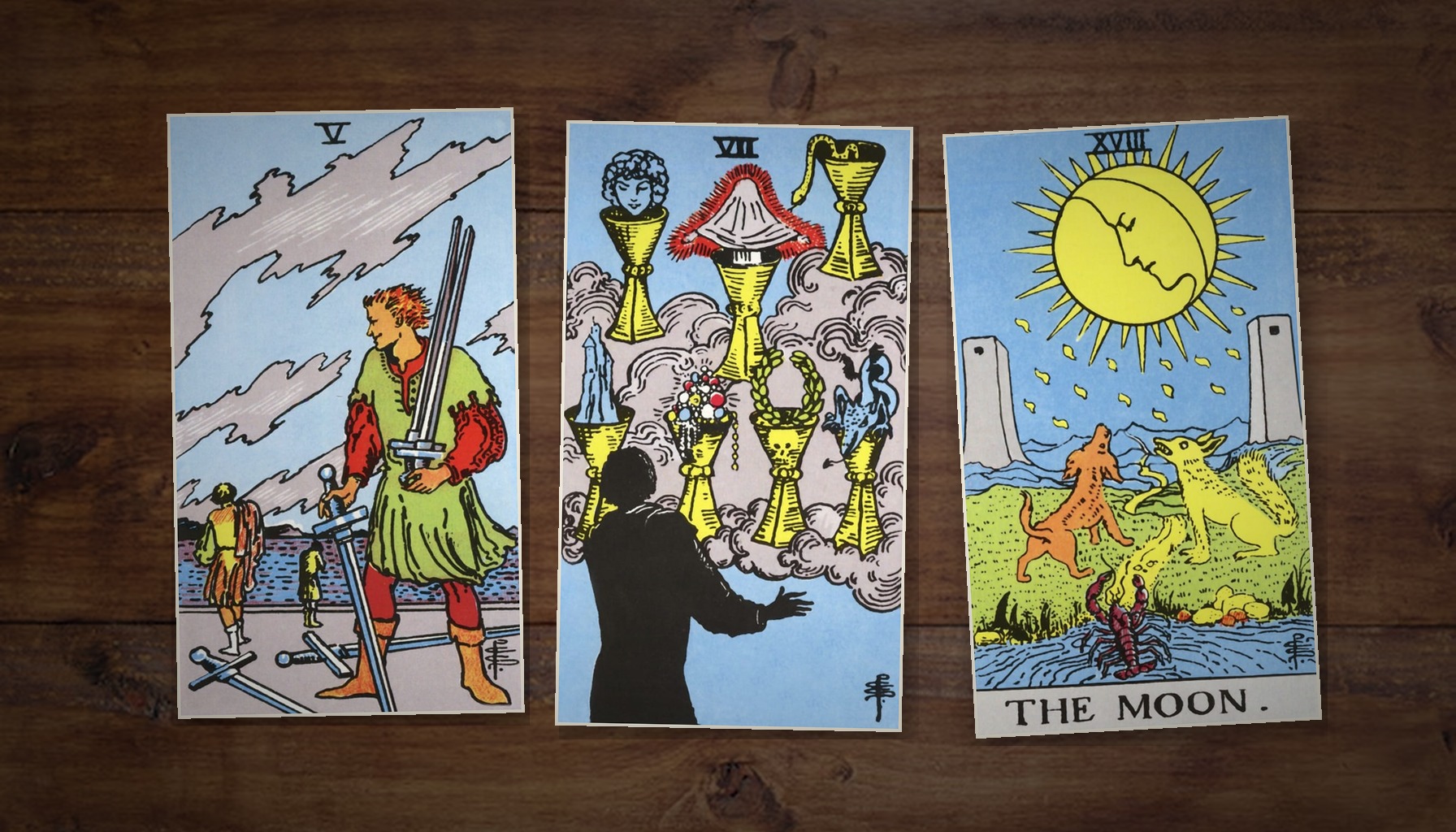
A figure in the foreground holds three swords, one in each hand and a third balanced across them. Two more swords lie on the ground nearby. Behind him, two people walk away — their posture defeated, shoulders dropped, heads down. The sky is a mess of jagged clouds, torn yellow and grey.
The Five of Swords is the card of hollow victory. The figure holding the swords looks satisfied, maybe even smirking. But look at what he's won: he's standing alone in a field of discarded weapons under an ugly sky. Everyone left. He got the swords. He lost the people.
Jealousy operates this way. Every time you "win" a jealousy confrontation — your partner admits someone flirted with them, you find the proof you were looking for, you extract the confession — you're the figure holding three swords in an empty field. You were right. And now what?
The Moon's Fog
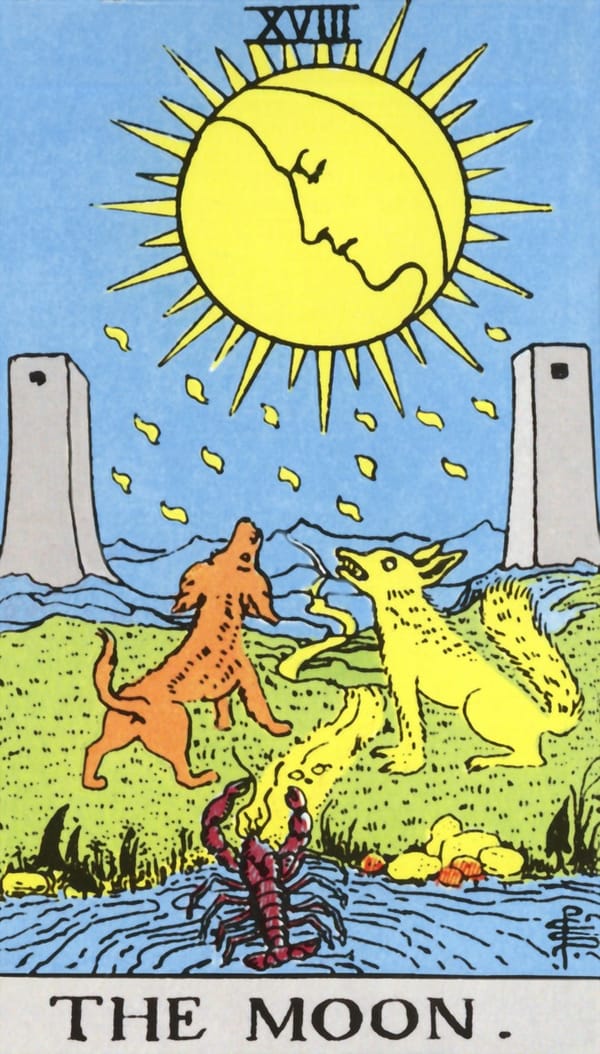
The Moon is the card of jealousy's favorite tool: projection. A moon with a stern profile hangs in the sky, dropping rays. Two towers stand in the distance. A dog and a wolf howl from either side of a winding path. A red crayfish crawls out of a pool in the foreground. Nothing is clear. The path exists but you can't see where it goes.
When The Moon appears in a jealousy reading, your fear is creating the evidence. You interpret a late reply as deception. A friendly conversation becomes flirting. A weekend away with friends becomes opportunity. The dog and wolf represent your domesticated self (the one that trusts) and your wild self (the one that doesn't) — and right now the wild one is louder.
Research on jealousy distinguishes between reactive jealousy (responding to a real threat) and suspicious jealousy (creating threats from ambiguous evidence). The Moon is suspicious jealousy. The fog is yours. Clearing it requires admitting that the threatening thing you see might not actually be there.
The Seven of Swords — When It's Real
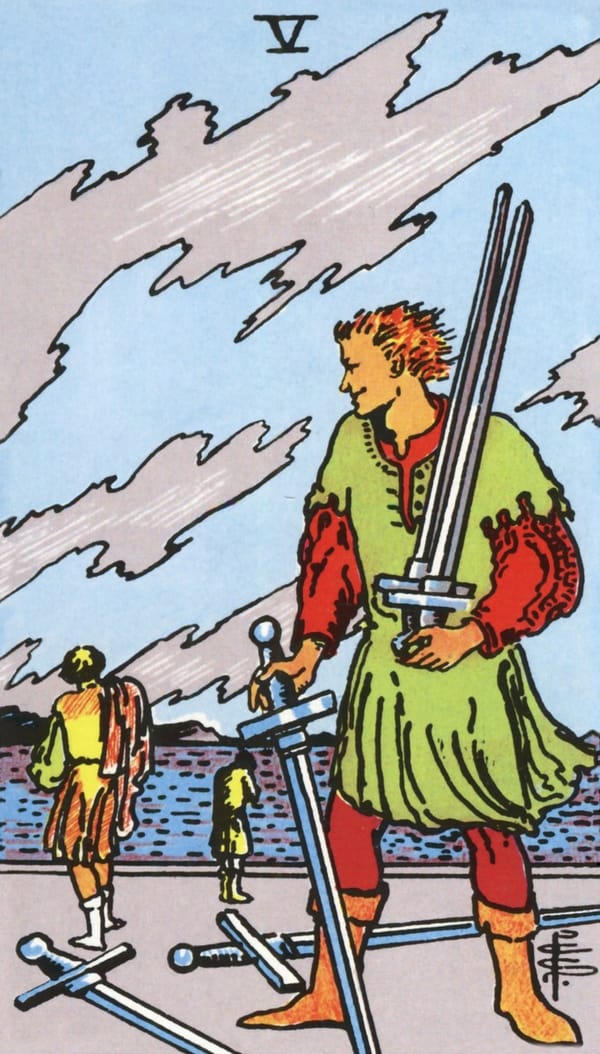
Not all jealousy is projection. The Seven of Swords shows a figure sneaking away from a camp carrying five swords, two left behind, tiptoeing with a look over the shoulder. When this card appears in a jealousy reading, something is actually happening. Someone is being sneaky. The details might not match your specific fear, but the energy of deception is present.
The difference between Moon jealousy and Seven of Swords jealousy: The Moon makes you feel crazy for suspecting. The Seven of Swords makes you feel crazy for trusting. If you're reading this and nodding because you've been told you're paranoid about something your body keeps flagging — pay attention to whether the reading gives you the Moon (your fog) or the Seven (their fog).
A Spread for When Jealousy Won't Quiet Down
Don't do this spread in the middle of a jealous episode. Wait until the initial adrenaline passes — at least a few hours, ideally a day. Jealousy's chemical cocktail distorts everything, including card interpretation.
Card 1: What am I actually afraid of? Not "they're cheating" — deeper. Am I afraid of being abandoned? Of not being enough? Of being replaced by someone better? The surface fear (they'll leave) usually masks a root fear (I'm not worth staying for). This card names the root.
Card 2: Is the threat real? Straight answer from the deck. The Sun means no — the situation is clear and your fear is unfounded. The Seven of Swords means yes — something genuinely requires your attention. The Two of Cups means the bond between you is solid and mutual, and what you're afraid of doesn't match the reality.
Card 3: What I'm not seeing. The blind spot. Jealousy narrows your vision to the perceived threat and blocks everything else. This card shows what you're missing — maybe that your partner is going through something that has nothing to do with you, or that the person you're jealous of is irrelevant, or that your own behavior is creating distance that you're then interpreting as evidence.
Card 4: How to move forward. The action card. The Ace of Swords says have the honest conversation — one clean cut of truth. Temperance says take it slow and restore balance. The Empress says turn the energy inward and tend to your own neglected needs instead of monitoring someone else's behavior.
The Queen of Swords Reversed
When jealousy becomes chronic, the Queen of Swords reversed often appears. Upright, she's clear-eyed, truth-telling, cutting through nonsense with her raised sword. Reversed, that sharp intelligence turns bitter. She's still smart, still perceptive — but now her perception serves the jealousy instead of cutting through it. She finds evidence because she's looking for evidence, and she's very, very good at looking.
If you recognize yourself in the reversed Queen of Swords, the issue isn't your intelligence. It's what you're directing it toward. The sword in her hand doesn't need to be put down. It needs to be pointed at the actual problem, which is almost never the other person. It's the wound inside you that predates this relationship.
When the Cards Say to Walk Away
Sometimes jealousy is data. The Three of Swords — heart pierced by three blades, rain falling — doesn't sugarcoat. If this card appears alongside the Seven of Swords (deception) and The Tower (destruction), the reading isn't about managing your jealousy. It's about recognizing that the situation is genuinely damaging and your gut was trying to tell you.
Not every jealousy reading ends with "it was all in your head." Sometimes the cards confirm what your body already knew. The relief of being right and the grief of what that rightness means tend to arrive at the same time.
In either case — whether the jealousy is projection or perception — the Five of Cups eventually appears. Three cups spilled, two still standing behind the figure. The jealousy consumed real energy, real time, real peace of mind. Regardless of whether the threat was real, the cost of obsessing over it was real too. The two cups still standing are the things that survived the spiral. Turn around and look at them.