Every other post on this site is about someone else. What does he feel. Will she come back. Is he thinking about me. You've been reading about other people's inner lives so long you forgot to check on your own.
This post is different. Nobody else is in the reading. Just you.
The Woman in the Vineyard
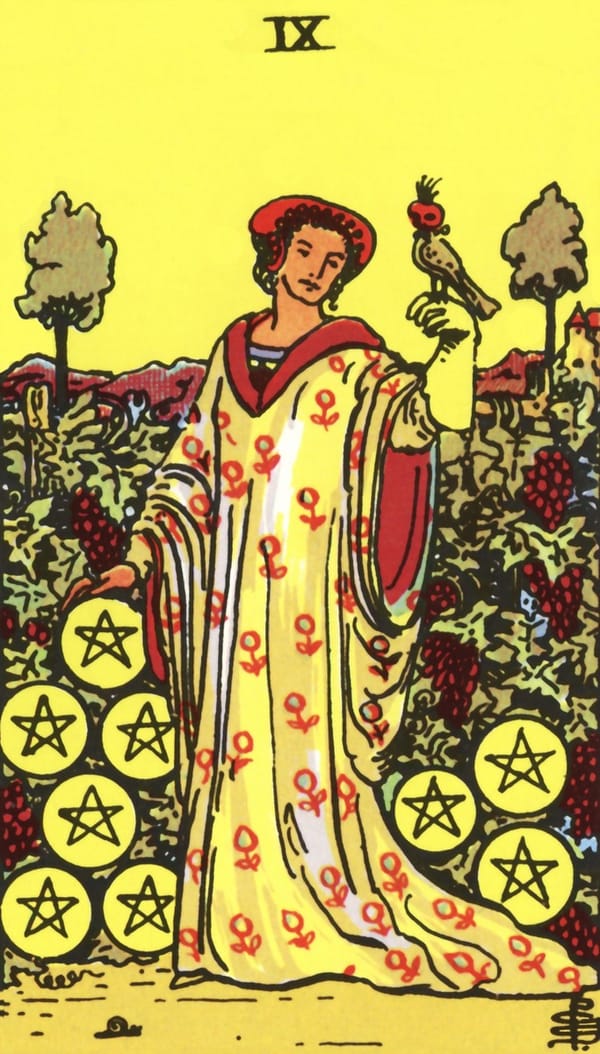
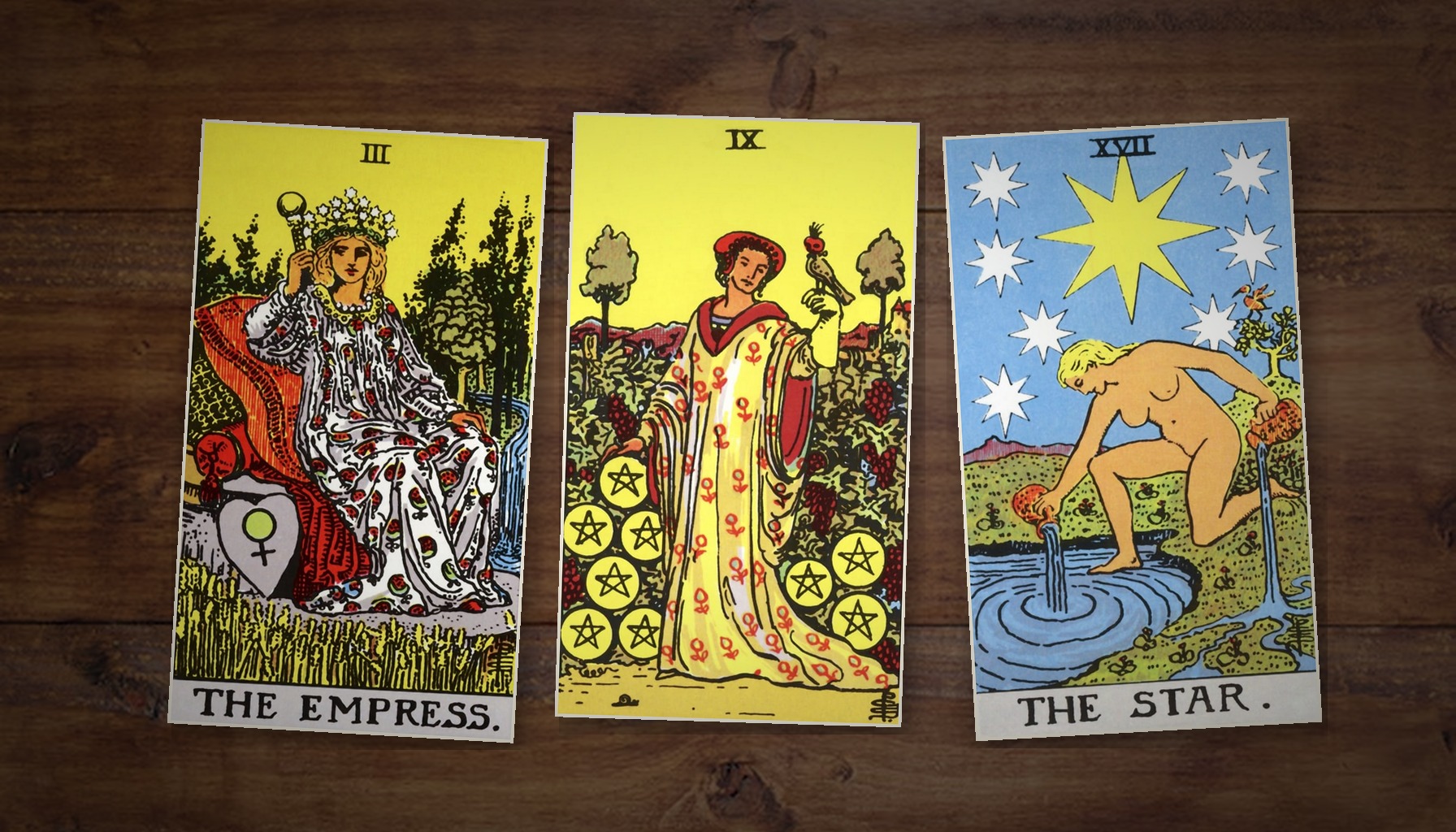
A woman stands in a garden or vineyard, surrounded by grapevines heavy with fruit. She wears a long yellow robe patterned with flowers — or possibly red flowers on gold fabric, depending on the print. A falcon perches on her left hand, which is covered by a thick glove. At her feet, a small snail. In the background, trees and a large house or estate. Nine golden pentacles are embedded in the greenery around her.
Notice what's missing from this image: another person. She's alone and the card doesn't frame that as a problem. The vineyard is hers. The falcon is trained — it takes months to build that kind of trust with a wild bird. The snail at her feet suggests she got here slowly, not through luck or someone else's generosity.
The Nine of Pentacles is what self-love actually looks like once you stop performing it for Instagram. It's not affirmations in a mirror. It's having built something — a career, a home, a daily practice, a set of friendships — that you can stand inside and feel genuinely proud of.
The Morning Pull
Here's a practice that works better than most self-care routines because it takes sixty seconds and forces you to check in with yourself before you check in with anyone else.
Before your phone. Before coffee, before email, before the group chat's opinion seeps into your morning. Shuffle and pull one card. Ask one of these:
What do I need from myself today?
Not from anyone else. From you. If you pull the Four of Swords, you need rest — real rest, not scrolling while horizontal. If you pull the Ace of Cups, you need to let yourself feel something you've been holding back. If you pull the Eight of Pentacles, you need to focus on one thing and do it well instead of scattering your energy across twelve tasks.
The question matters because it makes you the subject. Most tarot questions people ask put them in the object position — what does he think, how does she feel, will they call. This question puts you back in the center where you belong.
The Empress as Self-Nurturing
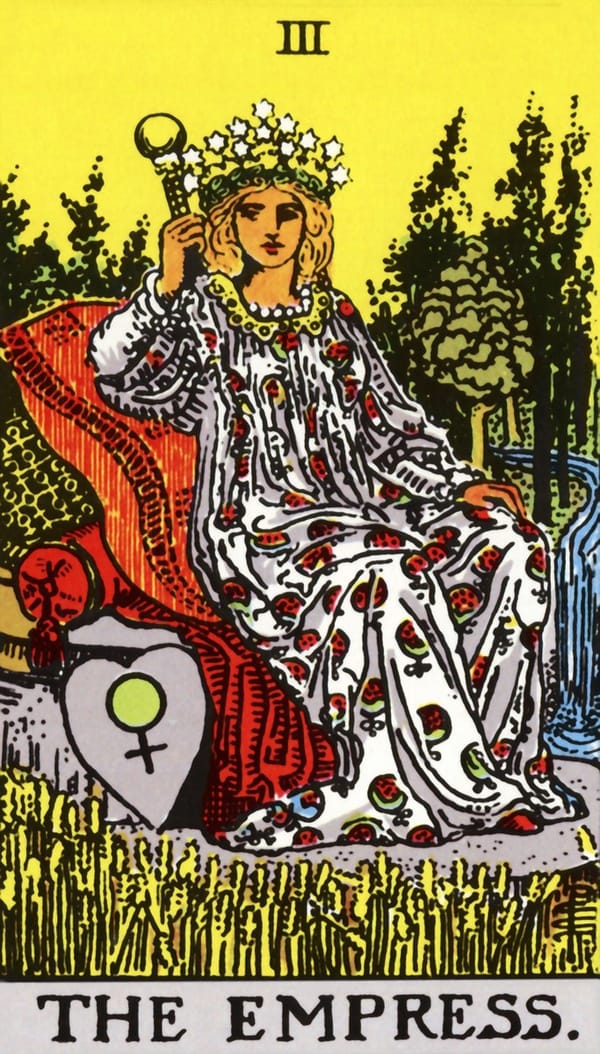
The Empress sits on red cushions in a wheat field, crown of twelve stars on her head, a golden scepter in one hand, a heart-shaped shield with the Venus symbol at her feet. Everything around her is growing. The wheat is ready to harvest. A waterfall cascades behind her. Trees form a dense green wall. Even her robe is covered in symbols of fertility.
When the Empress shows up in a self-love reading, it's asking whether you're tending to yourself the way she tends to that wheat field. Not productivity — nourishment. Are you eating food that makes your body feel good, not just food that's fast? Are you sleeping enough? Do your surroundings feel like hers — abundant, comfortable, alive? Or have you let your own garden go untended while tending everyone else's?
The Empress reversed in a self-love pull is blunt: you're depleted. The waterfall has dried up. You've been giving from an empty well, and the first person who needs to stop drinking from it is everyone who isn't you.
The Star After You've Been Through It
The Star shows a naked figure kneeling by still water under a clear sky, pouring water from two vessels — one into the pool, one onto the land. Eight stars shine overhead, one larger than the rest. No walls, no clothing, no armor, no pretense.
This card appears in self-love readings when you've recently been through something difficult — a breakup, a loss, a period of anxiety or burnout — and you're starting to come back to yourself. The nakedness isn't vulnerability in the wounded sense. It's the vulnerability of having nothing left to hide behind, and discovering that you're fine without the armor.
The two vessels matter. She pours onto land and into water. Research on self-compassion shows it requires both action (the land — doing something concrete for yourself) and feeling (the water — actually allowing the emotions). Self-love that's all action becomes rigid discipline. Self-love that's all feeling becomes self-indulgence. The Star does both.
The Sun Without Performance
The Sun card shows a child on a white horse under a beaming sun, arms spread wide, sunflowers in a row behind a stone wall. The child is naked and joyful — not performing joy, just experiencing it. The horse moves at a walk, not a gallop. Nothing urgent.
When The Sun appears in a self-love reading, it's asking when you last felt joy that didn't require an audience. Not the contentment of a good meal with friends. Not the satisfaction of a compliment at work. Pure, solitary, uncomplicated enjoyment — the kind the child on the horse feels, which is the kind most adults have forgotten how to access.
The sunflowers behind the wall are important. They face the sun, not the child. The joy source is external — the sun itself — but the child's ability to receive it is entirely internal. Self-love means putting yourself in the sunlight and then letting it land, rather than standing in shade and wondering why you feel cold.
What Self-Love Readings Won't Do
They won't replace therapy. If you're pulling tarot cards instead of calling a professional about something that needs professional attention, the cards will keep telling you. The Nine of Swords doesn't go away because you rephrase the question.
They won't fix loneliness. If what you actually need is human connection, no amount of solo card-pulling will substitute. The Three of Cups says call your friends. Do that.
They won't make someone come back. If you're framing "self-love" as a strategy to become more attractive to someone who left, the cards will call you on it. The Hermit in a self-love reading means genuinely turning inward, not performing independence until someone notices.
What self-love readings will do: interrupt the pattern of making every reading about someone else. Sixty seconds each morning, one card, one question that starts with "I." It's a small practice. It's also the one most people skip, which is how they end up scrolling through relationship tarot posts at midnight looking for answers they could find by asking themselves first.