

Look at the Child
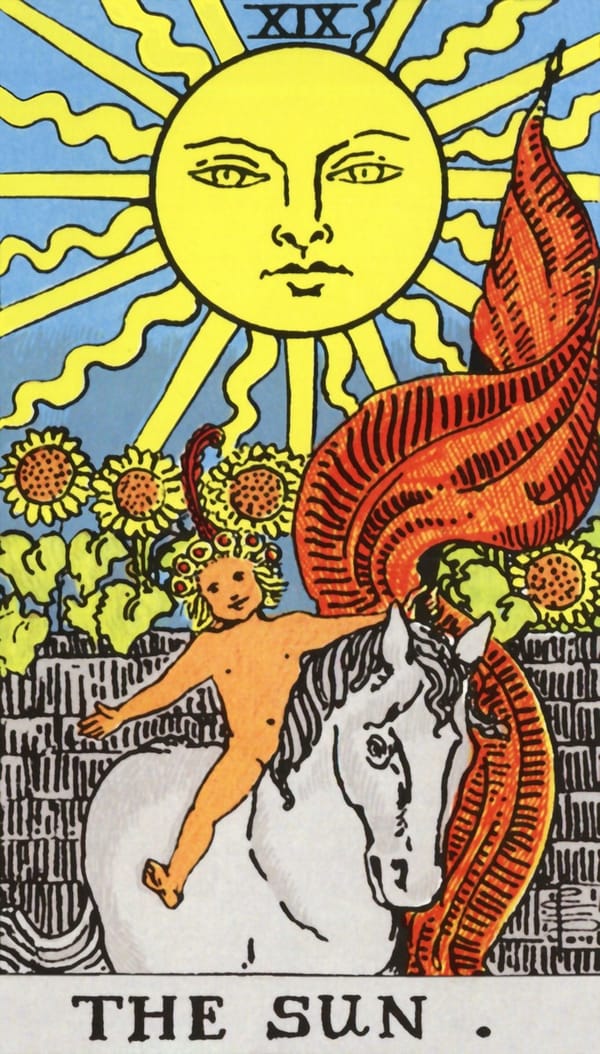
A naked child sits on a white horse, arms spread wide, wearing a crown of flowers. Behind the child, a large red banner streams in the wind. Behind that, a stone wall with sunflowers growing over it, their faces turned toward the enormous sun that fills the upper half of the card.
The sun itself has a face — not the disturbing, ambiguous face of the Moon, but a clear, calm, open face. It radiates in every direction. No clouds. No obstruction. Just light, everywhere, touching everything equally.
The child is naked — no armor, no robe, no pretense. The horse has no saddle, just a simple cloth. The flowers are tall and fully open. Everything in this card is exposed, unprotected, and completely fine with being seen. There is zero defensiveness anywhere in the image.
Waite's Pictorial Key to the Tarot from 1910 offers the original textual description, though Pamela Colman Smith's artwork carries layers of meaning that his words only begin to capture.
The Person Who Makes Every Room Warmer
The Sun as a person is someone whose energy precedes them. They walk through a door and the temperature in the room goes up. Not because they're loud or demanding — because they're genuinely, visibly alive in a way that most adults have forgotten how to be.
This is the friend who laughs at things before they're funny, because they see the humor approaching. The coworker whose desk everyone ends up at during breaks. The family member who picks up the baby and the baby immediately stops crying, not because of any technique but because the baby can feel what everyone else can feel — this person is safe, warm, and happy to be here.
They don't edit themselves the way most people do. They say what they're thinking. They show what they're feeling. If they're excited about something, you'll know it from across the parking lot. If they love you, it's written on their face in a font size that doesn't require reading glasses.
What They're Like to Be Around
Being around the Sun person feels like stepping outside on the first warm day after winter. You didn't realize how contracted you'd been until you started to expand. Their lack of self-consciousness gives everyone around them permission to be less guarded, less careful, less performed.
They're generous with their attention. Not in the strategic, observant way of the High Priestess — in the wholehearted way of someone who finds other people genuinely interesting. They ask you questions and lean forward for the answer. They remember details about your life and bring them up later with real enthusiasm. "How was that thing with your sister? The one you were worried about?"
They can be overwhelming for introverts. Their energy is persistent. It doesn't dim in response to your dim — it stays bright, which can feel like a lot when you need quiet. They're the person who keeps trying to cheer you up when sometimes you just need to sit in the dark for a while.
Reversed Sun energy can mask genuine feelings behind people-pleasing — performing happiness because anything less feels like failure.
Dating the Sun Person
In a relationship, the Sun person is uncomplicated in the best possible way. They like you and they show it. They want to see you and they say so. They think you're beautiful and they tell you, in the middle of the grocery store, loudly enough that the person in the next aisle smiles.
Physical affection is constant and unself-conscious. They hold your hand in public. They sit in your lap. They touch your face when they're talking to you. Look at the child on the horse — arms wide, body open, no shame. That's how the Sun person loves: with their whole body, visibly, unprotected.
They struggle with partners who are guarded. Your walls confuse them. Your need for space sometimes reads as rejection. They're not trying to invade — they're just open by default, and meeting someone who's closed by default requires a recalibration they don't instinctively understand.
The best thing about dating a Sun person: they make you feel like the most interesting person they've ever met, and in the moment, they mean it. The challenge: their light is indiscriminate. They shine on everyone. If you need to feel like the only person they've ever been warm to, you'll struggle, because warmth is just how they exist.
At Work
The Sun person at work is the one who raises morale without trying. Their desk has something funny on it. Their emails include exclamation points that are genuine. They celebrate other people's wins like they're their own.
They're excellent in roles that require enthusiasm, connection, and energy: teaching, performing, sales, event planning, customer-facing anything. They make people feel good, and in many industries, making people feel good is the whole product.
They struggle in roles that require sustained intensity, cynicism, or emotional distance. They can't fake caring less than they do. They can't deliver harsh criticism without feeling it in their body. They're not built for the kind of work that requires you to shut off the warm part of yourself.
The Wall and the Sunflowers
Behind the child, there's a stone wall. The sunflowers grow above it, reaching toward the sun. The wall is a boundary — between the garden and the world, between the protected space and the open one. The child has ridden past it.
The Sun person has moved beyond whatever walls they grew up behind. They might have come from difficulty — the cards before the Sun are the Tower, the Star, and the Moon, which is a gauntlet of crisis, healing, and confusion. The Sun person's joy isn't naive. It's what's on the other side of having been through all of that and choosing to stay open anyway.
That's their real gift. Not happiness — openness. The willingness to ride the horse with no saddle, arms wide, no armor, knowing that the world can hurt you and deciding to feel it all anyway.
If you love a Sun person, let them be bright. Don't ask them to dim. The sunflowers need the light, and so, probably, do you.


