

Look at What's Howling
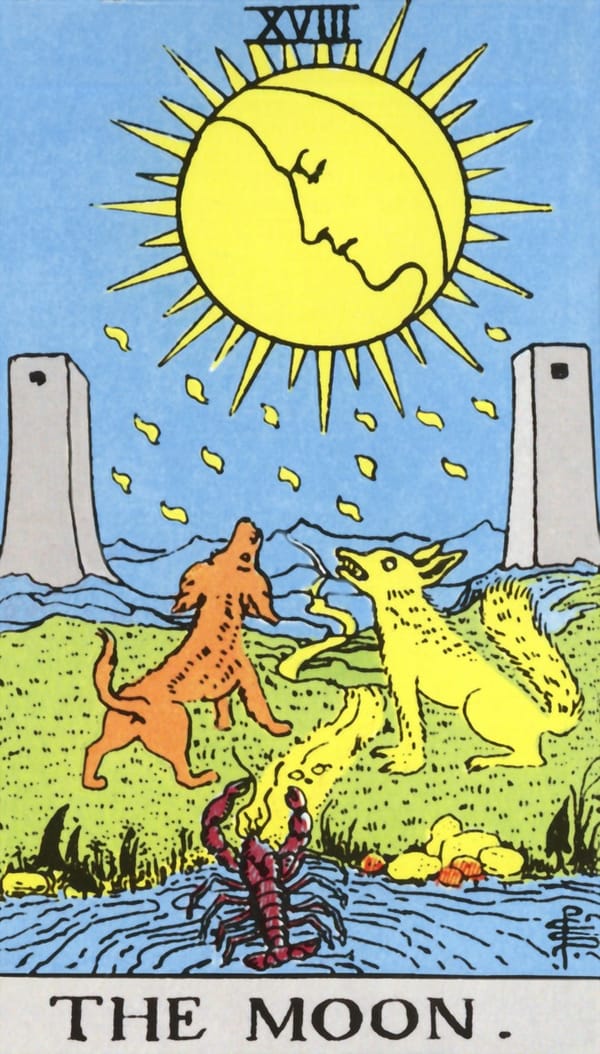
Two creatures stand on the path — a dog and a wolf, one tamed and one wild, both howling at the same moon. They look similar enough that in the half-light, you might confuse one for the other. That confusion is the entire point of this card. The Moon doesn't reveal — it distorts. The face in the moon itself is turned sideways, frowning, dropping yellow tears or sparks from its rays.
Between the howling animals, a winding path leads through two grey stone towers into the unknown distance. And from the water at the bottom of the card, a red crayfish emerges — something crawling up from the depths, from the unconscious, from wherever the things live that you've been trying not to look at.
Everything in this scene is in between. Between water and land. Between dog and wolf. Between known and unknown. Between what the light shows and what it hides.
The Anxious Overthinker
The Moon person is the friend who texts you the same question in three different ways because the first two didn't feel accurate enough. They're the one who lies awake replaying a conversation from earlier that day, certain they said something wrong, certain the other person noticed, certain this is the beginning of something bad.
Their anxiety isn't general — it's specific and relentless. Psychologists would call this hypervigilance — an elevated state of scanning for threats that makes you notice everything and trust nothing. They don't just worry about things. They construct elaborate theories about what might be happening beneath the surface of every interaction. "She said 'fine' but her tone was different." "He didn't text back for four hours when he usually texts back in two." "Did you notice how quiet she was during the second half of dinner?"
Some of these observations are accurate. The Moon person is perceptive — painfully so. But they can't sort the real signals from the noise, and in the moonlight, everything looks like a signal.
The Person Hiding Something (From Themselves)
Sometimes the Moon as a person represents someone who is keeping a truth submerged. Not a deliberate secret — the kind of truth that lives in the water the crayfish is crawling out of. The kind that's been buried so long it's become part of the landscape, and acknowledging it would mean rearranging everything.
This is the coworker who says they love their job but flinches every Sunday night. The partner who insists the relationship is good but hasn't initiated intimacy in months. The friend who swears they've forgiven their parent but changes the subject every time the parent's name comes up.
They're not lying to you. They're lying to themselves, and the Moon's light helps them do it. The distortion isn't just in how they see the world — it's in how they see themselves. The crayfish is coming up whether they want it to or not, but they're hoping the moonlight will make it look like something else.
In Relationships
The Moon person in a romantic context gives you just enough to keep you invested and just enough confusion to keep you off-balance. Not on purpose. They genuinely feel strongly about you at 10pm and genuinely uncertain by morning. They want to commit and they're terrified of committing. They reach for you and then pull back, and if you ask what's wrong, they say "nothing" because they genuinely can't name it.
Dating a Moon person requires you to develop your own internal compass, because you can't rely on theirs. They'll send signals that mean three different things. They'll say something that sounds like a promise and later not remember saying it, because in the moonlight, they meant it, and in the daylight, it feels like something someone else said.
This doesn't make them bad partners. It makes them complicated ones. If they're willing to do the work of understanding their own fog — therapy, journaling, whatever helps them see by a clearer light — they can be deeply insightful, empathetic, and creative partners. The same sensitivity that makes them anxious makes them attuned to you in ways that other people aren't.
At Work
The Moon person at work is the one whose performance fluctuates with their internal weather. Some weeks they're brilliant — creative, intuitive, producing work that nobody else could have made. Other weeks they're paralyzed by self-doubt, reworking the same paragraph for hours, unable to trust their own judgment.
They need a manager who provides clear, specific feedback rather than vague encouragement. "Great job" means nothing to them because they'll spend the next three hours wondering if you really meant it. "The analysis in section two is exactly what the client needed" gives them something real to stand on.
They're surprisingly good in roles that involve navigating ambiguity or complexity — where the path winds between towers and the truth isn't obvious. Research, creative writing, investigative work, counseling. Their comfort with the uncomfortable makes them valuable in situations where most people want a simple answer and the simple answer doesn't exist.
The Sun Is the Next Card
Here's the thing about the Moon person that's easy to forget: in the major arcana sequence, the Sun follows the Moon. This isn't a permanent state. The fog lifts. The crayfish finishes its crawl. The dog and the wolf stop howling and the path between the towers reveals where it was going all along.
The Moon person is in transit. They're crossing through the darkest, most confusing stretch of the journey, and they won't be here forever. The question isn't whether they'll find clarity. It's whether you're willing to walk with them through the part where nothing is clear.
If you love a Moon person, be the tower they can see in the distance. Not the answer — just a fixed point in the shifting light. Something they can orient toward when everything else is moving.