

Look at What She's Guarding
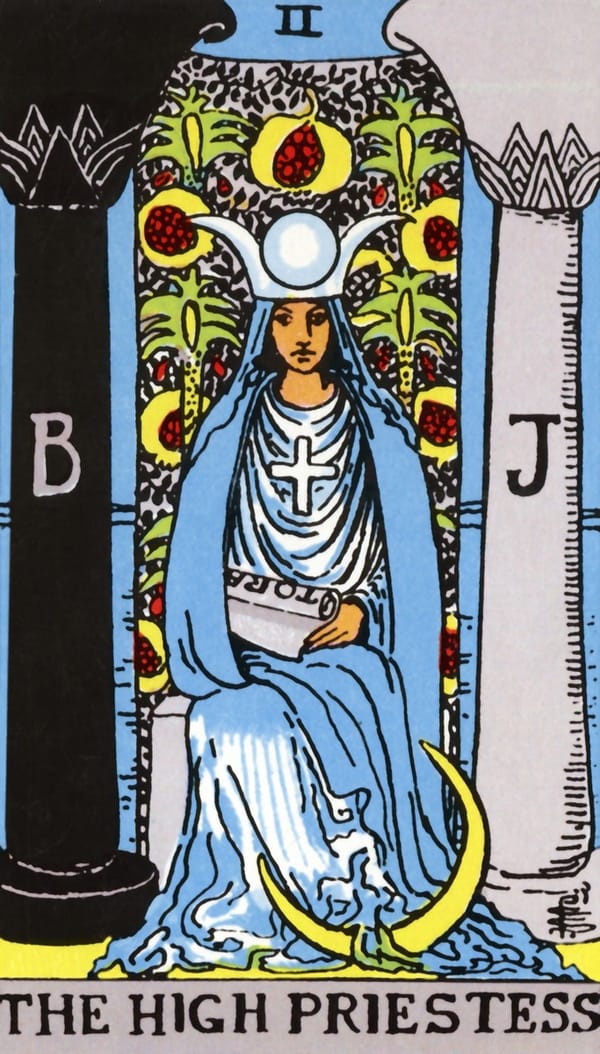
She sits between two pillars — one black, marked B, one white, marked J. She's not leaning toward either side. She's perfectly centered, a gatekeeper between opposites: light and dark, known and unknown, conscious and unconscious. Behind her hangs a tapestry covered in pomegranates, and behind that tapestry is something you can't see. She knows what's back there. She's not showing you.
In her lap, she holds a scroll with the letters TORA partially visible. Partially. The rest is hidden in the folds of her blue robe. She has the knowledge, the full text, but she's only letting you see a portion of it. Not because she's cruel, but because she understands that some things need to be discovered at the right pace.
Her crown is a horned moon with a full sphere between the crescents — a complete lunar cycle sitting on her head. She operates in cycles, in phases, in the kind of knowing that doesn't arrive on a schedule. And at her feet, a crescent moon rests on the floor. She's standing on intuition. It's her foundation, not her decoration.
The original 1910 meaning appears in Waite's Pictorial Key to the Tarot, but much of what makes this card powerful comes from choices Pamela Colman Smith made in the artwork that Waite never commented on.
The Person Who Reads the Room Before They Enter It
The High Priestess as a person is someone who knows things they shouldn't be able to know. Not in a dramatic, psychic-hotline way. In a quiet, factual way. They meet your new partner and say nothing negative — but later, when the relationship implodes, they say "I know" instead of "I'm sorry," and you realize they saw it coming the entire time.
They're the friend who texts you "are you okay?" at the exact moment you're sitting in your car after a bad meeting. The coworker who looks at a spreadsheet and says "something's off in the third quarter numbers" before anyone's run the analysis. The family member who says "don't take that job" and can't explain why, but they're right.
This knowing isn't magic. It's pattern recognition operating below conscious thought. The High Priestess person absorbs information constantly — tone of voice, body language, what was said and what was carefully not said — and processes it in a way that produces conclusions before the evidence is fully in. They trust their gut because their gut has a better track record than most people's research.
What They're Like in Conversation
Quiet. Not shy — there's a difference. The High Priestess person can speak perfectly well and will when it matters. But they don't fill silence. They let other people talk and they listen in a way that can feel uncomfortably attentive. You'll find yourself saying more than you planned to because they're so present in their listening that the words just keep coming.
When they do speak, it tends to be precise. They don't ramble. They don't hedge. They say the thing that cuts to the center of whatever everyone else has been circling around for twenty minutes. This can make them seem cold or blunt, but they're not being aggressive. They're just done with the surface-level conversation and ready to talk about what's actually happening.
They give advice rarely, and when they do, it's unsettling in its accuracy. You might not take it. Most people don't, at first. But you'll remember it months later when the thing they described is exactly what happened.
What psychologists call intuition — the ability to know things without conscious reasoning — is the High Priestess person's default setting.
Dating the High Priestess Person
This person won't chase you. Look at the card — she's seated. She's not reaching for anything. She's not coming to find you. If you want to know her, you come to the threshold and you sit there until she decides to let you past the tapestry.
Early dating with a High Priestess person can feel like being studied. They're quiet, watchful, and they reveal themselves slowly. They might ask you a question that feels unexpectedly deep for a second date. They're not testing you — they're trying to see past the version of yourself you're presenting and find out who's actually there.
Once they trust you, the depth of connection is extraordinary. They remember things about you that you told them once, in passing, at 2am. They anticipate what you need before you articulate it. Being loved by a High Priestess person feels like being truly known, which is both the most comforting and the most terrifying thing in the world.
The difficulty: they don't always share what they're thinking. That scroll in her lap — they hold things close. You'll need to ask directly, and even then, they might give you only the piece they think you're ready to hear.
At Work
The High Priestess person is the one everyone goes to for the real story. Not the official version, not the one in the email chain — the truth about what's happening. They know who's about to quit, which project is secretly failing, and why the VP was in a bad mood on Tuesday. They don't gossip. They just know, and if you ask, they'll tell you what you need to hear.
They're excellent in any role that requires reading situations accurately: counseling, consulting, research, mediation, editing. They see what's missing from a document, a conversation, or a plan. They're the person who says "we haven't talked about this" and points to the gap that everyone else was unconsciously avoiding.
They struggle in roles that require constant external performance — sales, motivational speaking, anything that demands visible enthusiasm. Their power is receptive, not projective. They take in, process, and know. They don't broadcast.
The Weight of Knowing
The hardest part of being a High Priestess person, or loving one, is that they can't turn it off. They see the cracks in the relationships around them. They sense the emotions people are trying to hide. They know when someone is lying, sometimes before the liar knows they're lying.
This is exhausting. It's why they need solitude. It's why they seem to withdraw sometimes. That tapestry behind her isn't just hiding what's beyond — it's protecting her from having to process everything at once.
If you're close to a High Priestess person, give them space without taking it personally. They're not pulling away from you. They're managing the volume of everything they absorb from the world, and sometimes they need a quiet room and a closed door to hear their own thoughts again.
To find out which Major Arcana card is yours from birth, try the birth card calculator.