

He Won't Turn Around
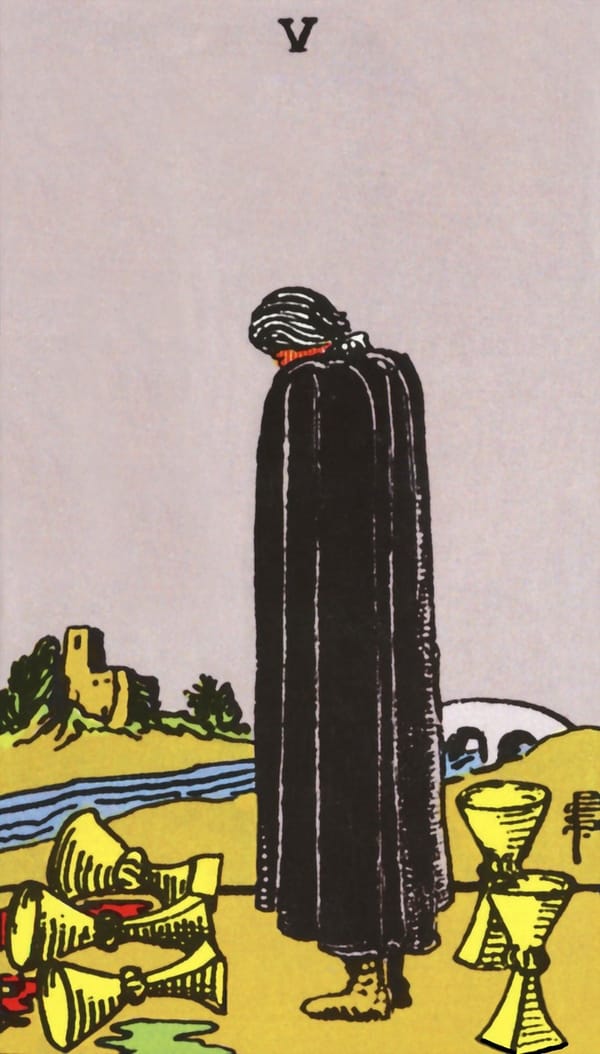
A figure in a long black cloak stands with head bowed, staring at the ground. Three golden cups lie knocked over in front of them, their contents spilling out — you can see the dark red liquid pooling where they fell. The figure's entire body is oriented toward the loss. Shoulders hunched. Head down. Everything points at what went wrong.
Behind them, unnoticed, two cups stand perfectly upright.
Behind them further, a river flows. A stone bridge crosses it, leading to a castle or a cluster of buildings on a distant bank. There's a whole landscape of possibility at their back, and they don't see any of it.
That's the Five of Cups as feelings. Not someone who has nothing. Someone who can't stop staring at what they lost.
The Black Cloak
Every other figure in the Cups suit wears color. The Queen wears blue and white. The Knight wears silver and blue with a winged helmet. The Page wears a pink tunic. But this person has wrapped themselves entirely in black, head to toe. Waite's original description called it simply "a dark, cloaked figure" — the illustrator Pamela Colman Smith made that darkness consume the entire body. Only their boots show beneath the hem.
That cloak is the feeling. It's not decoration. It's weight. When someone feels Five of Cups energy, they're wearing their grief like a garment. It's the first thing you notice about them — not who they are underneath, but the sorrow they've wrapped around themselves.
In practical terms, this is the person who sighs before they speak. The one who brings every conversation back to what happened. The friend who can't talk about the future because they're still processing the past. The grief isn't hidden. It's the only thing visible.
What Spilled
Look at those three cups on the ground. They didn't just tip over neatly. They're scattered, fallen at angles, contents already running into the dirt. Whatever was in them can't be put back.
When someone feels Five of Cups energy toward you, those spilled cups represent specific losses between you. Maybe it's trust that was broken. Maybe it's a version of the relationship that existed before a particular fight, a lie, a disappointment. Maybe it's the future they thought you'd have together.
The key word is specific. This isn't vague sadness. They're grieving particular things. They could name them if you asked. The first cup might be the time you let them down. The second might be the hope they had for what you could be. The third might be their confidence that things would work out. Three distinct losses, each one pooling on the ground.
The Two Cups They Cannot See
Here's what makes this card both heartbreaking and hopeful: there are still two cups standing. They're right behind the figure, upright, full, completely intact. But the figure's back is turned to them.
When this person looks at you, or thinks about your situation, or sits with their feelings about what happened — they're only counting what's gone. They're not tallying what remains. If you've been trying to remind them of what's still good between you, of what hasn't been damaged, you've been pointing at those two cups. And they keep staring at the three on the ground.
This isn't stubbornness. It's the mechanics of grief — what psychologists call negativity bias, the brain's tendency to weigh losses more heavily than equivalent gains. The human eye goes to the wreck, not the intact building next door. When something you cared about shatters, your attention locks onto the shattered pieces. You can't look away because looking away feels like betraying how much it mattered.
The Bridge and What It Means
Past the cups, past the figure, past the river — there's a bridge. And beyond the bridge, buildings. A place to go. A structure someone built.
This is the part of the Five of Cups that people miss when they read it as pure despair. The card shows you the exit at the same time it shows you the grief. The bridge isn't hidden. It's right there. The figure just hasn't turned around yet.
In feelings terms, this means the situation isn't hopeless. There is a way forward — a way across the emotional river they're drowning in. But the figure has to choose to look away from the spill. They have to decide that what's ahead matters as much as what's behind.
If you're the person standing across that bridge, you know what this feels like. You can see the path. You can see that they have cups still standing. But you can't make them turn around. That pivot — from staring at loss to walking toward what's left — has to come from inside the cloak.
When This Card Appears Reversed
Reversed, the figure begins to shift. Maybe they glance over their shoulder. Maybe a cup catches the light and they notice it's still standing. Reversed Five of Cups as feelings means the grief is beginning to lift. Not gone — the spilled cups are still on the ground and the cloak is still black — but something has changed in where they're looking.
This person might be starting to feel ready to rebuild. They're not over what happened, but they've begun to accept that staring at the spill won't refill the cups. They might reach out to you tentatively, not because they've forgiven everything, but because they've noticed there's something still standing and they want to know if it's worth picking up.
Reversed, the bridge comes into focus. They might not cross it yet, but they see it. That matters.
What to Do With This Reading
If the Five of Cups represents someone's feelings, the most important thing to understand is their timeline. They're not on yours. Their grief has its own pace, and rushing it doesn't drain the cups faster — it just makes the figure grip the cloak tighter.
What you can do: be one of the standing cups. Stay upright. Stay full. Don't knock yourself over trying to compete with the spilled cups for their attention. When they're ready to turn around, what they'll see is that something survived. That something could be you.
But don't wait forever. Two cups standing behind someone who won't look at them is patient, but it's not a permanent position. At some point, you need to be seen by someone who is willing to open their eyes.