
Look at What She Holds
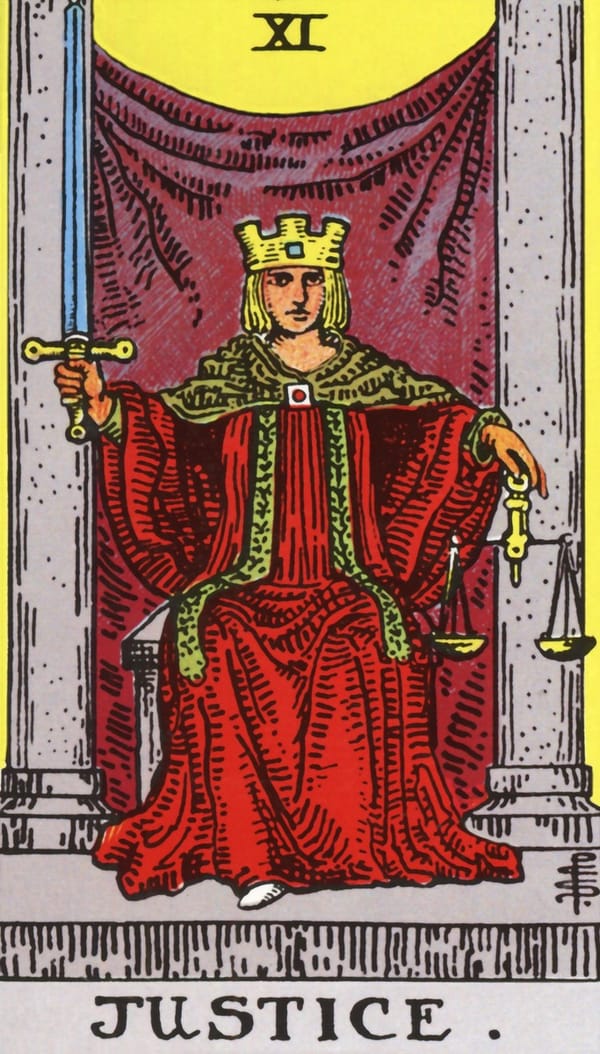
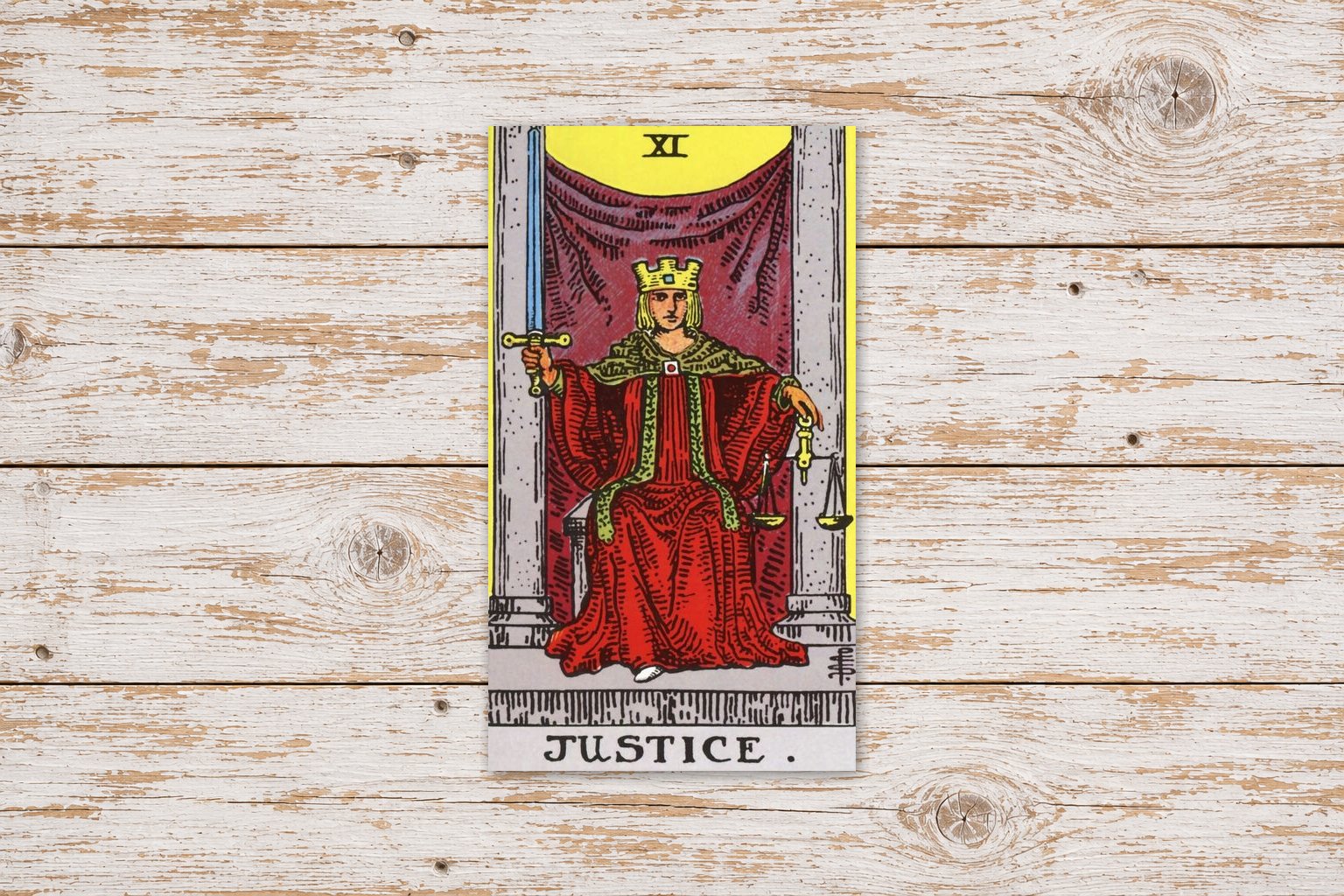
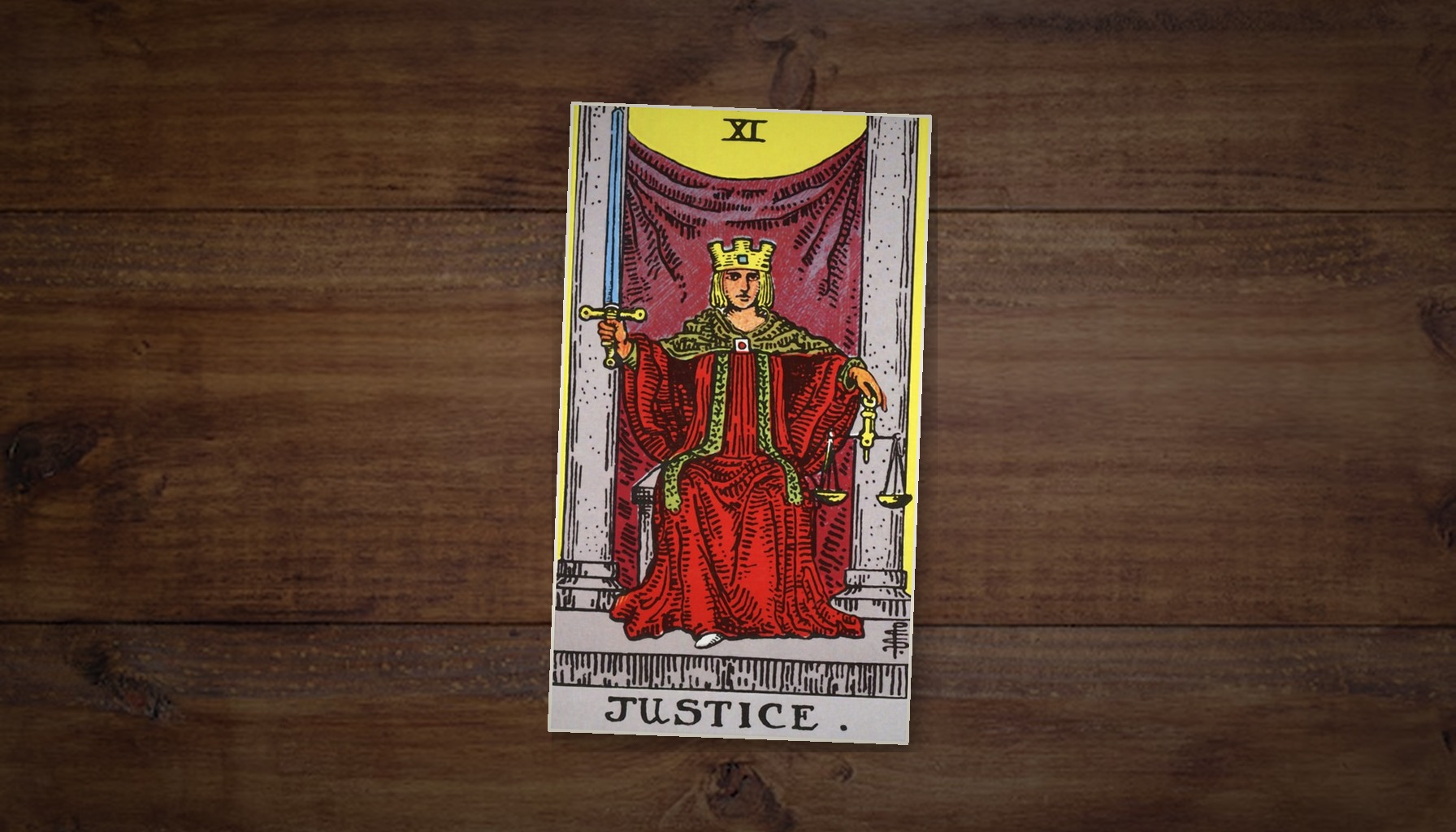
In her right hand, a double-edged sword, held upright and slightly raised. Not resting, not sheathed — ready. In her left hand, a set of golden scales, balanced, still. She holds both at the same time, which means she measures before she cuts. But she does cut.
She sits between two grey stone pillars with a red curtain draped behind her. Seated, not standing. This isn't a warrior heading into battle. This is a judge who has taken her seat and will not be moved from it. Her crown is small and squared, practical rather than decorative. A red jewel sits at her collar. Her robes are red — red for blood, for consequence, for the heat under the calm surface.
Her face is forward, looking directly at you. Not to the side, not down at the scales, not up at the sky for guidance. She's already done the weighing. She's already arrived at the answer. Now she's looking at you to see if you know what it is.
Where Justice weighs evidence, The Emperor as a person builds structure — both are authority figures, but their methods differ.
Waite's Pictorial Key to the Tarot from 1910 offers the original textual description, though Pamela Colman Smith's artwork carries layers of meaning that his words only begin to capture.
The Person Who Remembers What You Said
The Justice person is the friend who quotes your own words back to you. Not to be cruel, but because they were listening when you made that promise, set that boundary, or stated that value — and they noticed when your actions stopped matching.
They're the coworker who says "we agreed to deliver this by Friday" when you try to push the deadline to next week. The partner who says "you told me you were done talking to your ex" when your phone lights up at midnight. The parent who says "you said you'd clean your room before you went out" and means it, every word, no negotiation.
If the weighing feels more spiritual than legal, Judgement as a person describes someone operating from a deeper kind of accountability.
This isn't nagging. The Justice person doesn't track your behavior out of suspicion. They do it because they believe words should mean something. A commitment is a commitment. A boundary is a boundary. If you said it, they believed you, and if you didn't mean it, that's your problem, not theirs.
What They're Like to Be Around
Being around a Justice person feels like being held accountable, constantly, without malice. They don't lecture. They don't moralize. They simply notice when things don't add up, and they're not afraid to say so.
They split every bill to the penny — not because they're cheap, but because fair is fair, and why should you pay for the wine they didn't drink? They remember who drove last time and whose turn it is next. They track reciprocity not with resentment but with the quiet attention of someone who genuinely believes that balanced relationships are healthy relationships.
They're honest in a way that can feel blunt. They don't cushion feedback with excessive kindness. "That dress doesn't fit well" or "your business plan has a gap" comes out clean and direct. They assume you'd rather know the truth than hear something comfortable, because that's what they would want.
Justice people are natural at healthy boundaries because they see relationships as agreements.
Dating the Justice Person
In a relationship, the Justice person is fair. Consistently, sometimes inconveniently, always fair. They divide household labor equitably. They acknowledge their own mistakes as readily as they point out yours. When you argue, they fight fair — no low blows, no bringing up old wounds, no nuclear options.
This sounds ideal until you realize it means they also expect fairness from you. Every time. Without exception. If you cancel plans, they expect equivalent consideration later. If you apologize, they expect the behavior to change. Words without follow-through erode their trust faster than almost anything else.
They're not keeping score in a petty way. They're maintaining the scales. And when the scales tip too far in one direction for too long, they'll address it — not with anger but with a clear, measured statement that lands harder than any shout.
The sword in her hand — it goes both ways. A double-edged blade. The Justice person will cut through your excuses, but they'll also cut through their own. They hold themselves to the same standard they hold you. That's why their judgment carries weight. It's not hypocritical.
At Work
The Justice person is the one you want reviewing the contract, auditing the books, investigating the complaint. They'll find the discrepancy. They'll identify the unfairness. They'll document it clearly and present it without embellishment.
They thrive in legal work, compliance, HR, quality assurance, editing — any role where accuracy and fairness are the product. They're the person who reads the fine print because they know that's where the real agreement lives.
They struggle in environments that reward politics over merit. They get frustrated when promotions go to the well-connected rather than the well-qualified. They can't stomach "that's just how things work" as a justification for something they see as unjust.
The Sword and the Scales Together
Most people focus on one or the other — the scales or the sword. But the Justice person holds both, always, simultaneously. They measure and they act. They weigh and they cut. This is what makes them both valuable and difficult: they don't just identify what's wrong, they do something about it.
The shadow side is rigidity. Sometimes life doesn't fit neatly on the scales. Sometimes mercy should outweigh fairness. Sometimes the technically correct answer isn't the kind one. The Justice person can get so focused on what's right that they forget about what's compassionate. The sword doesn't know how to be gentle, and the scales don't measure love.
The analytical energy here is shared by King of Swords as a person — someone who leads with logic and clear boundaries.
If you love a Justice person, be honest with them. Above everything else, be honest. They can forgive a mistake. They can work with a flaw. But they cannot forgive a lie, because a lie throws the scales off, and once the scales are off, they don't trust any of the measurements anymore.
Keep Reading
For how this card reads as someone's emotional state, see Justice as feelings.
The full Justice page covers upright and reversed meanings across love, career, money, and practical advice.
When trust is the real question, tarot when someone is lying covers the cards that speak to deception.
When the reading is really about whether you can trust someone, tarot for trust issues goes deeper.
The tarot spreads guide has layouts designed for different types of questions, from a single card to a full weekly forecast.