

The Smaller One Looks Up
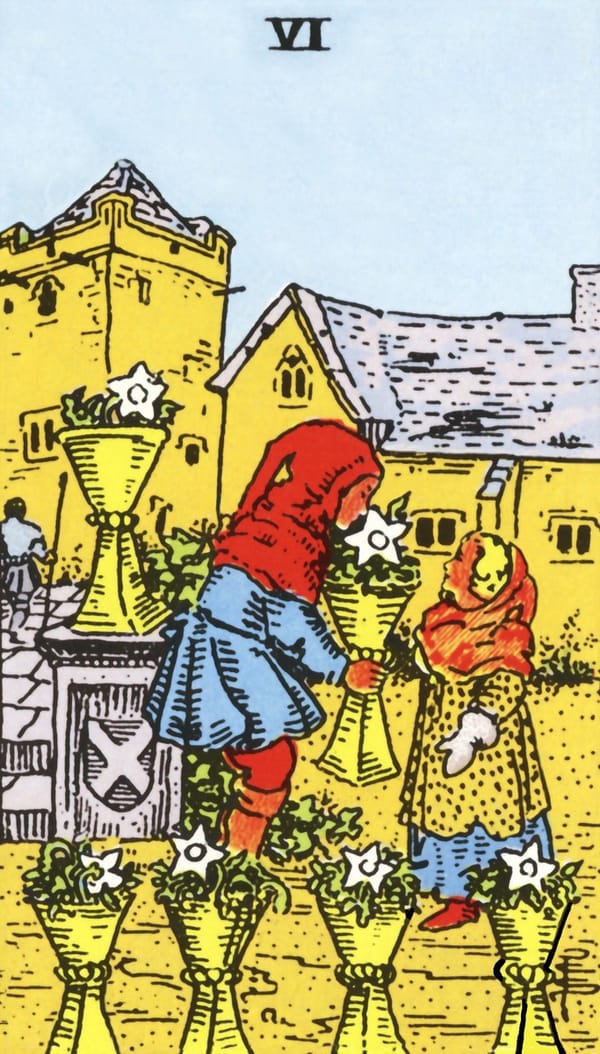
In a village square, surrounded by golden cups overflowing with white star-shaped flowers, a taller child bends toward a smaller one. The taller child wears a red hood and a blue tunic, and they're offering a cup — presenting it with both hands, leaning forward with the careful seriousness of someone giving something that matters. The smaller child, in a polka-dotted dress and orange headscarf, looks up to receive it.
Six cups are visible, each brimming with green leaves and those distinctive white flowers — five-petaled stars that look almost like they were made by hand. Behind the children, a golden-yellow village of old stone houses clusters together. A figure walks away in the far left background, near a pillar topped with another cup. The scene is warm, yellow, enclosed — a world that feels complete in itself.
Everything in this card is gentle. Everything bends toward care. Waite wrote that this card meant "the past and memories" — but Smith's illustration says something warmer than that.
For another powerful pairing, see Five of Cups and Six of Cups.
The Gesture That Asks Nothing Back
When the Six of Cups appears as someone's feelings, the defining quality is that their care doesn't come with conditions. The taller child isn't handing over the flower cup and waiting to see what they'll get in return. They're just giving. Leaning down, offering something beautiful, and doing it because giving felt like the natural thing to do.
This person's feelings toward you have that quality. When they think of you, the first impulse is generosity. They want to do something for you, share something with you, give you something they think you'd like. Not to impress you or earn your affection — because caring about you makes them want to offer things.
You'll notice it in small ways. They remember what you mentioned offhand and bring it up later. They share a song or a recipe because it reminded them of you. They ask how that thing you were worried about turned out. The flower-filled cup being handed to the smaller child — it's not expensive or impressive. It's personal.
Why the Village Matters
Look at the buildings behind them. These aren't modern or unfamiliar structures. They're old stone houses, a tower, peaked roofs — the kind of architecture that's been there for generations. The children aren't in a new place. They're in a place that's been lived in for a long time.
Six of Cups feelings are rooted in familiarity. When someone feels this way about you, there's a sense of "I've known you before" even if you met last month. You trigger something old in them — not a specific memory, necessarily, but a feeling of coming back to something they'd forgotten they missed.
This is why the Six of Cups so often appears in readings about ex-partners or childhood friends. The feelings carry the weight of shared history. But even in new relationships, this card says the person feels a surprising sense of recognition. You remind them of home. Not a perfect home — just the home they know, the one that shaped them.
The Children, Not Adults
This isn't the King of Cups on his throne or the Queen with her sealed chalice. These are children. That detail tells you everything about the quality of these feelings.
Six of Cups emotions are pre-defensive. They come from before the person learned to guard themselves, before they developed strategies and walls and "rules" about dating or relationships. This person's feelings for you bypass all their adult armor. Around you, they feel younger. Softer. More open than they usually allow themselves to be.
That vulnerability is beautiful, but it can also be fragile. A child offering a flower cup to another child is the most tender image in the tarot. It's also completely unprotected. If you're the smaller child looking up at what's being offered, handle it gently. This person is giving you something from a part of themselves they don't usually show anyone.
When Nostalgia Becomes the Whole Story
That figure walking away in the far left background — most people don't notice them, but they're there. Someone leaving the scene. This hints at the shadow side of Six of Cups feelings.
Sometimes this card shows someone who feels warm and connected to you — but the warmth is really about the past, not the present. They love how you make them feel because it reminds them of something they used to have. They're not quite seeing you. They're seeing the feeling you evoke — what psychologists call transference — and that feeling belongs to another time.
If you sense that someone's Six of Cups feelings for you have a wistful quality — if they seem to be looking through you rather than at you — they might be using the connection as a portal to nostalgia rather than building something in the present. The flower cups are beautiful. But flowers need fresh water to survive.
What the White Flowers Mean
Those five-petaled white stars in every cup are specific. They're simple flowers — not roses, not exotic blooms. They're the kind of flower a child picks from the side of a road because they thought it was pretty. Nothing cultivated or expensive. Something found and offered.
Six of Cups feelings have that quality. The person isn't performing grand romance. They're offering you what they have — which might be simpler than what you're used to, but it's honest. A cup full of hand-picked flowers says "I thought of you and I wanted to give you something" in a way that no purchased bouquet can match.
Reversed: When the Memory Stings
Reversed, the cups tip and the flowers scatter. The nostalgic warmth that felt so comforting curdles into painful memory. Reversed Six of Cups as feelings often means someone who is stuck in the past — not in a sweet way, but in a way that prevents them from being present with you.
They might idealize a previous relationship and compare you unfavorably to the memory. Or they might feel drawn to you because you remind them of someone, and when reality breaks the illusion, disappointment follows. The village behind them becomes a place they can't leave rather than a place that grounds them.
What to Do With This Reading
If someone feels Six of Cups energy toward you, what you're being offered is rare: genuine, uncomplicated affection. Don't dismiss it because it isn't dramatic. Don't mistake gentleness for weakness.
But do check whether you're being seen for who you actually are, or whether you're a screen onto which someone is projecting old feelings. The cup is beautiful. The flower is real. But make sure the person handing it to you is looking at you — present-tense you — and not at a memory wearing your face.
If they are seeing you, if the care is fresh even though the feeling is familiar — that's one of the most trustworthy kinds of love the tarot can show. Accept the cup. Smell the flowers. Let yourself feel as young and unguarded as the child looking up.