

Count the Cups. Then Count What's Inside Them.
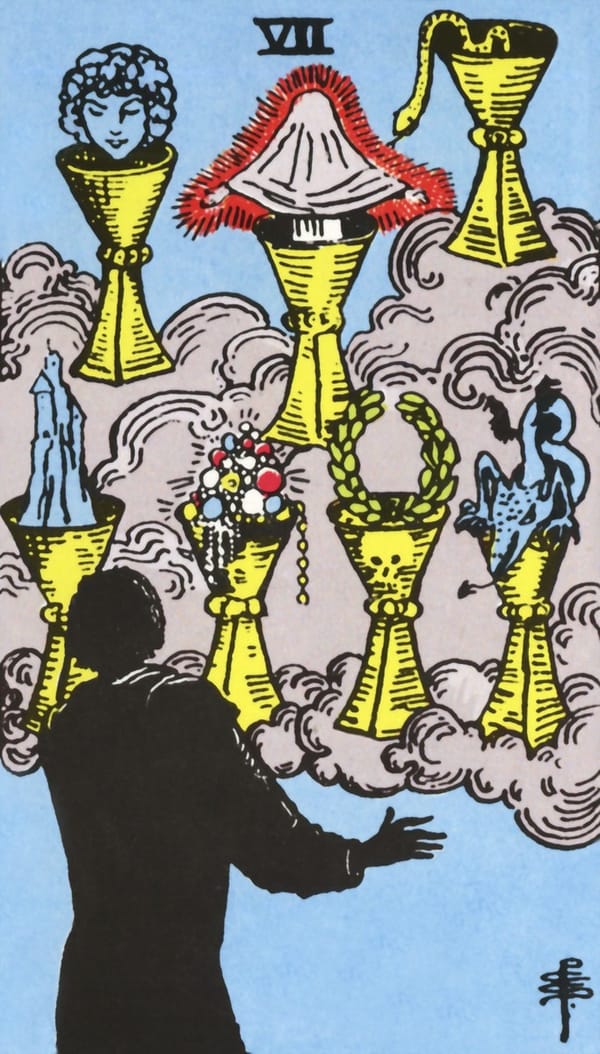
A dark silhouette stands with one arm raised toward a wall of clouds. In those clouds, seven golden cups float, each one holding something different. The top center cup contains a shrouded figure — veiled, glowing, mysterious. The top left holds a human face, eyes closed, serene. The top right overflows with something bright and formless. Below, the remaining cups hold a castle, a pile of jewels and gems, a laurel wreath with a skull beneath it, and a snake or dragon rearing up from the rim.
Seven cups. Seven desires. Seven fantasies competing for one person's attention. And the person — they're just a shadow, featureless, one hand out, as if gesturing at everything and nothing.
That's the Seven of Cups as feelings. Not one clear want. A whole sky full of them, and no way to reach any of them because they're all made of cloud.
The Person Who Can't Choose
When the Seven of Cups appears as someone's feelings toward you, what you're dealing with is genuine emotion buried under layers of confusion. They feel something. The outstretched hand proves that — this isn't the folded-arms refusal of the Four of Cups. They're reaching. They want.
But they want everything. They want the beautiful face in the cup. They want the castle. They want the glory of the wreath and the excitement of the snake and the wealth of the jewels and the mystery of the veiled figure. And somewhere in that collection of wants, they also want you. But you're competing with six other fantasies, and they can't figure out which cup to grab first.
In practice, this looks like someone who texts you constantly for three days and then disappears for a week. Someone who makes plans and cancels them. Someone who tells you they're really into you, then mentions they're also "figuring things out" with someone else. The signals aren't mixed because they're lying. The signals are mixed because their feelings are genuinely mixed — seven cups worth of mixed.
What Each Cup Contains
Look more carefully at the visions in each cup, because they tell you what's competing with your spot in this person's emotional landscape.
The face — idealized love, the fantasy of a perfect partner. The shrouded figure — mystery, the thrill of the unknown. The castle — ambition, the desire for status or security. The jewels — material want, the belief that having enough will fill the gap. The wreath — achievement, recognition, what Maslow would place at the top of his hierarchy of needs. The snake — danger, the pull toward what's exciting precisely because it's bad for you. And that bright overflowing cup — pure desire without form, wanting to want.
When someone feels Seven of Cups energy, they're not choosing between you and another person. They're choosing between you and a whole catalog of desires. Some of those desires aren't even about relationships. The castle might be their career ambition. The wreath might be their need for validation. The snake might be their attraction to drama. You're up there in the clouds alongside fantasies that have nothing to do with love.
The Cloud Problem
Every single cup is floating in clouds. Not one is on solid ground. The figure isn't reaching toward something real and tangible — they're reaching into vapor.
This is the crucial thing about Seven of Cups feelings: they haven't been tested against reality. Psychologists call this limerence — the intoxicating early state where fantasy and feeling are indistinguishable. The person may have strong feelings about you, but those feelings exist in their imagination, not in the lived experience of actually being with you through boring Wednesday evenings and miscommunicated texts and the long middle of real relationships.
They might describe their feelings with great intensity. They might send you poems at 2 AM or talk about how deeply they connect with you. But if you look at their actions — the follow-through, the consistency, the willingness to show up for the unglamorous parts — you'll find clouds where ground should be.
The Silhouette Has No Face
Look at the figure again. It's completely dark — a shadow, a silhouette. You can't see their face, their expression, their clothes. They're undefined, unformed, still a rough outline of a person rather than a fully realized one.
When someone is in Seven of Cups emotional territory, they often haven't fully formed their own identity around what they want. They don't know who they are in relationship to their desires because they have too many desires to organize. They can't tell you what they feel about you because they can't quite tell themselves what they feel about anything.
This is different from someone who is emotionally unavailable. The Four of Cups person has shut down — they won't reach out at all. The Seven of Cups person is all reach and no grip. They're extending themselves toward everything, touching nothing.
Reversed: The Cloud Clears
Reversed, the cups begin to settle. The cloud disperses. Not all at once — the figure might still be confused about a few things — but the overwhelming fog of wanting-everything starts to thin. One or two cups emerge as clearly more important than the others.
Reversed Seven of Cups as feelings often means someone who is beginning to get honest with themselves about what they actually want versus what they've been fantasizing about. The castle starts to look less appealing when they realize they'd have to live in it alone. The snake loses its charm when they remember the last time they chose excitement over stability.
If they choose you after the cloud clears, pay attention. That choice was hard-won. They had to let go of six other fantasies to reach for something real. That kind of clarity, for someone who's been drowning in options, is the closest thing this card produces to a genuine commitment.
What to Do With This Reading
If someone feels Seven of Cups energy toward you, the worst thing you can do is become another fantasy in their collection. Don't be the person who matches their energy by being unpredictable, mysterious, or just available enough to keep them guessing. That feeds the cloud, not the ground.
Instead, be specific. Be real. Be the option that has a face and a body and a Saturday morning routine and an opinion about what to have for dinner. The more concrete you are, the more you stand out from the other six cups in the vapor.
And if they can't choose — if the cloud never clears and you're left watching someone gesture vaguely at seven different futures — walk away. The silhouette can reach toward the clouds forever. You don't have to float there waiting to be chosen.