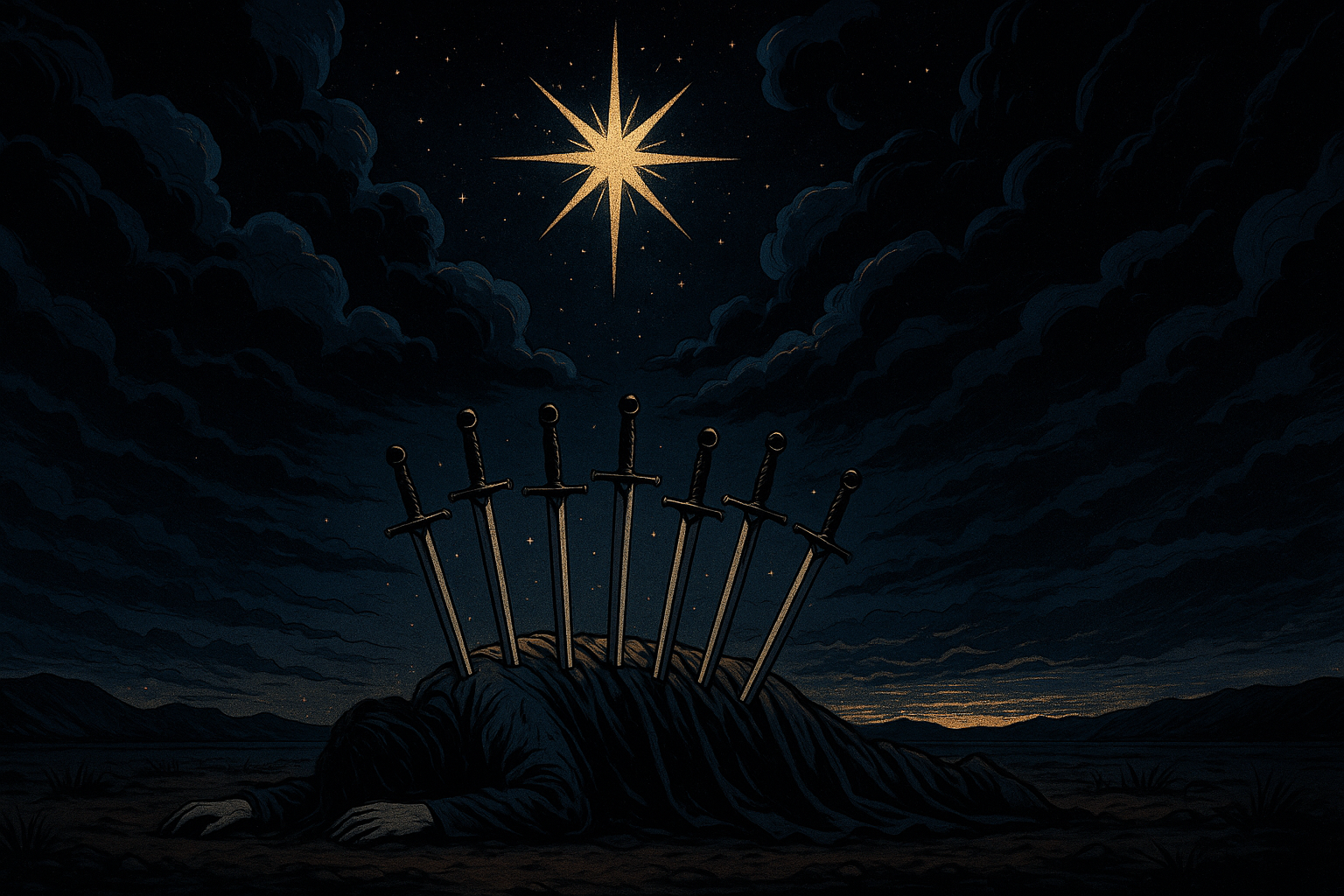
Here's the thing about rock bottom: it has a surface. You can lie on it.
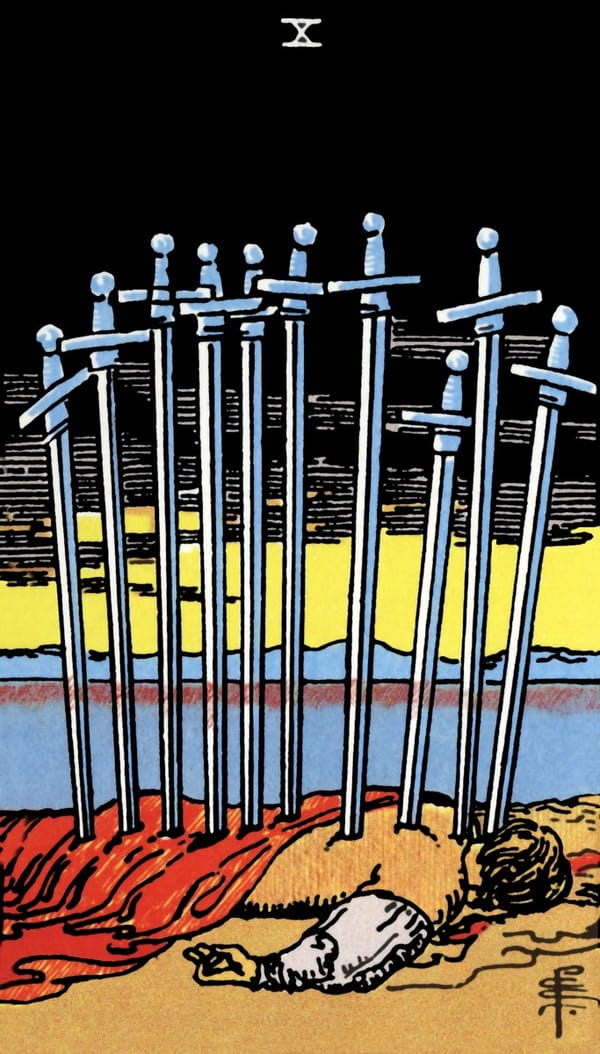
This figure is lying face down on the ground with ten swords driven into their back. Ten. Not three, not five — every single sword the suit has to offer. The sky above is black. But at the horizon line, a band of gold spreads over calm water. Dawn. It's already happening, even though the figure can't see it because they're face down in the dirt.
That gold strip is The Star, waiting.
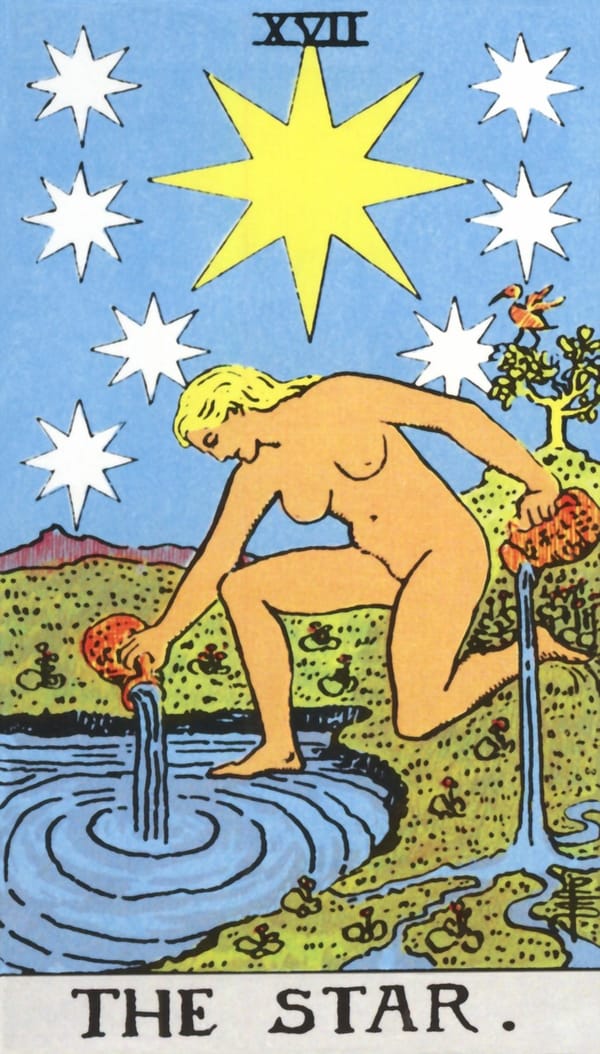
A naked woman kneels at the edge of a pool, pouring water from two pitchers — one into the pool, one onto the green land. Above her, one large yellow star surrounded by seven smaller white ones — which Waite identified as "the great star of the Magi" and the seven chakras of ancient tradition. A bird perches in a tree behind her. She's completely exposed, completely vulnerable, and completely at peace.
What These Cards Look Like Together
The contrast is almost violent. The Ten of Swords: black sky, prone figure, weapons, stillness. The Star: blue sky, kneeling figure, water, flow.
But look at the figures themselves. Both are in surrender postures. The Ten of Swords figure has given up — involuntarily, painfully. The Star figure has let go — voluntarily, peacefully. One collapsed under the weight of what happened. The other chose to kneel.
The journey between these two cards is the journey from being broken open against your will to being open by choice. Psychologists call this post-traumatic growth — the phenomenon where the worst experiences sometimes produce the deepest transformation.
The Dawn Line
The most important visual detail connecting these cards is the golden horizon in the Ten of Swords. That thin band of light at the bottom of a mostly black sky is The Star entering the scene before The Star card even appears.
When you're in Ten of Swords territory — betrayed, defeated, exhausted past the point of caring — the healing has already started. You just can't see it yet because you're face down. The light exists before you can perceive it.
This is not toxic positivity. It's sequencing. The Star doesn't fix the damage or pretend it didn't happen. It begins the slow work of replenishment only after the destruction is complete. It can't arrive while the swords are still falling. It waits until they've all landed.
What Position Changes
Ten of Swords first, Star second: the classic sequence. Total defeat followed by the first stirrings of hope. You're moving from crisis to recovery. The swords are in your back, but you're about to feel the warmth of that dawn.
Star first, Ten of Swords second: rarer and harder. You had a period of hope or healing, and something knocked you down again. This isn't a cruel joke — it usually means you tried to rebuild on an unstable foundation. Something needed to fully collapse before the real healing could begin. The Ten of Swords is finishing what the previous crisis started.
The Two Streams of Water
The Star pours from two pitchers — one stream into the pool (emotional replenishment), one onto the land (practical rebuilding). She doesn't choose between inner work and outer work. She does both simultaneously.
After a Ten of Swords experience, you need both streams. You need to process the emotional devastation (therapy, grief, honest conversations with people you trust). And you need to rebuild the practical structures the crisis destroyed (finances, housing, social connections, daily routines).
People who focus only on the emotional work get stuck in the processing phase. People who focus only on the practical rebuilding bury the pain under productivity. The Star says: pour both streams.
The Naked Truth
The Star's figure is naked. After the Ten of Swords, pretense is impossible. You can't fake being okay when ten swords are in your back. And weirdly, that's the gift. You're past the point of performing strength or maintaining appearances.
You can be honest now. With yourself, with the people around you, with the universe. "I'm destroyed and I need help" is a complete sentence. The Star's nudity isn't shame — it's the relief of dropping every mask.
The people who show up for the naked version of you are the people worth keeping.
What Recovery Actually Looks Like
Not a dramatic comeback. Not a phoenix rising. The Star is a woman kneeling by a pond, pouring water. It's quiet, repetitive, grounding work.
Recovery looks like sleeping through the night for the first time in weeks. It looks like eating a meal because you're hungry, not because someone reminded you. It looks like a morning where the first thought isn't about what happened. It looks like laughing — genuinely, briefly, unexpectedly — and being surprised by the sound.
Those small moments are The Star working. Trust them. They accumulate.
Keep Reading
The full Ten of Swords page covers upright and reversed meanings across love, career, money, and practical advice.
The tarot spreads guide has layouts designed for different types of questions, from a single card to a full weekly forecast.
Your birth cards — the Major Arcana pair calculated from your birthday — add another layer to any reading.