
You keep ending up here. Different face, different name, same feeling in your stomach. The argument that starts the same way every time. The moment where you could say something different but don't. The door that closes and then opens again three months later because one of you texted at midnight.
That's not bad luck. That's a pattern, and tarot has specific cards for it.
The Wheel That Won't Stop Turning
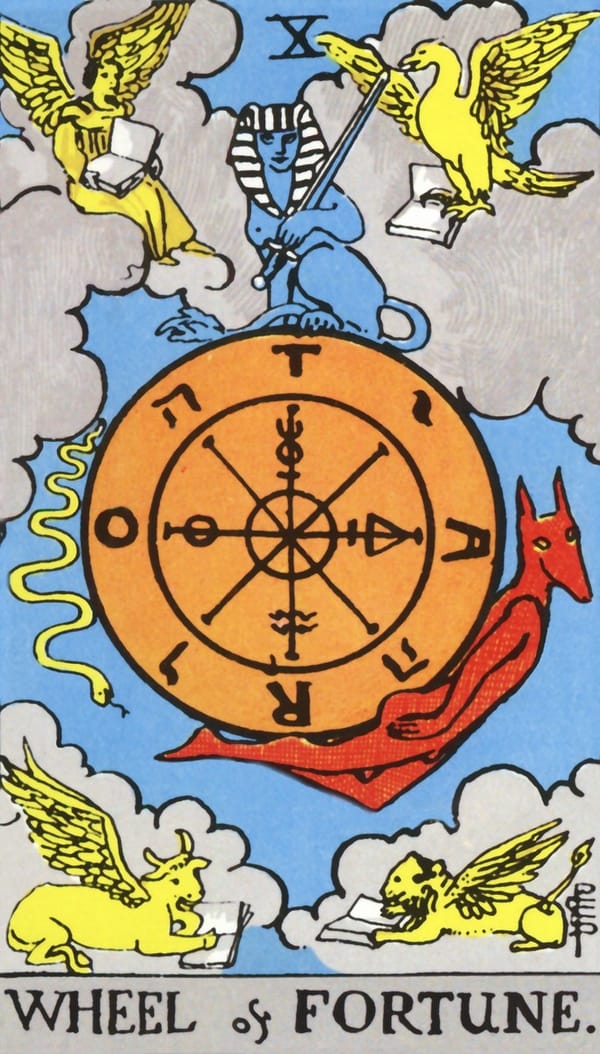
The Wheel of Fortune is the first card to understand in karmic relationships. Look at what's happening in the image. A great wheel turns in the sky, suspended among clouds. On the right side, a red figure rises — Anubis, ascending. On the left, a serpent descends. At the top sits the Sphinx, holding a sword, watching everything turn beneath her.
Four creatures occupy the corners: a winged human, an eagle, a lion, and a bull. They're reading books. They've seen this before. They know how the story goes because it's the same story on repeat.
That's a karmic relationship in one image. You're on the wheel. Sometimes you're rising — the relationship feels good, you think you've finally figured it out. Then the wheel turns and you're descending again. Same problems, same reactions, same sick feeling.
The difference between the Wheel of Fortune in a general reading and in a karmic one: here, you're not just experiencing change. You're experiencing repetition. The wheel has been through this rotation before. Waite described it as representing "the perpetual motion of a fluidic universe" — and in a karmic relationship, that fluidity is the part where you keep flowing back to the same person.
Justice and What Must Be Balanced
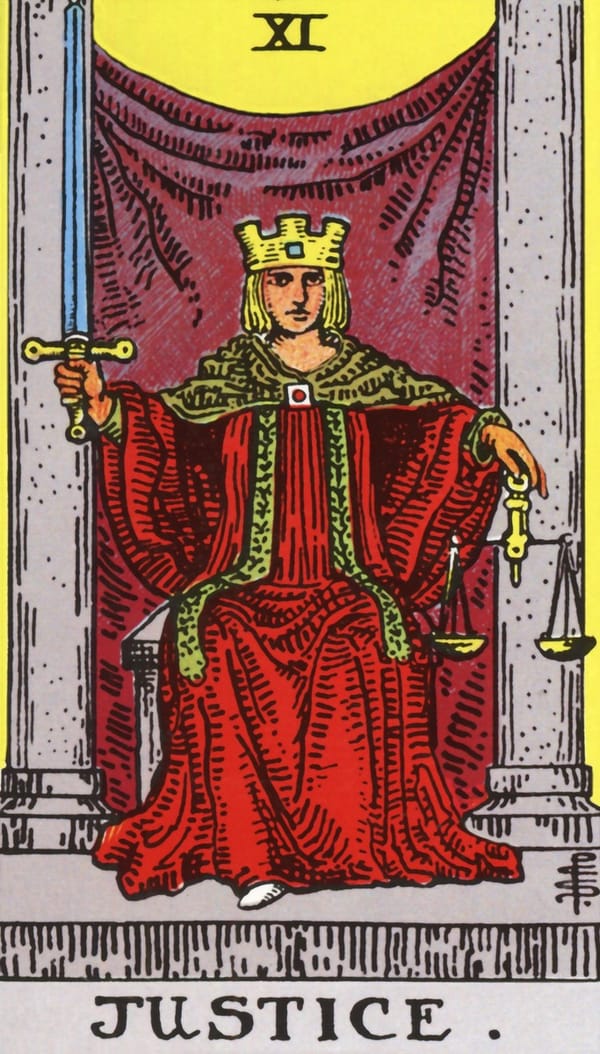
Justice sits between two grey pillars, a sword in her right hand and balanced scales in her left. A purple veil hangs behind her. She wears a red robe and a gold crown with a small square on it — a symbol of ordered thought.
In a karmic relationship reading, Justice says: something between you two is unresolved. Not emotionally unresolved — karmically unresolved. There's a debt, a lesson, an imbalance that hasn't been corrected yet. Maybe you hurt someone in the way you're now being hurt. Maybe you're learning what it feels like to be on the receiving end of your own behavior.
Justice doesn't care about your feelings about this. Look at her face — calm, neutral, assessing. She's not punishing you. She's accounting. The scales either balance or they don't, and the karmic relationship continues until they do.
When Justice appears reversed in a karmic reading, the lesson isn't landing. You're going through the motions of the relationship but refusing to see what it's trying to teach you. The scales are tipping and you're pretending they're level.
The Devil's Chains Are Loose
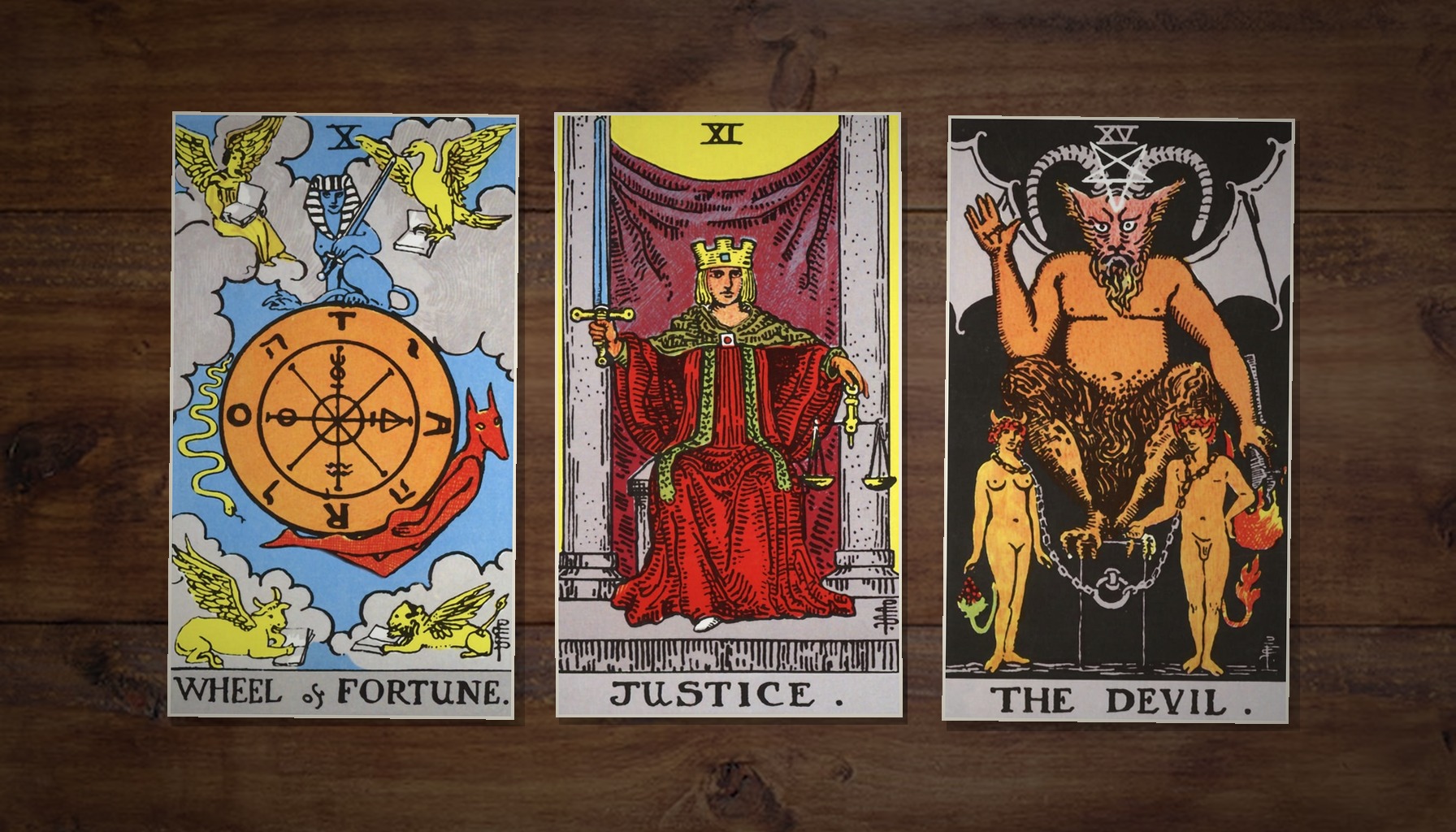
The Devil is the card that explains why karmic relationships are so hard to leave. Look at the image: two figures stand chained to a block on which the Devil sits. But the chains around their necks are loose. They could slip them off. They don't.
That's the compulsive pull of a karmic bond. You know this relationship isn't good for you. Your friends have told you. Your therapist has told you. You've told yourself, probably at 3am when the Nine of Swords energy has you wide awake cataloging every red flag you've ignored.
Research on trauma bonding describes this exact pattern — the intermittent reinforcement that makes unhealthy relationships feel more intense than healthy ones. The Devil in a karmic reading shows that the intensity you're mistaking for depth is actually the chain.
The difference between The Devil in a karmic reading and a toxic relationship: in a karmic context, the bondage serves a purpose. It's keeping you here until you learn something. In a purely toxic situation, it's just damage.
When Death Arrives, the Lesson Is Done
The moment a karmic cycle completes, Death appears. Not to punish — to release.
The skeleton rides a white horse, carrying a black flag with a white rose. A king has fallen. A bishop stands in his path, hands raised. A child offers flowers. In the background, the sun rises between two towers.
Death in a relationship context means the version of you that needed this karmic lesson is ending. Not might end — is ending. The king on the ground represents the identity you built around this pattern. The bishop trying to negotiate is the part of you bargaining for one more chance. The child with the flowers is the part of you that's ready to let it go without bitterness.
When Death appears alongside the Wheel of Fortune, the cycle has completed its final rotation. When it appears with Justice, the scales have balanced. Either way, the relationship's karmic purpose is fulfilled. What happens next — whether you stay together in a transformed way or separate completely — depends on whether there's anything between you besides the lesson.
How to Know You're in a Karmic Relationship
Pull three cards with this question: "What is the purpose of this connection?"
If you see the Wheel, Justice, or Judgement, you're likely in a karmic dynamic. If you see the Two of Cups or the Ten of Cups, the connection is based on genuine compatibility, not karmic debt.
The hardest part of a karmic relationship is that it feels significant — because it is. The intensity is real. The lessons are real. The mistake is assuming that intensity means you're supposed to stay forever. Sometimes the most karmic thing you can do is finally leave.
The Wheel stops turning when you stop getting on.