
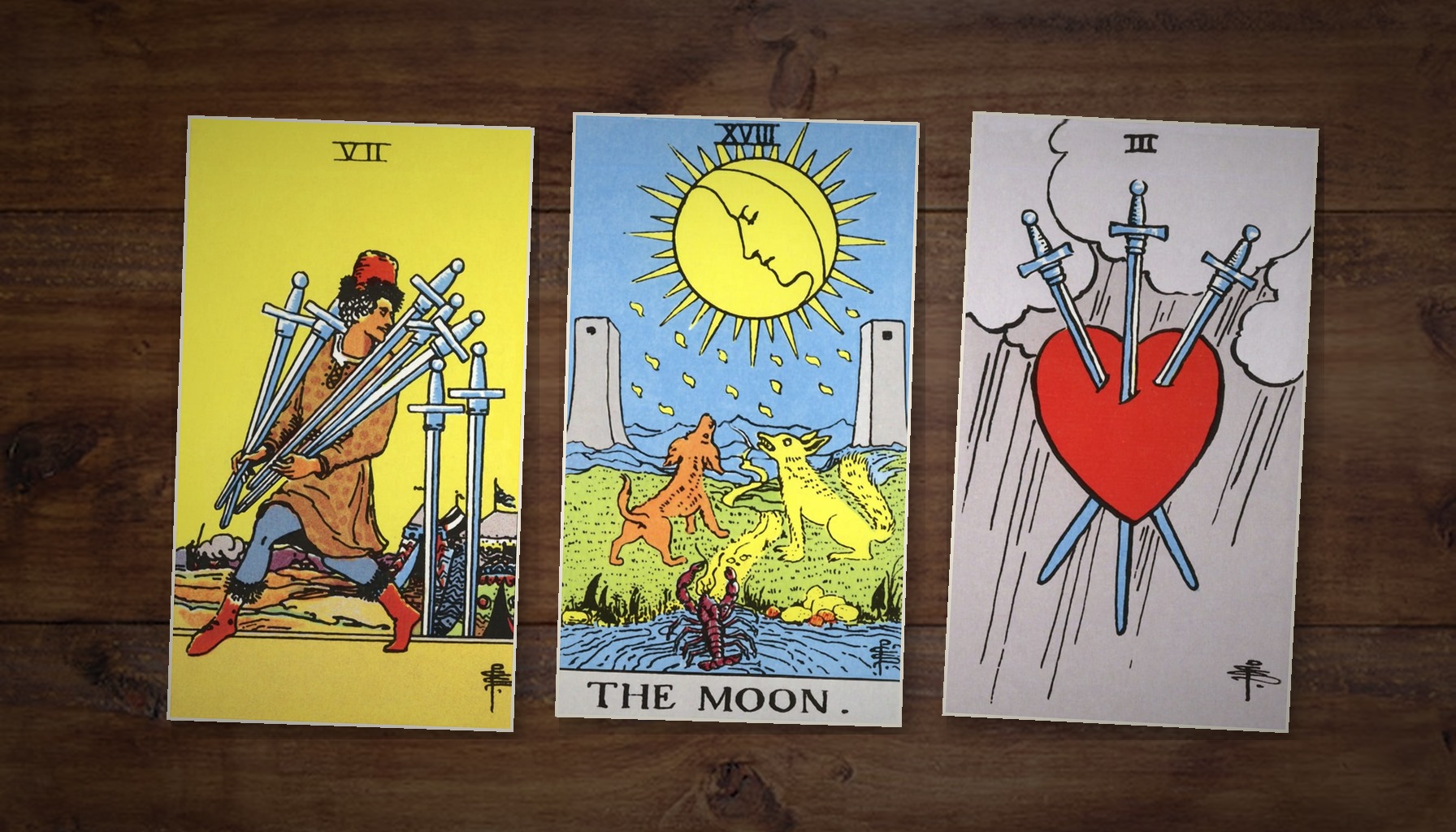
Look at the body language before you look at the meaning. The figure in the Seven of Swords isn't walking — he's tiptoeing. He clutches five swords against his body and glances back over his shoulder toward a cluster of tents with a small flag. Two swords remain planted in the ground behind him, the ones he couldn't carry. His expression is somewhere between smug and anxious, the face of someone who knows exactly what they're doing and knows it's wrong.
This card is where most people's eyes go when they suspect dishonesty in a relationship. And it's a fair instinct. The Seven of Swords is fundamentally about deception — someone taking something that doesn't belong to them and hoping they won't get caught. But before we go further, something needs to be said plainly.
What Tarot Can and Cannot Do Here
Tarot cards cannot confirm whether someone is cheating. They cannot replace a conversation, a therapist, or your own direct observation. As Psychology Today notes, suspicion itself shapes perception — you start finding evidence for what you already believe, which makes objectivity nearly impossible. What they can do — and this is genuinely useful — is reflect the emotional atmosphere of a relationship and point to patterns of dishonesty, secrecy, or misaligned energy.
If you're reading this, you probably already have a feeling. Something shifted. The timing of his explanations doesn't add up. His phone turned face-down on the table one day and it's been that way since. You noticed and you can't un-notice.
The cards aren't going to give you evidence. What they can give you is a framework for understanding what your intuition is already telling you.
Cards That Indicate Deception
The Seven of Swords is the most direct card for dishonesty. That figure sneaking away from the tents — he left two swords behind because he got greedy, tried to take more than he could carry. In a relationship reading, this doesn't always mean physical infidelity. It can mean emotional cheating, financial dishonesty, or someone leading a double life in subtler ways. The core meaning is the same: someone is operating in secret and hoping you don't look too closely.
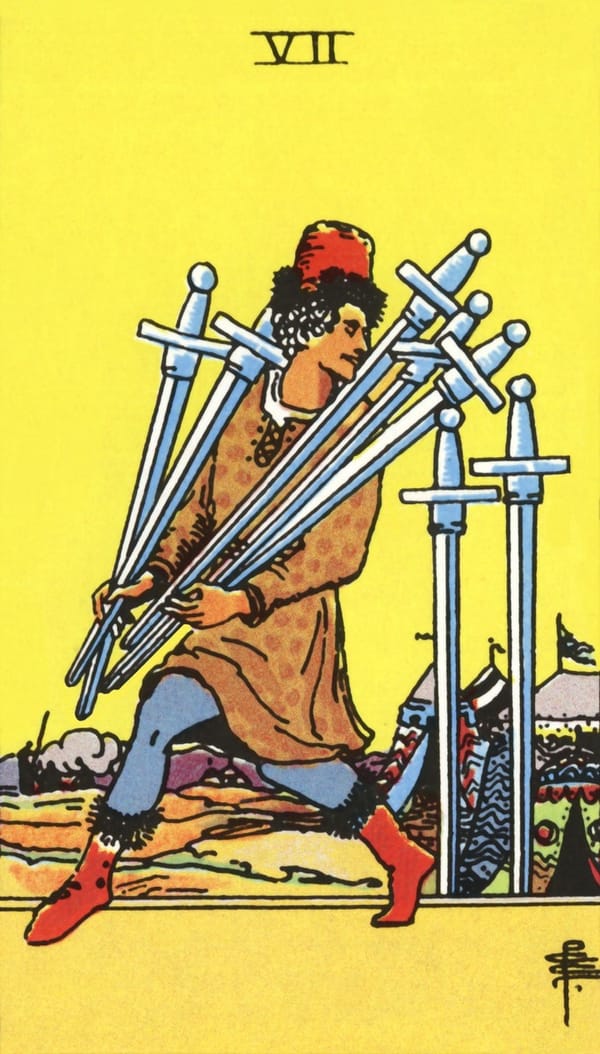
The Moon takes deception into murkier territory. In the card, a huge yellow moon with a downturned face hangs between two grey towers. Below it, a dog and a wolf — the tame and the wild — howl at the sky, and a crayfish crawls from a pool toward a winding path. Droplets fall from the moon like tears or seeds. Nothing in this card is what it appears to be. The path twists. The light is reflected, not real.
When The Moon appears in a relationship reading, it doesn't necessarily point at your partner. It says the whole situation is obscured. You're seeing illusions. Maybe he's hiding something. Maybe you're hiding something from yourself — the truth you don't want to face, the question you haven't asked because you're afraid of the answer. The Moon says: what you see and what's real are not the same right now.
For more on navigating this card's energy, read tarot when someone is lying.
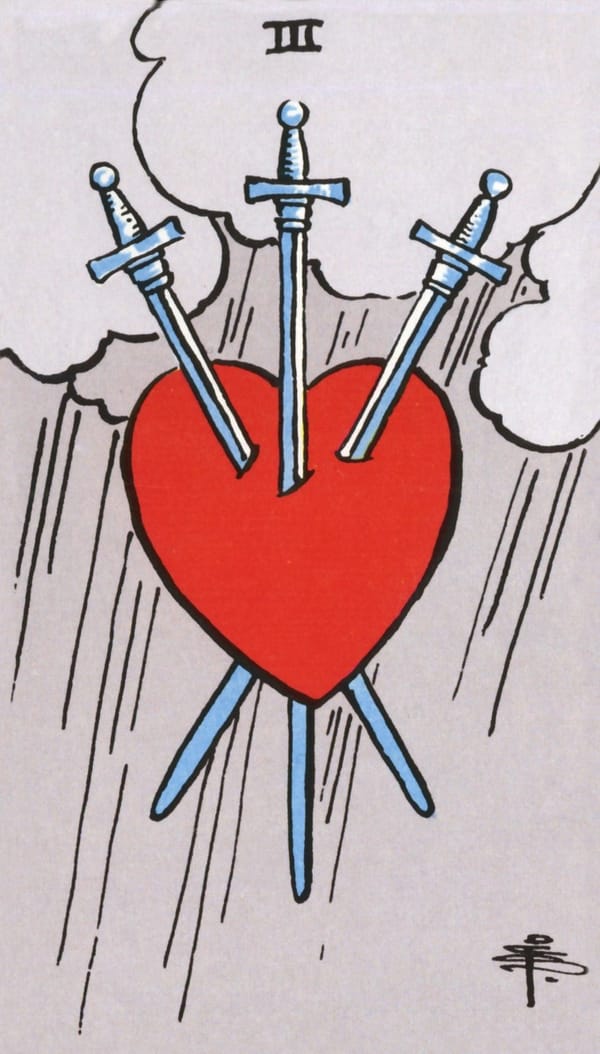
The Three of Swords isn't about deception — it's about the wound that deception leaves. Three swords driven clean through a red heart against a grey sky streaked with rain. No figures, no context, no explanation. Just the heart and the blades and the storm. This card appearing in a relationship reading about trust suggests that the damage has already happened, whether or not you've named it yet. The swords didn't land gently. They pierced.
The Five of Swords shows the aftermath of a conflict where nobody really won. In the foreground, a figure in green holds three swords and smirks at the two retreating figures whose swords lie on the ground. The sky is torn with ragged clouds. If this shows up in a reading about cheating, it often represents the dynamic after confrontation — someone who "won" the argument, explained it away, turned the accusation around. The Five of Swords is gaslighting in a card. The victor isn't proud. He's just the last one standing.
The Devil and the Chain That Fits Loosely
The Devil deserves its own section because it's the most misunderstood card in this context. The image: a winged, horned figure perched on a black pedestal, holding one hand up and one hand with an inverted torch pointed down. Below, two naked human figures stand chained to the pedestal by their necks. Their chains hang loose. They could lift them off.
People see The Devil and think evil, think the worst. But look at those chains. They're not tight. The two figures could leave. They stay because the dynamic has become familiar, because the pattern is easier to repeat than to break. In a cheating context, The Devil often points to the compulsive element — someone who keeps making the same destructive choice not because they enjoy it but because they can't stop. Addiction to the thrill, to the secrecy, to the version of themselves that exists in the affair.
It also sometimes points at the person asking: are you chained to this relationship by love, or by something less healthy? Fear of being alone? Financial dependence? The habit of being someone's partner?
Before You Read About This
If you're about to pull cards on this question, be honest with yourself about what you'll do with the answer. If you pull the Seven of Swords and The Moon together, are you going to have a conversation with your partner? Are you going to check their phone? Are you going to leave?
The cards are not going to make that decision for you, and they shouldn't. They can illuminate what's happening underneath the surface. They can confirm that the anxiety in your gut has roots. But action — the confrontation, the boundary, the hard choice — that's yours.
If you're finding yourself pulling cards about this person constantly, that pattern itself is information. Not from the cards, but from you. Constant checking, constant monitoring, constant suspicion — whether justified or not — is its own kind of prison. If the anxiety is overwhelming, Verywell Mind's guide to relationship anxiety covers when it's a signal and when it's a pattern. The Devil's chain fits loosely both ways.
For help navigating the pain that comes after, tarot after a breakup is a grounded place to start. And the Three of Swords in a love reading covers what that card means when the heart is already broken.