Wheel of Fortune
What the image shows
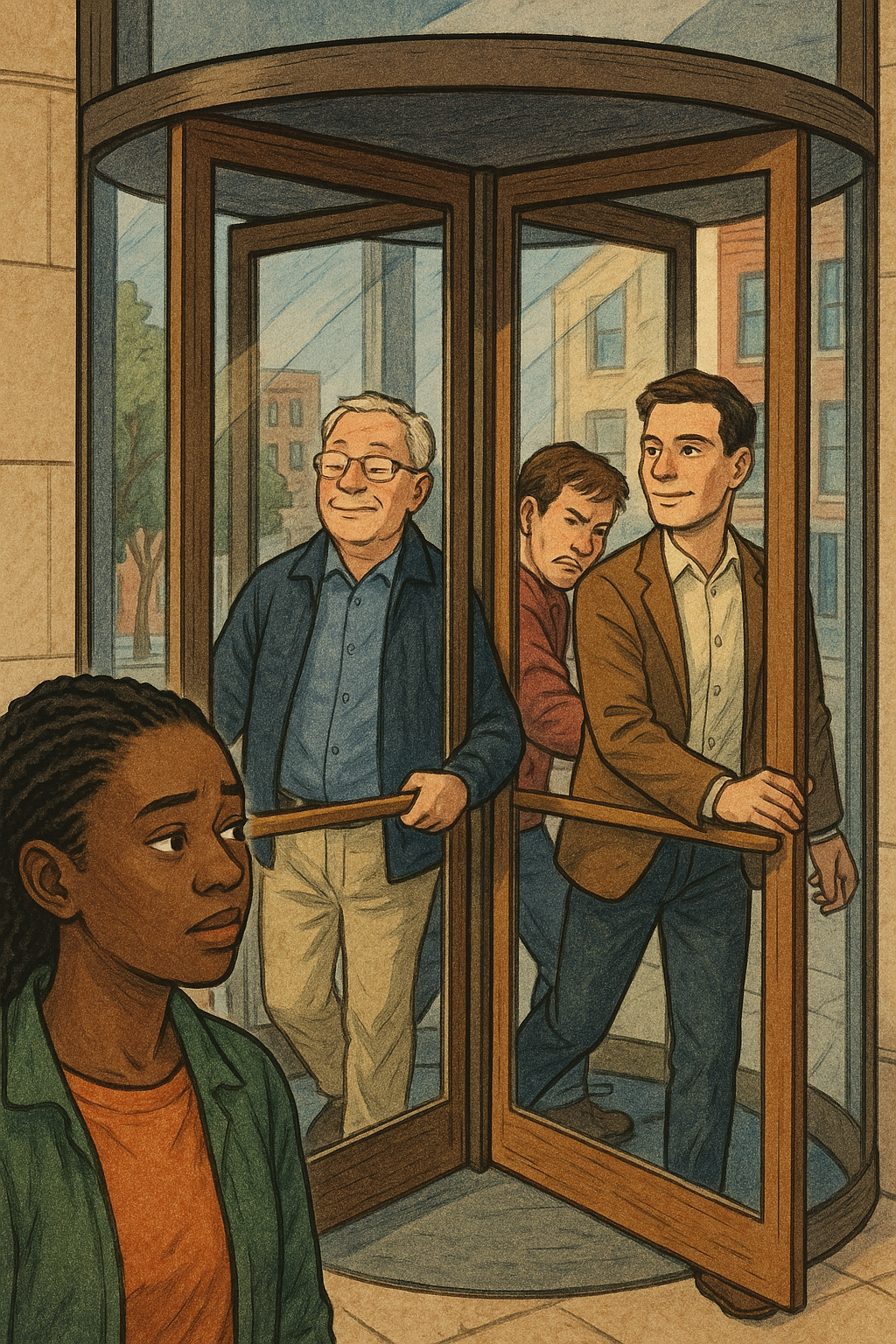
A revolving door captures the central action here — one of those heavy glass-and-wood rotating doors you'd find at the entrance to an office building, hotel, or department store. Three people are caught mid-rotation inside the door's compartments. An older man with white hair and glasses stands in one section wearing a blue button-down and khakis, looking calm and slightly amused. In the adjacent compartment, a younger man in a brown blazer steps forward with an easy smile, while behind him another man in a rust-colored jacket is hunched over, frowning, clearly stuck in an uncomfortable position.
Outside the door, a young woman in a green jacket over an orange shirt watches the scene. Her expression is hard to read — perhaps waiting her turn, perhaps observing the awkward dance of who gets through and who gets stuck. The street behind the door shows ordinary urban buildings, trees, the kind of nondescript downtown block you'd walk past without a second glance.
The revolving door itself is the star. It's a perfect mechanical wheel, constantly turning, moving people in and out whether they're ready or not. Some ride it smoothly. Others get caught in the wrong section at the wrong moment.
The modern read
This illustration cuts straight to what the Wheel of Fortune actually means in daily life: you're not the only one controlling your circumstances. The revolving door doesn't care if you're ready. It keeps turning. The three men inside are all in the same mechanism, but their experiences couldn't be more different — one's comfortable, one's moving forward with ease, one's cramped and frustrated. Same door, same rotation, different outcomes based on timing and position.
The woman outside adds another layer. She hasn't entered yet. She's watching, maybe calculating when to step in. This is the Wheel's real lesson: you can't stop it from turning, but you can pay attention to its rhythm. Sometimes the smartest move is waiting for the right compartment to come around rather than forcing yourself into whatever's available.
How it connects to the Rider-Waite-Smith
The traditional RWS Wheel of Fortune shows a large wheel suspended in the sky, inscribed with letters and alchemical symbols. Three creatures ride it: a sphinx at the top holding a sword, a snake descending on one side, and Anubis rising on the other. Four winged figures sit in the corners reading books — the lion, bull, eagle, and human representing the fixed signs of the zodiac. It's cosmic, fate-driven, suggesting forces far beyond human control spinning the wheel while we rise and fall with it.
This modern version strips away the mysticism but keeps the core mechanic. The revolving door is a wheel, literally. The three men are the figures rising and falling — one up, one stable, one down — just like the snake, sphinx, and Anubis. What's shifted is scale: instead of cosmic fate, this is everyday fate. Job promotions, lucky breaks, wrong-place-wrong-time moments. The woman watching from outside echoes those four corner figures — an observer who understands the pattern, biding her time, reading the situation.
Upright meaning
The Wheel of Fortune upright means things are changing, and you're not fully in control of the direction. This isn't bad news — it's just reality. The wheel turns for everyone.
In love: You meet someone through pure chance — a canceled flight, a friend's party you almost skipped. Or an existing relationship shifts because external circumstances change: one of you gets a job offer in another city, a family situation reshapes your priorities. You didn't plan this. Now you adapt.
At work: A promotion opens up because someone unexpectedly quit. A project you had nothing to do with suddenly needs your skills. Or the company restructures and your role expands. You didn't earn this through grinding harder — you were in the right place when the door swung open.
With money: An investment pays off more than expected. You inherit something. A side gig takes off because it hit the market at the right moment. Or on the flip side, a reliable income stream dries up because the industry shifted. Fortunes change.
In daily life: Traffic makes you late, and that delay means you miss something bad. A random conversation leads to an opportunity. You move apartments and your whole social circle shifts as a result.
Reversed meaning
Reversed, the Wheel of Fortune points to resistance, stagnation, or bad luck you're making worse by fighting against circumstances you can't control. The door is still turning, but you're stuck pushing against it instead of moving with it.
In love: You keep trying to force a relationship that circumstances keep interrupting. Long-distance isn't working, schedules never align, life keeps throwing obstacles — but instead of reading the pattern, you exhaust yourself insisting it should work anyway. Or you're clinging to someone from a past chapter because you refuse to accept that season is over.
At work: You're in a job or industry that's clearly declining, but you won't look elsewhere. Or you keep missing opportunities because your timing is off — arriving too late to projects, not seeing openings until they've closed. There's also the version where you blame bad luck for everything while ignoring what you could actually change.
With money: Poor timing on investments — buying high, selling low, jumping into things right before they tank. Or financial stagnation because you're waiting for a lucky break instead of making moves. Expecting the wheel to just hand you something.
In daily life: Everything feels stuck. Same patterns repeating. You might be the one keeping them stuck by refusing to accept that change is necessary, or by insisting on controlling things that were never yours to control.