The Hanged Man
What the image shows
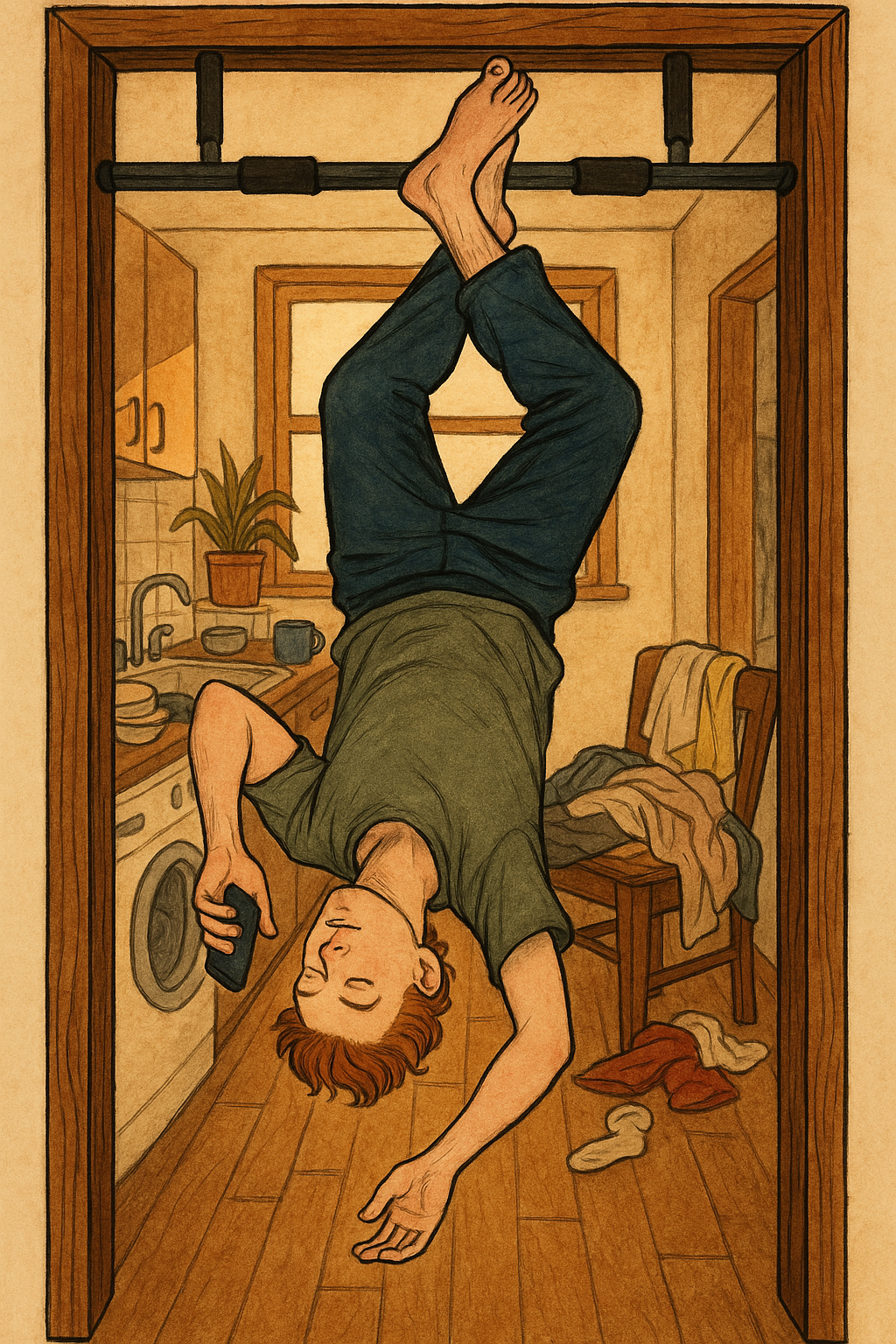
A bearded man hangs upside down in a doorway, his feet hooked over a pull-up bar mounted in the door frame. He's wearing dark blue sweatpants and an olive green t-shirt—casual, lived-in clothes. His eyes are closed, expression peaceful rather than strained. One arm dangles loosely toward the wooden floor while the other hand holds what looks like a phone, though he's clearly not using it.
The setting is a small, slightly cluttered apartment kitchen. There's a washing machine, a sink with dishes, a potted plant on the windowsill, a wooden chair with clothes draped over it. Socks and what might be slippers are scattered on the floor. Natural light comes through a window in the background. Everything about this space says "regular person's home"—not pristine, not a disaster, just lived-in.
The man isn't exercising. He's just... hanging there. Suspended. Taking a pause in the middle of an ordinary domestic space, choosing stillness in a room full of tasks that could be done.
The modern read
This illustration nails the core truth of The Hanged Man: sometimes you have to stop doing to actually see clearly. This guy isn't being forced into this position—he chose it. He has a phone in his hand but he's not scrolling. There are dishes to wash, laundry to fold, and he's decided that right now, none of that matters. He's opted out of productivity.
Placing this card in a mundane kitchen rather than some dramatic cliff or ancient tree makes the point sharper. You don't need a life crisis to need a pause. The suspension happens in regular life, between the dirty dishes and the pile of clothes. It's about recognizing that sometimes the most useful thing you can do is absolutely nothing—even when your to-do list is staring you in the face.
How it connects to the Rider-Waite-Smith
The traditional RWS Hanged Man shows a figure suspended by one foot from a wooden T-shaped structure (often interpreted as the World Tree). His other leg is bent behind him, forming a triangle. His hands are behind his back, and a golden halo surrounds his head. Despite his predicament, his face is serene. The background is typically plain gray, emphasizing the figure's isolation and altered state.
The modern version keeps the essential elements: voluntary suspension, peaceful expression, the sense that this pause is chosen rather than punished. The pull-up bar replaces the mystical tree, domestic clutter replaces the empty void. What's shifted is the context—this isn't spiritual martyrdom or cosmic trial, it's a guy who decided to hang upside down in his kitchen because he needed a different perspective. The halo is gone, but the calm face remains. The message stays the same: surrender isn't defeat, and sometimes you gain everything by letting go.
Upright meaning
The Hanged Man upright is about voluntary pause, seeing things from a new angle, and accepting that some situations can't be forced. It's the card of strategic waiting—not giving up, but recognizing that pushing harder right now won't help.
In love: You've been trying to "fix" a relationship problem through constant conversations and effort, but nothing changes. The Hanged Man says stop pushing. Give it space. Let your partner come to their own realizations without you engineering the outcome.
At work: A project is stalled and no amount of overtime is moving it forward. This card says step back. Take a mental health day. The solution will come when you stop white-knuckling it. Sometimes the best work move is doing nothing work-related.
With money: You're waiting on a decision—a loan approval, a job offer, an investment to mature. The Hanged Man says this isn't the time to make aggressive moves or panic. The waiting is part of the process.
In daily life: You keep trying the same approach to a problem and getting the same results. This card is telling you to flip your perspective entirely. What looks like a setback might be protecting you from something. What feels like failure might be redirection.
Reversed meaning
Reversed, The Hanged Man points to stalling, resistance to necessary change, or martyrdom without purpose. You're either stuck because you refuse to let go, or you're sacrificing yourself for no good reason.
In love: You're staying in a relationship that isn't working because you've "invested so much time." That's sunk cost fallacy, not loyalty. The reversal asks: what are you actually gaining from this sacrifice?
At work: You keep waiting for the "right moment" to make a change, ask for a raise, or start that project. The right moment isn't coming. Your pause has become procrastination dressed up as patience.
With money: You're paralyzed by analysis. You've researched every option, read every review, and still haven't made a decision. Meanwhile, opportunities pass. Sometimes an imperfect choice beats no choice.
In daily life: You're playing the victim. "I have no choice," "I'm trapped," "There's nothing I can do." The reversed Hanged Man says that's a story you're telling yourself. You have more agency than you're admitting.