
Six of Swords
What the image shows
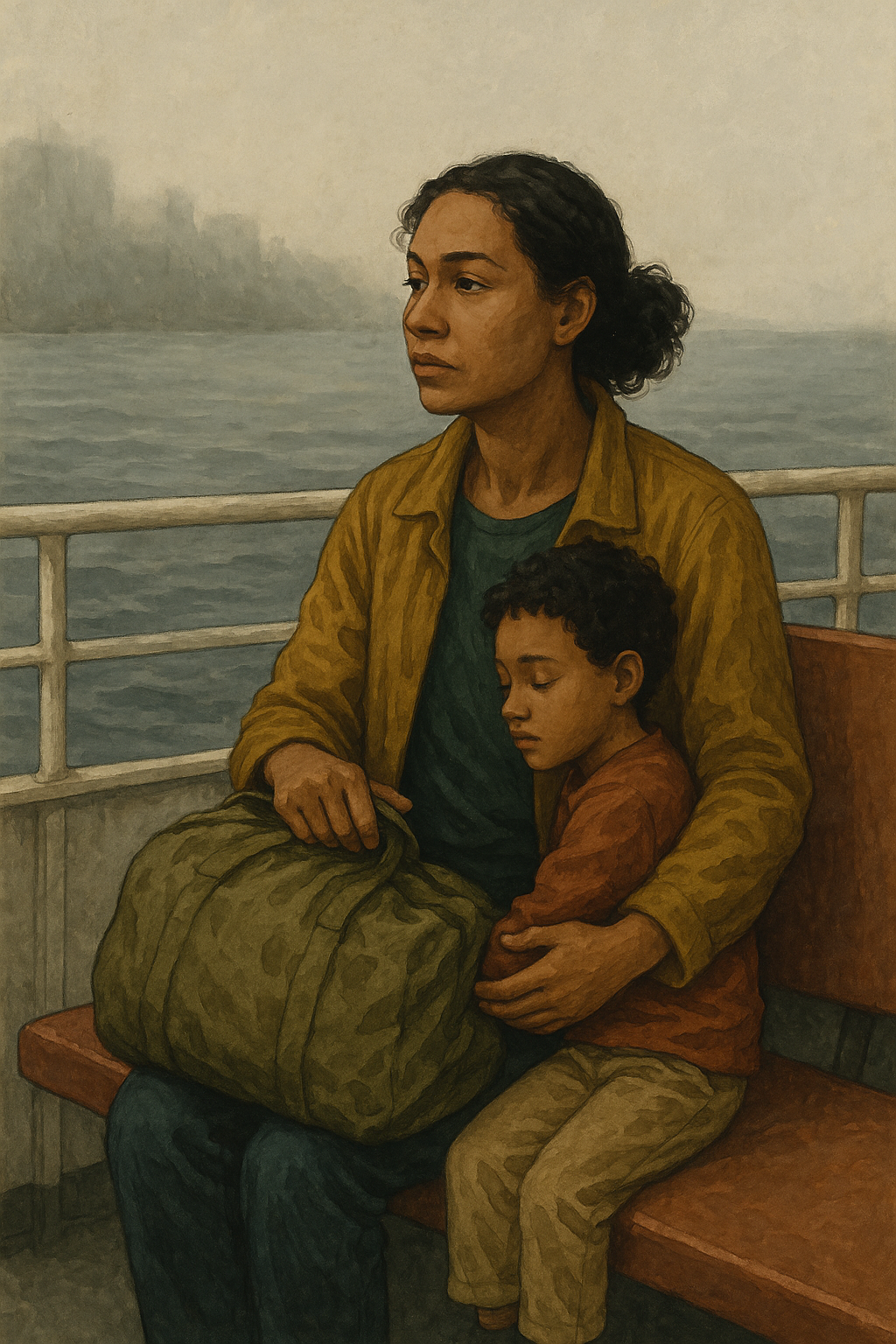
A woman sits on a ferry bench, her gaze fixed on the distant shoreline through the haze. She wears a mustard-yellow jacket over a dark teal shirt, her dark curly hair pulled back loosely. One hand rests on a large olive-green duffel bag beside her, the kind you pack when you're not sure how long you'll be gone. Her expression is steady but heavy—not crying, not smiling, just somewhere in between.
Tucked against her side, a young child in a rust-colored sweater sleeps with their head against her chest. The child's eyes are closed, face peaceful, completely trusting that wherever they're going, it's the right direction. Behind them, the water is gray-blue and choppy, and a city skyline emerges through the fog—indistinct, like a memory you're already starting to forget.
The bench is simple wood and metal, the ferry railing utilitarian. Nothing about this scene is dramatic or cinematic. It's Tuesday afternoon transportation, the kind of crossing people make when they're leaving something behind and don't have the luxury of looking back.
The modern read
This illustration captures what the Six of Swords actually feels like in the body: the exhaustion of choosing to leave, the weight of carrying someone else through your transition, the strange quiet that comes after a hard decision. The woman isn't celebrating her departure or grieving it theatrically. She's just doing it. That's the card's real message—sometimes moving on isn't triumphant, it's just necessary.
Placing this on a ferry instead of a mystical boat ride makes the meaning unmistakable. This is about real logistics, real bags packed, real kids who need to nap while the adults figure out what comes next. The foggy skyline suggests she can't see her destination clearly yet, but she's headed there anyway. The Six of Swords isn't about knowing where you'll land—it's about trusting that anywhere is better than where you were.
How it connects to the Rider-Waite-Smith
The traditional RWS Six of Swords shows a cloaked figure being ferried across water by a boatman, with a small child sitting in the boat. Six swords stand upright in the hull, and the water shifts from choppy on one side to calm on the other. The passengers face away from the viewer, moving toward an unseen shore. The image suggests passage through difficulty toward peace, with the swords representing the mental baggage being carried along.
This modern version keeps the core elements intact: a woman and child crossing water, heading toward an unclear destination, carrying what they can. The duffel bag replaces the swords as the visible burden—practical, tangible, stuffed with whatever she could grab. The ferry replaces the boatman, making this a journey she's navigating herself. What's shifted is the intimacy; we see her face, her weariness, her resolve. She's not a passive passenger being rowed somewhere. She's the one who bought the ticket.
Upright meaning
The Six of Swords upright means you're moving away from a painful situation toward something more stable. This isn't a dramatic escape—it's a measured departure. You've assessed the damage, decided you can't fix it, and chosen to leave. The transition might feel sad or numb rather than exciting, and that's normal.
In love: You're ending a relationship that stopped working, or you're both agreeing to let go of old arguments and start fresh. It's the drive home after finally signing divorce papers, or the conversation where you both admit the fighting needs to stop.
At work: You're leaving a toxic job, transferring to a new department, or finishing a project that drained you. You're not celebrating yet—you're just relieved it's over.
With money: You're moving to a cheaper apartment, consolidating debt, or finally leaving a financial mess behind. The belt is still tight, but you can see a path out.
In daily life: You're recovering from something hard—an illness, a loss, a rough patch. You're not back to normal, but you're functional. You're getting through the days.
Reversed meaning
Reversed, the Six of Swords indicates you're stuck in a situation you know you should leave, or you're trying to move on but keep getting pulled back. The ferry is stalled, the crossing isn't happening, and you might be sabotaging your own departure.
In love: You keep going back to the ex who hurt you. You say you're done, but you answer the texts. Or you're physically out of the relationship but mentally still living in it, replaying every fight.
At work: You know the job is destroying you, but you won't apply elsewhere. You're convinced yourself it might get better, or you're too scared of the unknown to leave.
With money: You're avoiding dealing with the financial problem—not opening bills, not making a plan, hoping it somehow resolves itself. Or you're trying to escape debt by making more rash decisions.
In daily life: You're refusing to accept that something is over. You're stuck in denial, nostalgia, or circular thinking. The bags are packed but you won't walk out the door.