
Seven of Swords
What the image shows
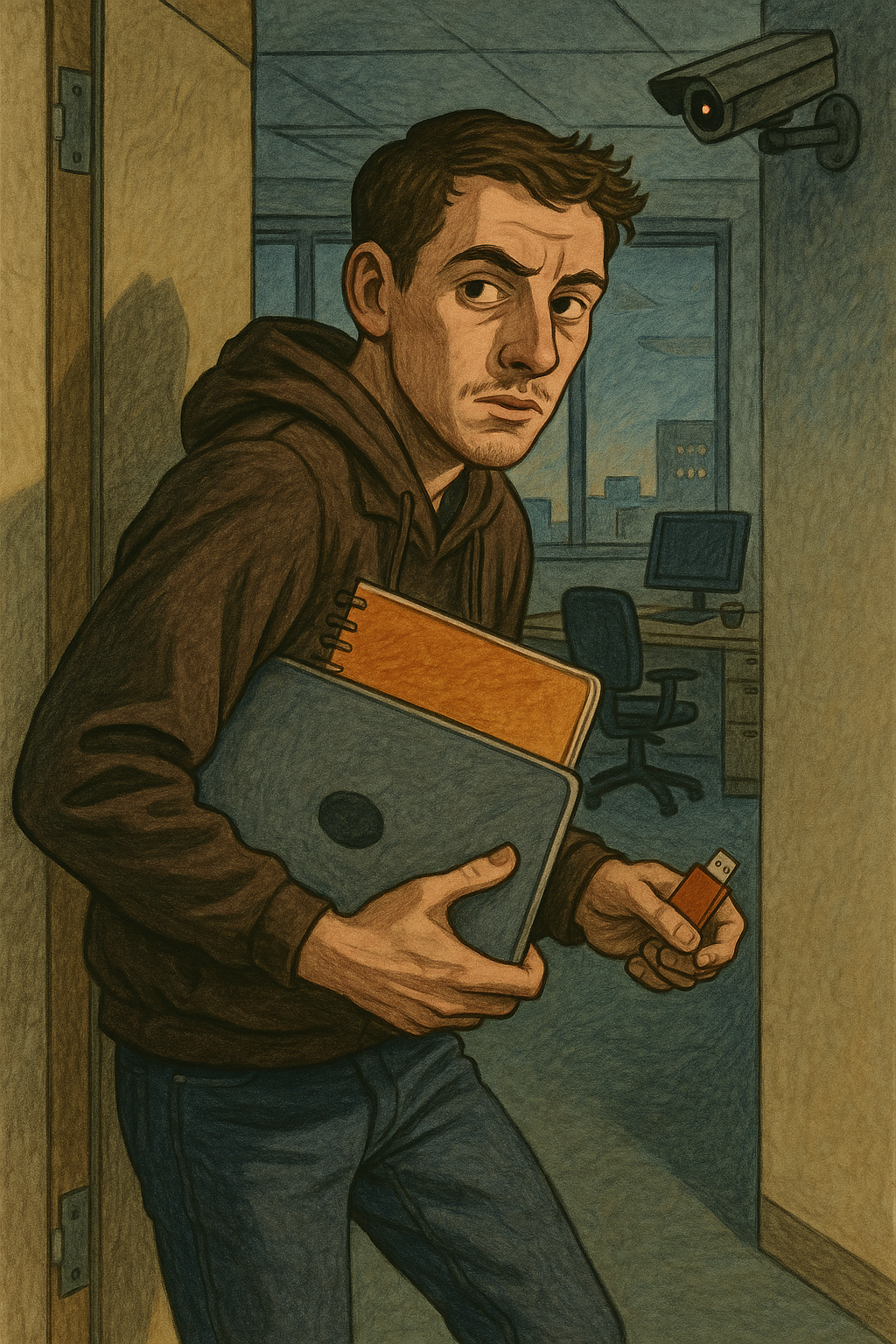
A man in a dark hoodie moves through a doorway, caught mid-step as he exits what looks like a corporate office. He's carrying a laptop tucked under one arm and a spiral-bound notebook, while his other hand grips a USB drive. His expression is tense, watchful—he's glancing back over his shoulder with the look of someone who knows they shouldn't be doing what they're doing.
Behind him, the office sits empty in dim evening light. There's a desk with a computer monitor, an office chair, and windows showing a city skyline at dusk. The space has that after-hours quiet of a workplace everyone else has left. Most notably, a security camera with a glowing red light is mounted in the upper corner, pointed right at him.
The details tell the story: this isn't a violent crime, it's a calculated one. The USB drive suggests data theft. The notebook could be proprietary information. Everything about his body language—the hunch of his shoulders, the furtive backward glance—says he knows exactly what he's taking and exactly why he shouldn't be.
The modern read
This illustration nails what the Seven of Swords actually looks like in contemporary life: intellectual property theft, corporate espionage, the quiet betrayal that happens when someone decides the rules don't apply to them. It's not dramatic or violent. It's someone walking out with things that don't belong to them, betting they're clever enough to get away with it.
The security camera adds a layer the traditional card doesn't have—the suggestion that getting away with something isn't guaranteed. Modern life has more witnesses than we think. This version of the Seven of Swords asks: what are you taking that isn't yours, and are you really as unobserved as you believe?
How it connects to the Rider-Waite-Smith
The traditional RWS Seven of Swords shows a figure sneaking away from a military encampment, carrying five swords awkwardly while two remain stuck in the ground behind him. He's got a self-satisfied smirk, moving on tiptoe, clearly pleased with his own cleverness. The encampment in the background suggests he's stealing from his own side—betrayal from within rather than an outside attack.
This modern version keeps the core DNA: someone taking what isn't theirs, the furtive body language, the sense of "getting away with it." What's shifted is the context—corporate theft instead of battlefield plunder—and the addition of surveillance. The RWS thief looks smug; this one looks nervous. The modern read acknowledges that deception has consequences and witnesses, even when we think we're being clever.
Upright meaning
The Seven of Swords upright is about deception, shortcuts, and strategic thinking that crosses ethical lines. Someone is being sneaky—that someone might be you, or it might be someone in your situation. This card shows up when there's lying, stealing (of ideas, credit, or actual things), or manipulation happening.
In love: Your partner is hiding something—maybe not an affair, but something they know you wouldn't approve of. Or you're the one keeping secrets, telling yourself they're "for the best." Someone's not being straight.
At work: A coworker takes credit for your idea in a meeting. Someone's padding their expense reports. You're tempted to cut corners on a project because no one will notice. This card is office politics at its most underhanded.
With money: Tax evasion. Hidden accounts. "Forgetting" to mention certain income. Financial moves that rely on no one looking too closely.
In daily life: Calling in sick when you're not. Lying about why you can't make it to something. The small deceptions we tell ourselves don't count—until they do.
Reversed meaning
Reversed, the Seven of Swords points to deception unraveling. The scheme falls apart. The lie gets discovered. Or it can mean someone who keeps trying the same manipulative tactics even though they've stopped working—a con artist who doesn't know when to quit.
In love: The affair comes to light. The gaslighting stops working because your partner finally sees through it. Or you realize you've been lying to yourself about a relationship that isn't what you pretended it was.
At work: The credit-stealer gets called out. An audit reveals the shortcuts. Someone's reputation for being "strategic" shifts to being known as untrustworthy. The chickens come home to roost.
With money: Financial deception gets discovered—overdue bills surface, hidden debt comes out, the IRS sends a letter. Schemes that depended on no one checking the math get checked.
In daily life: You get caught in a lie and have to deal with the fallout. Or you finally decide to come clean about something because carrying the deception has become exhausting. The reversed Seven can be the moment you choose honesty because sneaking around stopped being worth it.