Eight of Swords
What the image shows
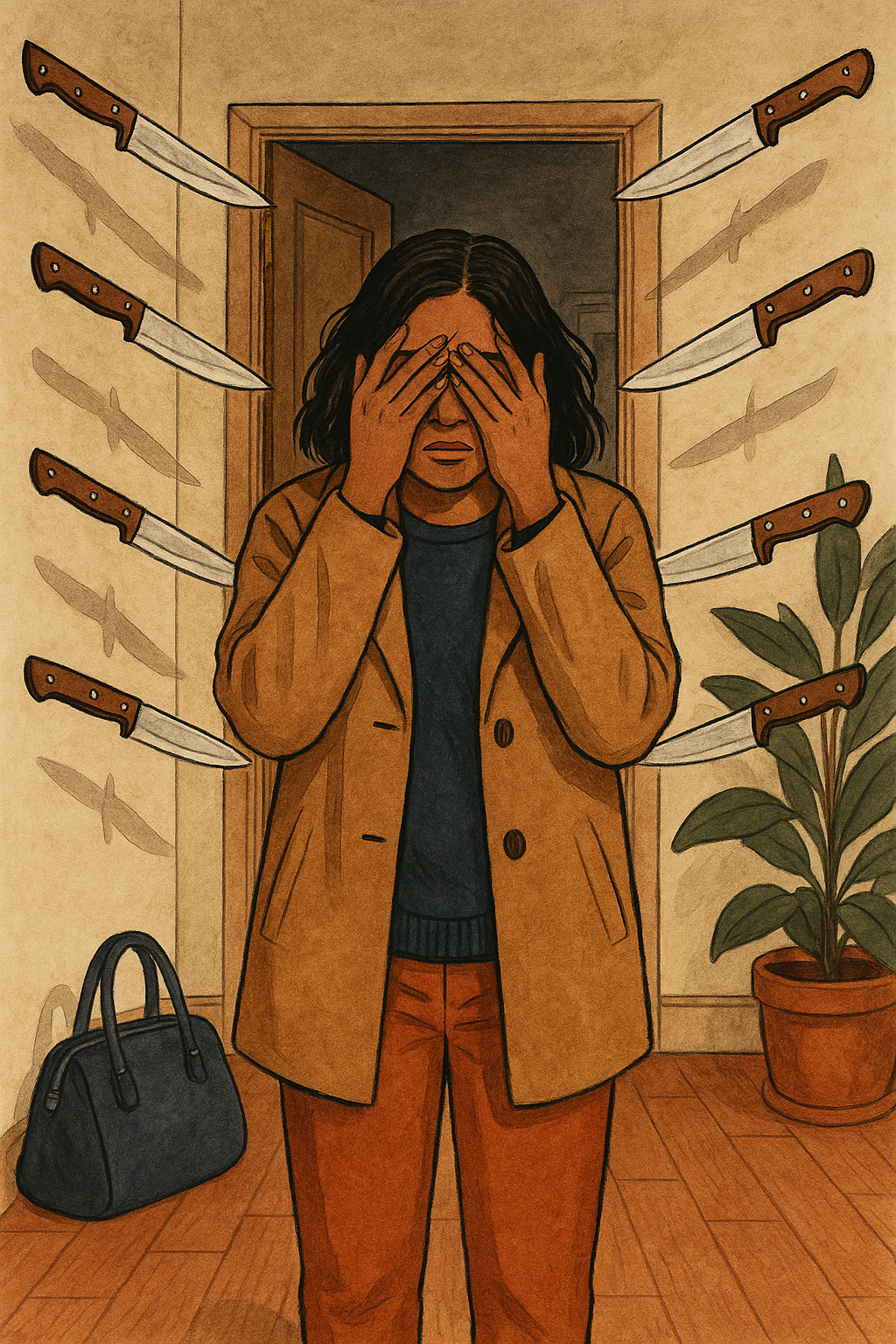
A person stands in what looks like an entryway or hallway of a home, hands pressed firmly over their eyes. They're wearing a tan coat over a dark sweater and rust-colored pants — dressed to go somewhere, with a handbag sitting on the floor beside them. But they're not going anywhere. They've stopped just inside the door, blocking out whatever they don't want to see.
Kitchen knives float in the air around them, pointed inward from both sides. Eight of them, arranged in rows, blades aimed at the figure but not touching. The knives cast faint shadows on the warm yellow walls. Behind the person, an open doorway leads to another room. A potted plant sits to the right — ordinary domestic details that make the threat of the knives feel even more surreal.
The person isn't bound or physically trapped. The door is right behind them. But with their eyes covered, they can't see that the knives aren't actually touching them, and they can't see the exit. They've made themselves blind to both the danger and the way out.
The modern read
This illustration nails what the Eight of Swords actually feels like: standing in your own home, surrounded by threats that may or may not be real, refusing to look. The knives aren't embedded in the walls or held by anyone — they're suspended, almost symbolic. The real problem isn't the knives. It's the hands over the eyes.
By placing this card in a domestic setting — coat still on, bag dropped, clearly just walked in the door — the image says something specific about how we trap ourselves in familiar spaces. This isn't a dramatic prison. It's Tuesday evening, and you've convinced yourself you can't move. The contemporary framing makes the self-imposed nature of the trap impossible to miss.
How it connects to the Rider-Waite-Smith
The traditional RWS Eight of Swords shows a woman bound and blindfolded, standing in mud with eight swords planted in the ground around her. She's near water, a castle visible in the distance. The bindings look loose, the swords don't actually cage her in completely, and if she could see, she might notice she could walk away. The card has always been about perceived entrapment versus actual entrapment.
This modern version keeps the blindness — now self-inflicted with hands over eyes instead of a blindfold placed by someone else. The swords become kitchen knives, domestic and familiar rather than medieval. The loose bindings are gone entirely because the image makes clear that no one is holding this person in place. What carries over is the central tension: the figure could leave, could look, could move. They just don't.
Upright meaning
The Eight of Swords upright says you're stuck because you've convinced yourself you're stuck. The obstacles feel real, the fear is real, but the cage has a door and you're not looking at it. This card shows up when your own thinking has become the trap.
In love: You stay in a relationship that isn't working because you've decided all the alternatives are worse — being alone, starting over, the awkwardness of a breakup. You've stopped examining whether those fears are actually true.
At work: You hate your job but you've told yourself a story about how you can't leave — the market is bad, you're not qualified for anything else, you need the benefits. You haven't actually tested any of these assumptions.
With money: You're paralyzed about a financial decision because every option seems risky. You've researched yourself into analysis paralysis and now you're doing nothing, which is also a choice.
In daily life: You've isolated yourself because social situations feel overwhelming, but the isolation is making everything worse. You know this, and you still can't make yourself reach out.
Reversed meaning
Reversed, the Eight of Swords can go two ways: either you're finally taking your hands off your eyes and seeing the situation clearly, or you're digging in deeper, refusing help, insisting the trap is real even when someone's showing you the exit.
In love: Someone points out that your partner isn't actually that bad, or that your fears about dating again are overblown, and you snap at them. You'd rather stay in the familiar anxiety than consider you might be wrong.
At work: You get offered an opportunity — a new role, a project, a connection — and you turn it down because it's easier to stay in the complaining than to risk change. Or, more positively, you finally update your resume and realize you have more options than you thought.
With money: You keep seeking reassurance about a decision instead of making it. You ask five different people for advice, hoping someone will tell you what to do, so you don't have to take responsibility for the choice.
In daily life: You've become so attached to your limitations that they've become part of your identity. "I'm just not good at that" becomes a shield against trying.