
Nine of Swords
What the image shows
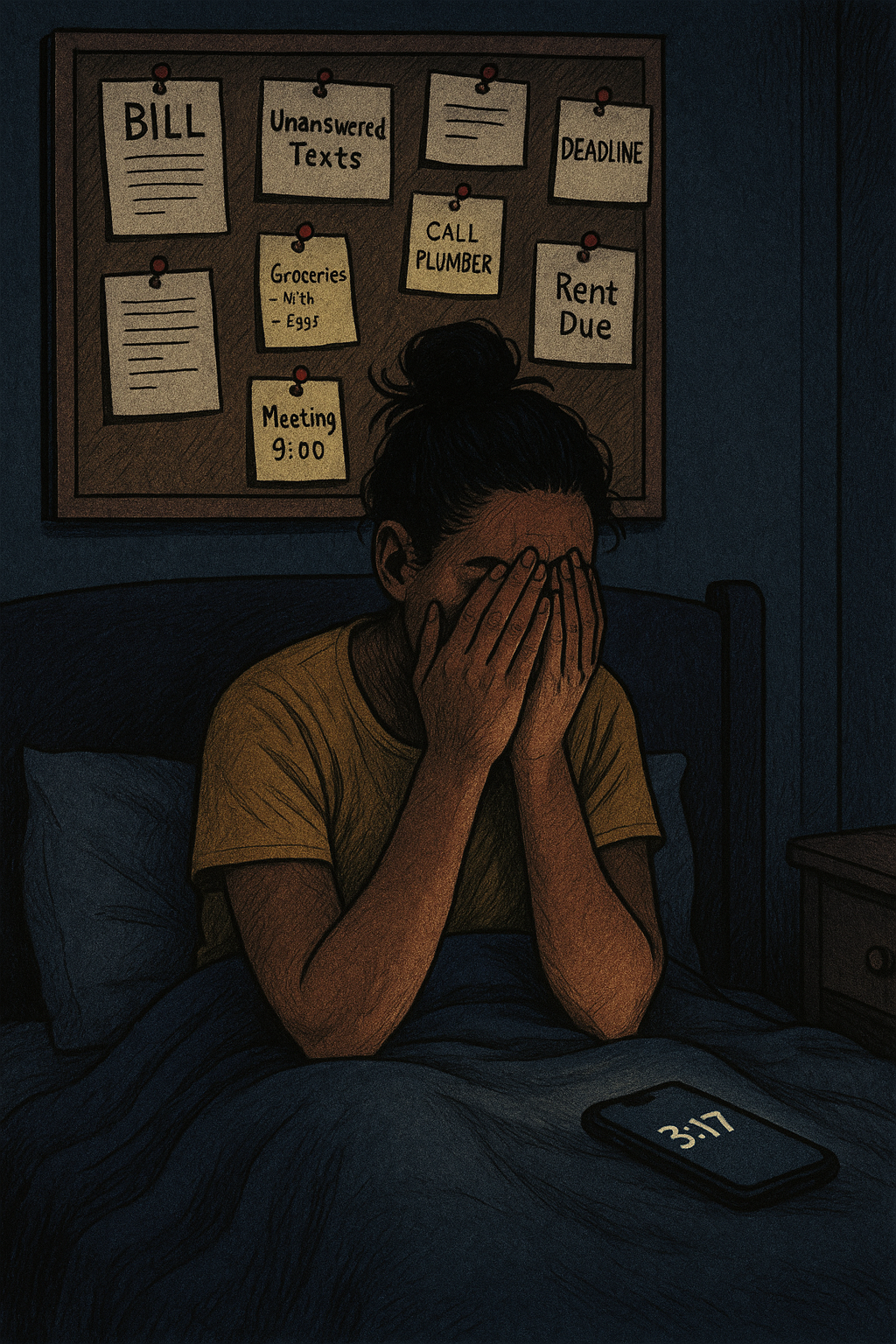
A person sits hunched on the edge of their bed, face buried in both hands. They're wearing a simple yellow t-shirt, hair pulled up in a messy bun—the look of someone who was trying to sleep but gave up. The room is dark, lit only by the glow of a phone lying on the rumpled blue bedsheets. The screen reads 3:17 AM.
Behind them, a corkboard dominates the wall, covered in sticky notes and papers that catalog every source of stress: "BILL," "Unanswered Texts," "DEADLINE," "CALL PLUMBER," "Rent Due," "Meeting 9:00," a grocery list with milk and eggs. Some are formal documents with lines of text, others are hasty handwritten reminders. Red pushpins hold everything in place like wounds.
The composition is claustrophobic. The person is boxed in—bed below, board behind, darkness all around. Even the pillow behind them offers no comfort. This is insomnia as a physical space, where every undone task and looming obligation hangs directly over your head while you're trying to rest.
The modern read
This illustration nails what the Nine of Swords actually feels like: it's 3 AM, you can't sleep, and your brain has helpfully compiled a comprehensive list of everything you're failing at. The corkboard isn't some abstract symbol—it's the mental inventory we all keep, the running tally of responsibilities that feels manageable during daylight but becomes a monster in the dark. The phone glowing with the time is both a comfort object and a tormentor, promising connection but delivering only the knowledge of how many hours you have left before the alarm goes off.
What this modern setting reveals is that the Nine of Swords isn't about actual disasters. Looking at that board, nothing is catastrophic. Bills, groceries, a plumber call, a meeting. These are ordinary life tasks. But anxiety doesn't care about proportionality. At 3 AM, "call plumber" carries the same weight as "rent due." The card isn't about what's actually wrong—it's about the gap between reality and the spiraling narrative in your head.
How it connects to the Rider-Waite-Smith
The traditional RWS Nine of Swords shows a figure sitting up in bed, head in hands, with nine swords hanging horizontally on a black wall behind them. The bed's quilt is decorated with roses and astrological symbols, and carved into the bed frame is a scene of one figure defeating another. The posture is pure anguish—someone jolted awake by nightmares or unable to sleep at all.
This modern version keeps the essential elements: the bed, the late hour, the person in distress, and most importantly, the swords transformed into something that hangs over them. Instead of literal blades, we get paper—which might be worse, because you can't fight a sticky note. The RWS hints at past violence in that bed carving; this version hints at future consequences in those deadlines and bills. Both are about the mind torturing itself. What's shifted is the specificity. We don't have to guess what's tormenting this person. We can read it, item by item, on the wall behind them.
Upright meaning
The Nine of Swords upright is anxiety, insomnia, and mental anguish—specifically the kind you inflict on yourself. This is worry that's out of proportion to the actual problem, fear that feeds on itself, the 3 AM spiral where everything feels impossible. The card doesn't mean something terrible has happened. It means you think something terrible has happened, or will happen, and you can't stop thinking about it.
In love: You sent a text and they haven't replied in four hours, so now you're convinced the relationship is over. You replay every conversation looking for signs you missed. You've written the breakup speech in your head before anything has actually gone wrong.
At work: You made a small mistake in a presentation and now you're certain you'll be fired. You lie awake running through worst-case scenarios instead of just fixing the error tomorrow. Imposter syndrome is eating you alive.
With money: You're behind on one bill and suddenly you're mentally calculating how long until you're homeless. The math doesn't actually add up to disaster, but you can't stop running the numbers in your head at 2 AM.
In daily life: You forgot to text a friend back three days ago and now it's become A Thing. The longer you wait, the worse it feels, but you can't bring yourself to just send the damn message. Small tasks pile up until they feel insurmountable.
Reversed meaning
Reversed, the Nine of Swords can go a few directions. Sometimes it's the anxiety finally breaking—you hit bottom and started climbing out, you got some sleep, you realized your fears were overblown. The reversal can mark the moment you stop catastrophizing and start doing. But it can also indicate suppression: you're pushing down the anxiety instead of addressing it, numbing out, refusing to look at what's actually bothering you.
In love: You're telling everyone you're "fine" after the breakup while crying in your car every day. Or alternatively, you finally stopped obsessing over why they didn't text back and just accepted that people have their own lives.
At work: You've stopped caring about the job that was keeping you up at night—either because you've gained healthy perspective, or because you've checked out entirely and are coasting on autopilot. Context matters here.
With money: You've stopped opening bills because looking at them hurts too much. You've deleted the banking app. The problems haven't gone away; you've just stopped letting yourself see them.
In daily life: You finally talked to a therapist about the anxiety, or you started self-medicating to avoid feeling it. This reversal asks: are you healing or hiding?