
Ten of Swords
What the image shows
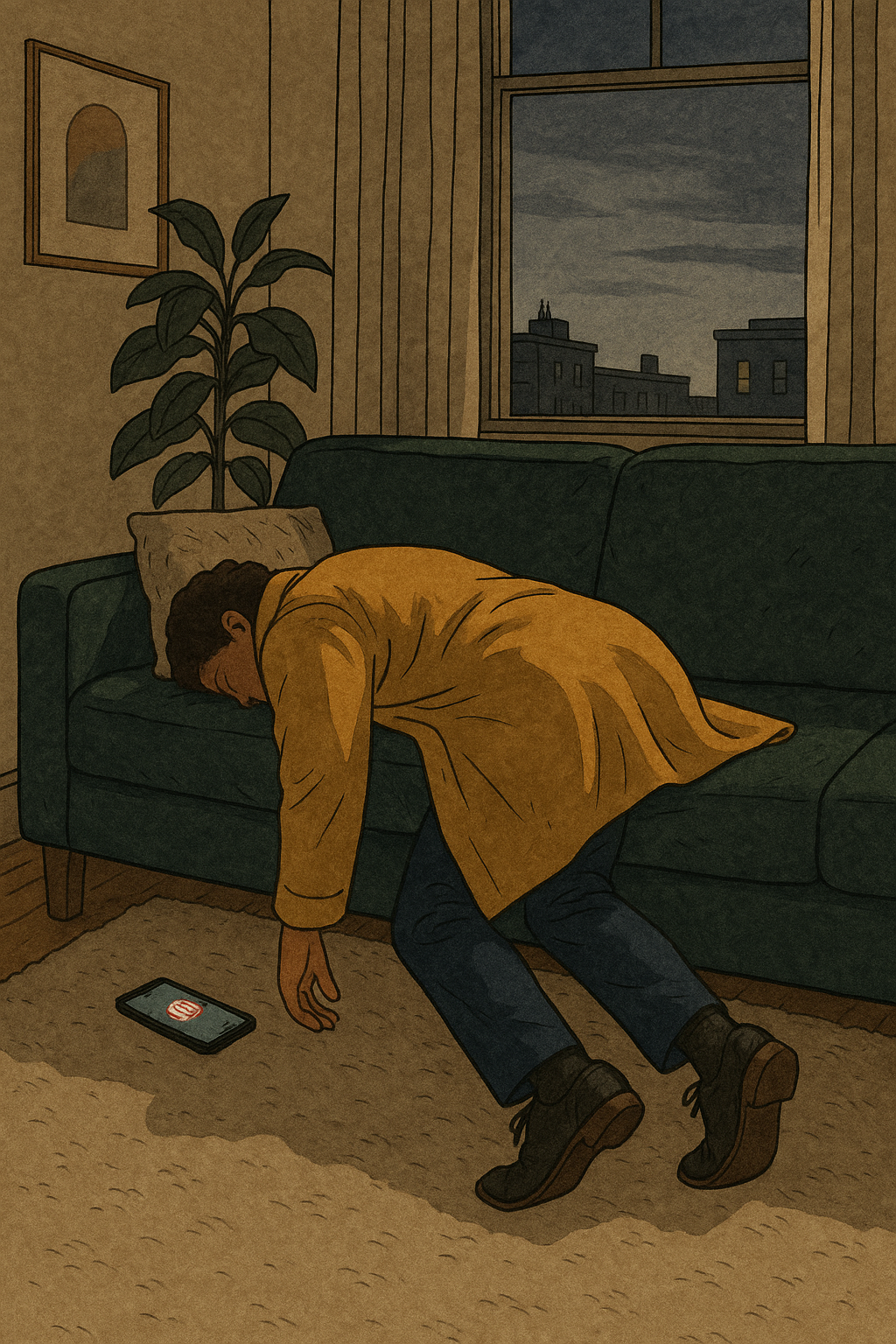
A person in a mustard-yellow sweater and dark jeans has collapsed face-down onto a dark green couch, their body slumped in complete defeat. Their face is buried in a beige pillow, arms hanging limp, one hand nearly touching the floor. Their posture suggests total exhaustion or emotional devastation—this isn't someone taking a casual nap. This is someone who has given up, at least for now.
The setting is a modest apartment in what looks like early evening or dusk. Through the window behind the couch, we can see a grey urban skyline with nondescript buildings. A tall houseplant sits in the corner, and a framed picture hangs on the wall. On the floor near their dangling hand sits a phone or tablet, its screen glowing with what appears to be a notification—perhaps the source of whatever news knocked them flat.
The muted color palette—browns, greens, greys—reinforces the heavy, defeated mood. There's no drama here, no blood, no swords. Just a person alone in their apartment, completely undone by something they saw on that screen.
The modern read
This illustration strips the Ten of Swords down to its emotional core: the moment when you simply cannot take any more. The traditional card shows a dramatic death scene, but most of us experience this card's meaning in quieter, more private ways. Bad news arrives via text. A rejection email lands. You find out something you can't unfind out. And then you collapse on the couch because what else is there to do?
The phone on the floor is the modern sword—the device that delivers the final blow. It could be a breakup text, a layoff notice, a message that confirms your worst suspicions. Placing this scene in an ordinary apartment makes the devastation feel mundane and relatable. This isn't theatrical suffering. This is the kind of defeat that happens behind closed doors, with no audience, just you and the news that leveled you.
How it connects to the Rider-Waite-Smith
The traditional RWS Ten of Swords shows a figure lying face-down on the ground with ten swords plunged into their back. It's a brutal, almost excessive image—overkill, literally. The sky is black, but there's a strip of golden light on the horizon, hinting that this is rock bottom and dawn is coming. The figure is often interpreted as already dead, meaning the worst has already happened.
This modern version keeps the face-down collapse and the sense of total defeat, but removes the violence. The ten swords become a single glowing screen—one device that delivered the killing blow. The golden yellow sweater echoes that strip of hope in the original, a subtle reminder that even this will pass. What's lost is the dramatic finality; what's gained is recognition. We've all been that person on the couch.
Upright meaning
The Ten of Swords upright means it's over. Whatever you were dreading, fighting, or trying to prevent has happened. This is the ending you couldn't avoid—the final blow that puts a definitive stop to a situation. The good news buried in this terrible card: you can stop bracing for impact because impact has occurred.
In love: Your partner admits the affair. The person you've been dating ghosts you completely. You finally accept that the relationship is dead and has been for months.
At work: You get laid off. The project you poured yourself into gets cancelled. You're passed over for the promotion and told it's not happening, period.
With money: The business fails. You check your account and it's worse than you thought. The loan is denied.
In daily life: You hit a wall with your health, your living situation, or a family conflict. Something breaks in a way that can't be fixed, only accepted.
Reversed meaning
Reversed, the Ten of Swords suggests you're either refusing to accept an ending or you're starting to pull yourself up off that couch. It can mean the worst is behind you and recovery is beginning—or it can mean you're in denial about how bad things actually are.
In love: You keep texting your ex even though it's clearly over. You stay in a relationship that ended emotionally years ago. Or, more positively, you're finally ready to date again after a devastating breakup.
At work: You won't acknowledge that the job is making you miserable. You keep trying to revive a dead project. Alternatively, you're dusting off your resume and starting to look forward.
With money: You're ignoring the debt, pretending the financial crisis isn't happening. Or you've hit bottom and are now taking the first steps toward rebuilding.
In daily life: You're dragging out an ending that needs to happen, or you're finally getting off the couch and facing what comes next.