
Seven of Pentacles
What the image shows
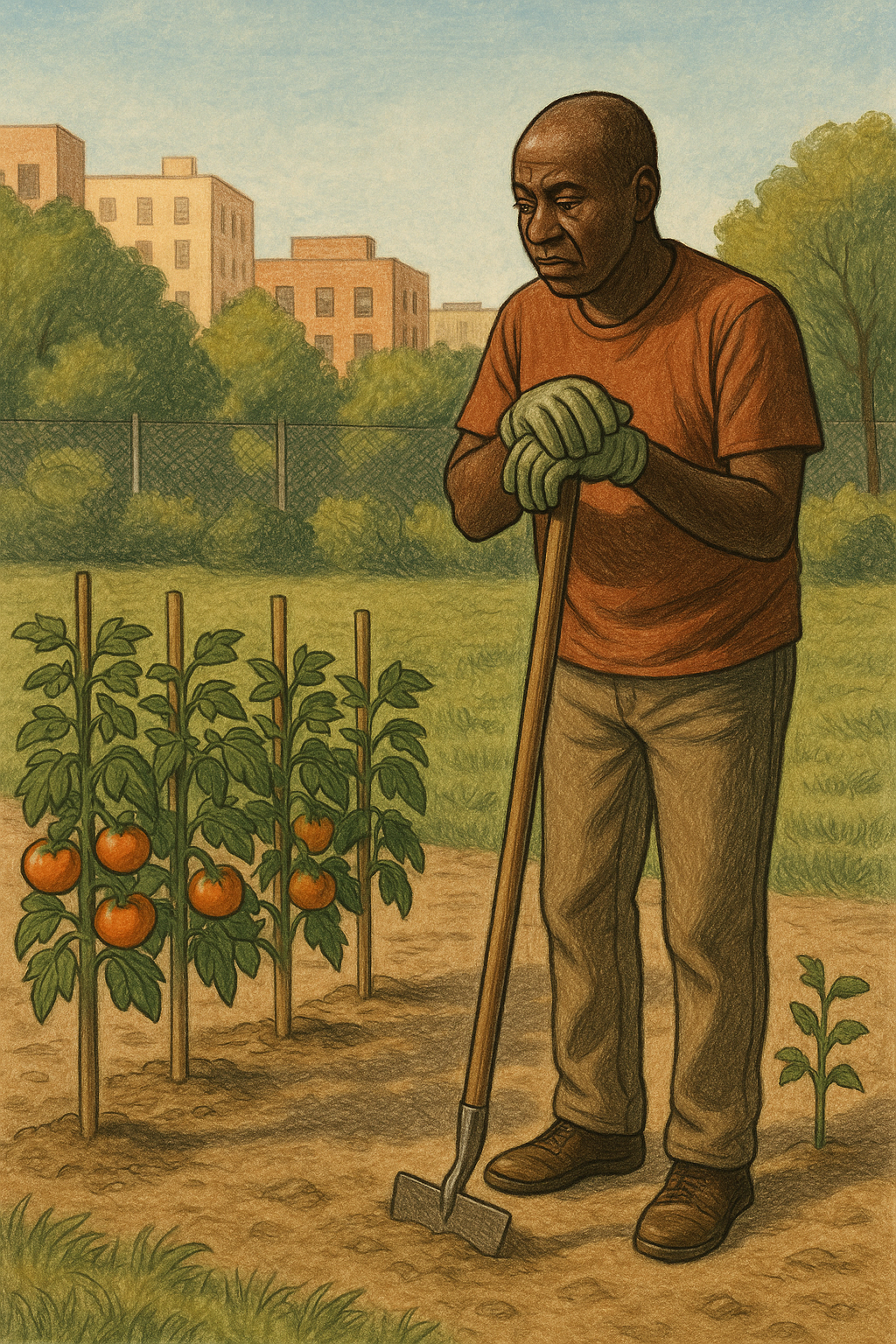
A middle-aged man stands in what appears to be a community garden, leaning on a hoe with both gloved hands. He wears a rust-orange t-shirt, tan work pants, and brown shoes—practical clothes for physical labor. His posture suggests he's paused mid-work, taking stock of what's in front of him rather than actively digging.
To his left, a row of staked tomato plants displays ripe orange fruit ready for harvest. To his right, a single small seedling has just started growing—clearly planted more recently. The contrast between the mature plants and the tiny new one is striking. Behind him, apartment buildings rise beyond a chain-link fence and a line of trees, placing this garden firmly in an urban setting.
His expression is contemplative, almost weary. He's not celebrating the tomatoes or excitedly tending the seedling. He's just standing there, looking at what he's grown, seemingly asking himself whether it's been worth the effort or what comes next.
The modern read
This illustration nails the Seven of Pentacles question: "Is this working?" The man has clearly put in real labor—the tomatoes didn't grow themselves—but now he's at a decision point. Does he keep expanding (that new seedling), or has this whole endeavor been more trouble than it's worth? The community garden setting makes this deeply relatable. It's not about abstract abundance; it's about whether the hours you spent here could have been spent better elsewhere.
The urban backdrop adds another layer. This man probably has a job, a commute, a life beyond this plot. The garden represents something he's chosen to invest his limited time in. That makes the evaluation more honest. You can't romanticize it as pastoral fulfillment when there are apartment buildings right there reminding you of all the other things competing for your attention.
How it connects to the Rider-Waite-Smith
The traditional RWS Seven of Pentacles shows a young farmer leaning on a hoe, gazing at a bush or vine bearing seven pentacles. One pentacle rests at his feet, sometimes interpreted as recent harvest or investment. The figure's posture suggests waiting and assessment rather than active work. The background is simple farmland, keeping focus on the relationship between the worker and what he's cultivated.
This modern version keeps the essential elements: the hoe, the leaning posture, the contemplation of what's been grown. What shifts is the context—urban community garden instead of rural farm—and the addition of the small seedling, which makes the "what now?" question more explicit. The RWS figure could be simply waiting for harvest. This man seems to be weighing whether to invest more or cut his losses. Both capture the pause before a decision, but the modern version emphasizes choice over patience.
Upright meaning
Seven of Pentacles upright is about taking stock before deciding whether to continue. You've put in work—now you're evaluating whether the results justify more effort.
In work: You've been at a project or job for a while and you're asking yourself if this is really going anywhere. Maybe you've been grinding on a side business for two years and it's breaking even but not growing. Time to honestly assess: push harder, pivot, or walk away?
In love: You're several months or years into a relationship and wondering if this is actually what you want long-term. Not a crisis, just a natural checkpoint. Are you building something real or just comfortable?
In money: You check your investment portfolio or savings account and calculate whether your strategy is working. The numbers are fine, but are they good enough given what you're putting in?
In daily life: You've been going to the gym for six months. You're stronger, but not where you hoped. Do you change your routine, hire a trainer, or accept that this pace is realistic?
Reversed meaning
Reversed, this card points to bad judgment about where you're investing your time, impatience that sabotages long-term results, or refusing to honestly evaluate what's not working.
In work: You keep pouring hours into a project that clearly isn't viable because you can't face the sunk cost. Or the opposite—you abandon something right before it would have paid off because you got bored.
In love: You stay in a relationship you know isn't right because you've "already invested three years." Or you bail on someone good because growth feels too slow and you want instant connection.
In money: You panic-sell investments during a dip, or you keep throwing money at a failing business because admitting failure feels worse than losing more.
In daily life: You quit the diet after two weeks because you haven't lost ten pounds yet. You know results take time but you're not willing to actually wait.