
Eight of Pentacles
What the image shows
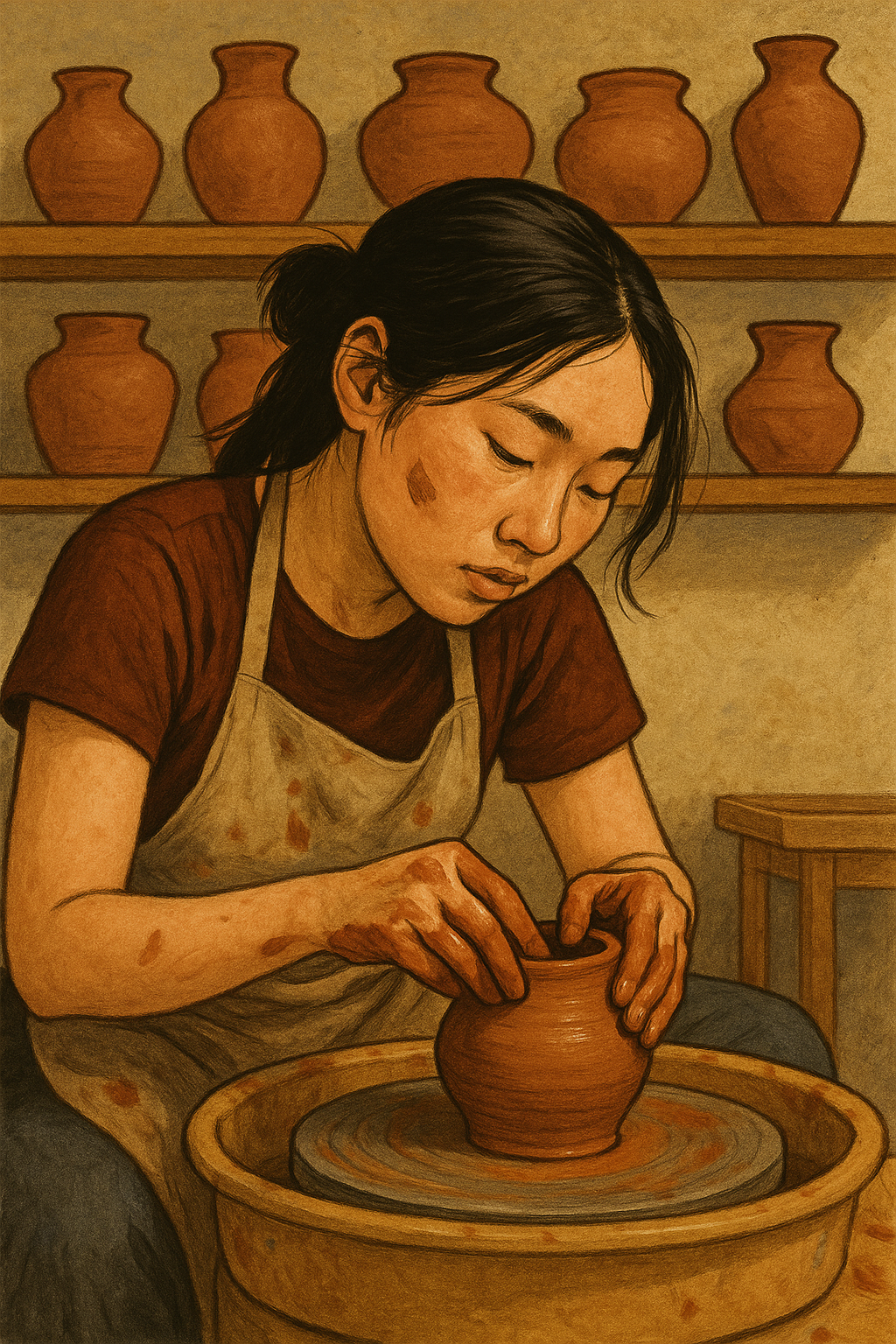
A woman in a clay-spattered apron leans over a pottery wheel, her full attention on the small terracotta vase forming beneath her hands. She wears a simple burgundy t-shirt, and her dark hair is pulled back loosely, a few strands falling free. Her expression is one of complete absorption—eyes focused downward, brow slightly furrowed with concentration. Her hands and forearms are covered in wet clay, showing she's deep into her work, not just starting out.
Behind her, two wooden shelves display rows of finished pots in matching terracotta, all similar in shape but each slightly unique. These aren't displayed like precious art pieces—they're lined up practically, evidence of repeated practice. The workspace is simple and functional: warm ochre walls, a wooden stool visible in the corner, nothing fancy or decorative.
The illustration has a textured, almost grainy quality that gives it warmth and weight. The color palette stays within earthy browns, rusts, and muted yellows, reinforcing the grounded, tactile nature of the work being done. Every detail points to someone in the middle of their craft, not performing for anyone, just doing the work.
The modern read
This illustration strips the Eight of Pentacles down to its essence: skill built through repetition. The potter isn't making one masterpiece—she's making the same form over and over, and those shelves prove it. This is about showing up, doing the reps, and trusting that competence comes from consistency. There's no shortcut visible here, no hack. Just hands on clay, again and again.
Placing this card in a pottery studio makes the message physical and immediate. You can almost feel the wet clay, the resistance of the wheel. It says that mastery isn't glamorous—it happens in quiet rooms, alone, with no audience. The contemporary setting reminds us that this kind of dedication still exists and still matters, whether you're learning to code, practicing a language, or building any skill that requires patience over time.
How it connects to the Rider-Waite-Smith
The traditional RWS Eight of Pentacles shows a craftsman on a wooden bench, carving a pentacle. Six completed pentacles hang on display beside him, one sits at his feet, and he's focused on the eighth. He's often depicted apart from a distant town, suggesting he's stepped away from daily life to focus on his craft. The emphasis is on skilled labor, apprenticeship, and the dedication required to produce quality work.
This modern version keeps the core elements intact: the solitary worker, the evidence of repeated effort (the shelves of pots mirror the displayed pentacles), and the complete focus on the task at hand. What shifts is the medium and the figure—a woman at a pottery wheel instead of a man carving coins. The setting feels more intimate and accessible, less medieval guild and more contemporary studio practice. The message stays the same: mastery requires showing up and doing the work, one piece at a time.
Upright meaning
The Eight of Pentacles upright is about putting in the hours. It's the card of deliberate practice, skill-building, and taking your craft seriously. You're not looking for recognition right now—you're focused on getting better.
In work: You're in learning mode. Maybe you're new to a job and studying everything you can, or you've decided to level up your skills through a course, certification, or just focused practice. You stay late not because you have to, but because you want to understand something fully.
In love: You're putting effort into the relationship itself—learning how to communicate better, reading books on attachment styles, actually trying the things your therapist suggested. It's not romantic in a flowers-and-candlelight way, but it's the work that makes relationships last.
In money: You're investing in yourself. Taking a class that costs money now but pays off later. Building a side skill that could become income. Being strategic about where your resources go.
In daily life: You're showing up consistently for something—gym sessions, a creative project, learning to cook, studying for an exam. Progress is slow but visible. You're not skipping days.
Reversed meaning
Reversed, the Eight of Pentacles points to effort that's gone sideways. Either you're cutting corners, spinning your wheels on busywork, or you've lost the thread of why you started in the first place.
In work: You're going through the motions without actually improving. Maybe you've been at the same skill level for years and haven't pushed yourself. Or you're producing quantity over quality, rushing through tasks just to check them off.
In love: You're not putting in the effort, or you're putting effort into the wrong things. Buying gifts instead of having hard conversations. Saying you'll change without actually changing. The relationship is coasting on autopilot.
In money: You're spending on courses you never finish, tools you never use, or shortcuts that don't work. Money's going out, but skills aren't coming in. There's a gap between what you say you want and what you're actually doing about it.
In daily life: Perfectionism is freezing you in place. You won't start until conditions are perfect, so you never start. Or you've burned out from grinding without rest and now everything feels pointless.