King of Swords
What the image shows
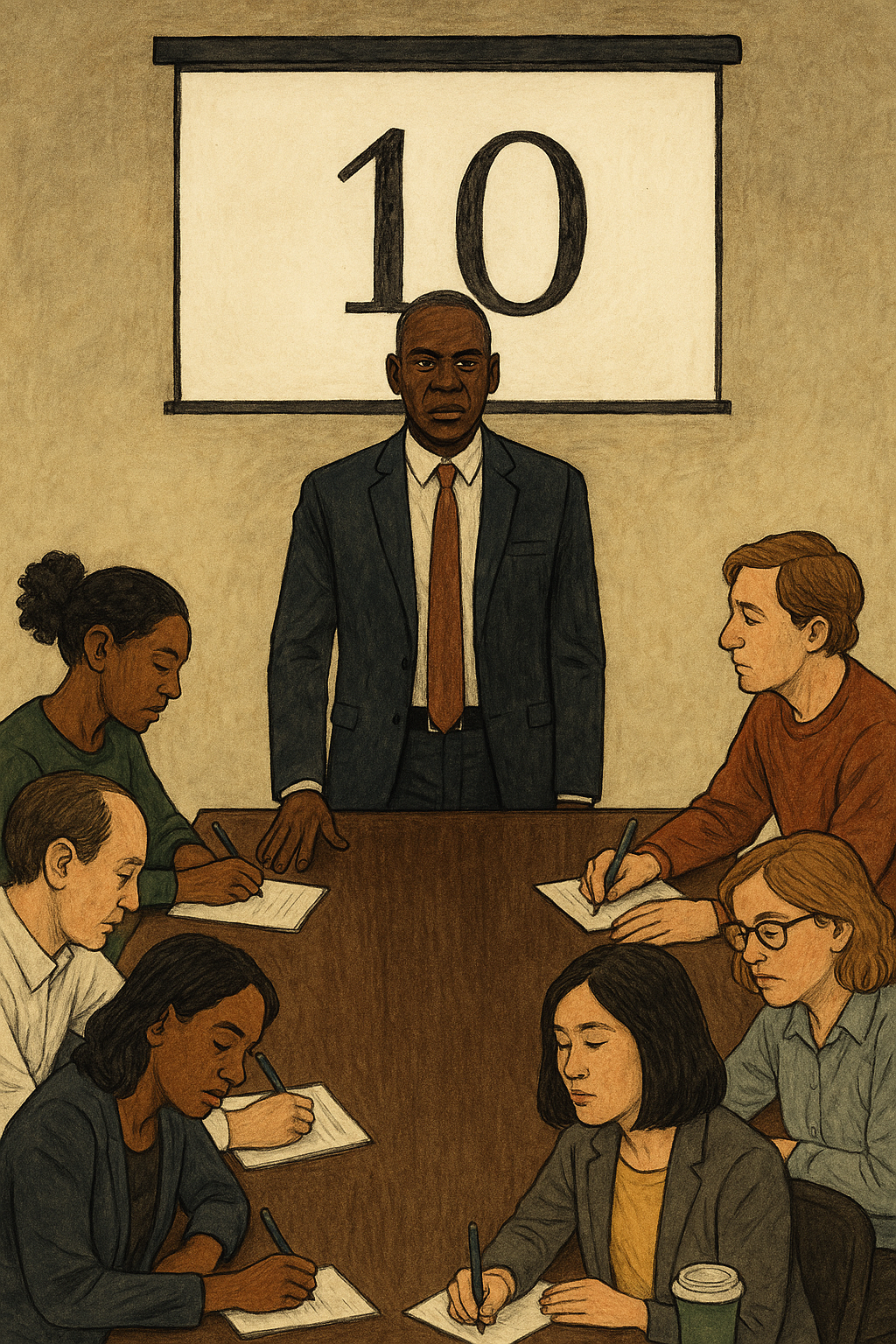
A man in a dark suit and rust-colored tie stands at the head of a conference table, both hands planted firmly on its surface. He's older, with a receding hairline and a serious, evaluating expression—not angry, but absolutely present and in command. Behind him, a screen displays the number "10," suggesting a meeting in progress, perhaps a countdown, a score, or a key metric under discussion.
Around the table sit seven people of varying ages, all focused on their work. Some write on papers in front of them, pens moving. Others listen or observe. The setting reads as a workplace—a boardroom, a planning session, a team assembled for a purpose. No one looks distracted. No one's checking their phone. The man standing has their attention without demanding it theatrically.
The color palette is muted—olive walls, earth tones in the clothing, warm wood of the table. The illustration style has a textured, almost lithographic quality that gives weight to the scene. Everything about the composition centers on the standing figure and his position of authority.
The modern read
This King of Swords is the person who runs the meeting, not through charisma or intimidation, but because they've done the work. They know the numbers. They've thought through the angles. The people around the table aren't cowering—they're engaged, because this leader has earned respect through competence and clarity. The "10" on the screen suggests decisions are being made based on real information, not gut feelings or ego.
Placing this card in a contemporary office strips away the medieval trappings and shows what this king actually does. He's not sitting on a throne waiting to pass judgment—he's in the room, facilitating, directing, cutting through nonsense to get to what matters. This illustration says the King of Swords is about showing up with your homework done and your thinking sharp.
How it connects to the Rider-Waite-Smith
The traditional RWS King of Swords sits rigidly on a stone throne, sword raised in his right hand, left hand resting on his lap. He wears a purple cloak and blue tunic, symbols of both royalty and intellect. Butterflies and sylphs decorate his throne, representing the air element. His expression is stern, assessing. Clouds gather behind him, but he sits above them—he's not swayed by emotional weather. The upright sword indicates clear, uncompromising judgment.
This modern version keeps the core: a figure of intellectual authority making decisions based on analysis, not feeling. The conference room replaces the throne; the team replaces subjects; the presentation screen replaces the sword held aloft. What's shifted is the isolation—the RWS king sits alone, but this one leads a group. The authority is collaborative rather than solitary, though still unmistakably his. The mental sharpness remains, but it's being used to direct others, not just to judge from a distance.
Upright meaning
The King of Swords upright is about clear thinking, honest assessment, and making decisions based on facts rather than feelings. This card shows up when you need to be objective, even when objectivity is uncomfortable.
In love: You're having the direct conversation instead of dancing around the issue. You're asking "where is this actually going?" and meaning it. You might be the one who finally says what everyone's been avoiding.
At work: You're the person who cuts through a rambling meeting to say "here's what we're actually deciding." You're asked for your honest opinion because people know you won't sugarcoat it. You get promoted because you solve problems without drama.
With money: You're looking at your actual numbers—what you earn, what you spend, what you owe—without lying to yourself. You're making a budget that reflects reality, or walking away from a deal that doesn't add up.
In daily life: You're setting a boundary clearly and sticking to it. You're ending a debate with "I've thought about this, and here's where I stand." You're choosing logic over impulse.
Reversed meaning
Reversed, the King of Swords points to intellect misused—cruelty disguised as honesty, rigidity mistaken for principle, or thinking so cold it loses the plot entirely.
In love: You're being harsh and calling it "just being honest." You're winning arguments instead of solving problems. You've become so focused on being right that you've stopped caring about being kind.
At work: You're the boss everyone fears but no one respects—dismissive, cutting, or so obsessed with logic you ignore that people aren't spreadsheets. Or you're the one overthinking every decision until nothing moves forward.
With money: You're so focused on optimization you miss the obvious choice. You're analyzing paralysis—running scenarios forever instead of acting. Or you're being ruthless in negotiations to the point of burning bridges you'll need later.
In daily life: You're shutting people down instead of hearing them out. You've convinced yourself that being cold is the same as being smart. Your "boundaries" have become walls, and your "standards" have become excuses to dismiss everyone.