
Queen of Swords
What the image shows
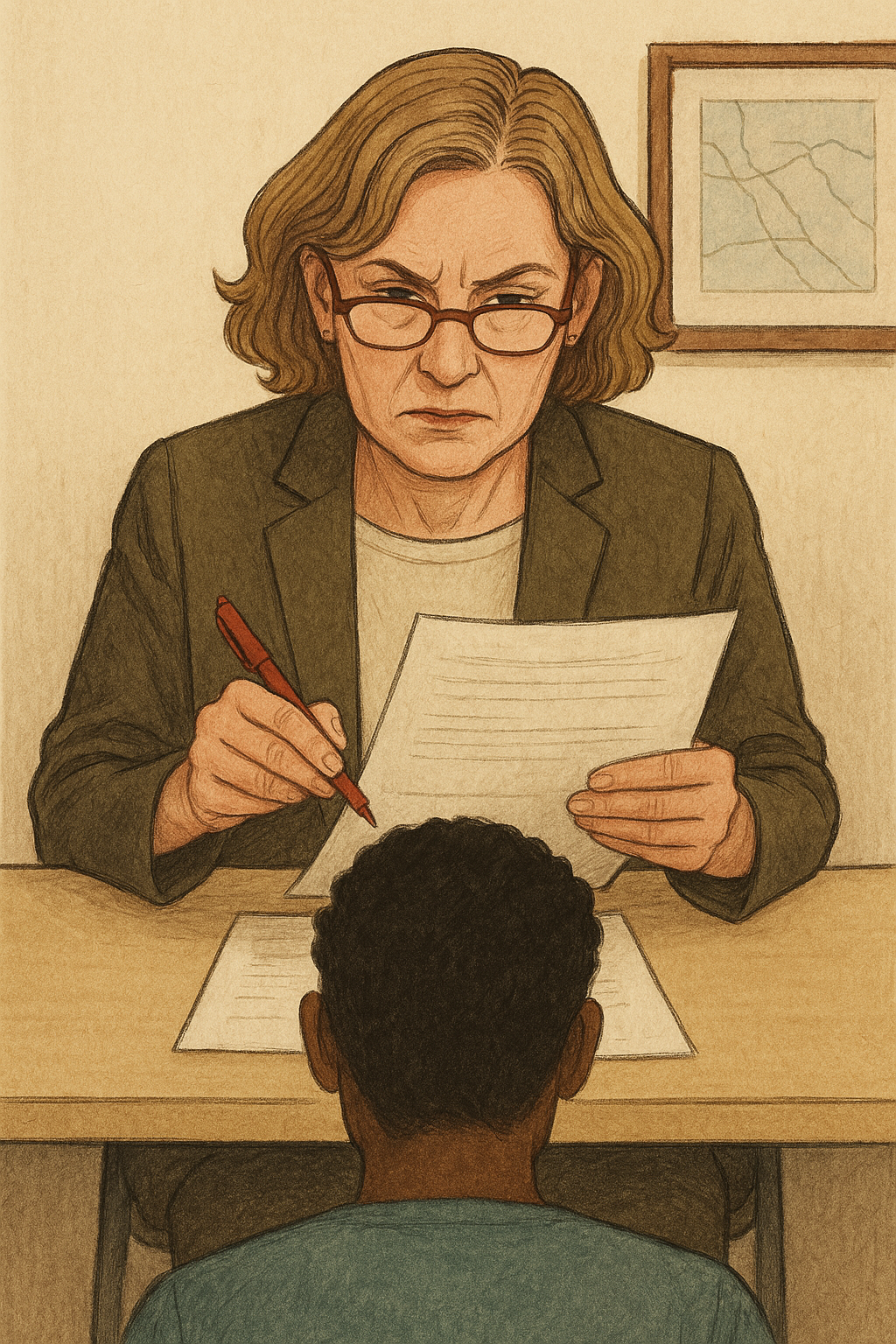
A middle-aged woman sits behind a desk, holding a document in one hand and a red pen in the other. She wears rectangular glasses, a dark olive blazer over a cream top, and her blonde hair falls to her shoulders in a practical cut. Her expression is focused and serious — she's clearly evaluating whatever is written on that page, and she's not impressed. The red pen suggests she's about to make corrections or notes.
Across from her sits another person, seen only from behind — dark curly hair, wearing a teal shirt. They're positioned lower in the frame, on the other side of the desk, in what reads as an interview, performance review, or some kind of formal assessment. A framed picture hangs on the wall behind the woman, and papers are spread on the desk between them.
The power dynamic is clear. The woman controls this interaction. She has the information, the authority, and the pen. Whatever happens next depends on her judgment.
The modern read
This illustration nails the Queen of Swords as the person who cuts through nonsense for a living. She's not cruel, but she's not here to make you feel good either. She's here to assess, to be accurate, and to tell you the truth whether you want to hear it or not. The red pen is perfect — it's the tool of editors, teachers, and anyone whose job is to find what's wrong and fix it.
Placing her in an office setting makes her authority tangible and professional rather than mystical. She's not on a throne in the clouds; she's across a desk with your future in her hands. This version emphasizes that the Queen of Swords shows up in everyday life as the boss who gives honest feedback, the hiring manager who sees through your rehearsed answers, or the accountant who finds the error you missed. Her power comes from competence and clarity, not from rank alone.
How it connects to the Rider-Waite-Smith
In the traditional RWS deck, the Queen of Swords sits on a stone throne decorated with butterflies and a cherub, her sword raised upright in her right hand, her left hand extended as if beckoning or measuring. She wears a stern expression and a crown with a butterfly motif. Clouds gather around her, and a single bird flies in the sky. She's associated with air — intellect, truth, and sometimes sorrow or loss that has sharpened her perception.
The modern version keeps her core qualities: authority, intelligence, and unflinching assessment. The raised sword becomes a red pen — still a tool for cutting, just verbal instead of literal. Her throne becomes a desk, her crown becomes glasses, and her formal robes become a blazer. What carries over is her position of judgment and her refusal to soften the truth. What shifts is the setting — she's no longer isolated on a throne but engaged directly with someone whose work or words she's evaluating.
Upright meaning
The Queen of Swords upright is clear thinking, direct communication, and the ability to assess situations without letting emotions cloud your judgment. She tells you to look at what's actually happening, not what you wish were true.
In love: You're finally seeing a relationship for what it is, not what you hoped it would be. Or you need to have a difficult conversation and deliver it straight — no hedging, no softening it so much the point gets lost.
At work: You're the person who catches the mistake before it ships. You give feedback that stings but helps. Or you're dealing with a boss or colleague who operates this way — take their criticism as information, not as a personal attack.
With money: Time to look at your actual numbers, not your optimistic projections. Cut subscriptions you don't use. Question fees that don't make sense. Be honest about what you can afford.
In daily life: You stop tolerating situations that waste your time. You say no to the commitment you've been dreading. You set a boundary clearly enough that it actually sticks.
Reversed meaning
Reversed, the Queen of Swords points to harsh judgment that crosses into cruelty, or intellect used to cut people down rather than cut through problems. It can also mean you're suppressing what you know to be true because the truth is inconvenient.
In love: You're being cold when the situation calls for warmth. Or you're picking apart your partner's every flaw instead of addressing the real issue. Alternatively, you're staying quiet about something important because you don't want to deal with the fallout.
At work: You've become the person everyone avoids because your feedback destroys rather than corrects. Or you're refusing to acknowledge a problem because admitting it means admitting you were wrong.
With money: You're so focused on cutting costs that you're being penny-wise and pound-foolish. Or you're ignoring financial red flags because you don't want to do the math.
In daily life: You're using logic to justify behavior you know isn't right. You're being dismissive of other people's feelings because you've decided emotions are weakness. Or you've isolated yourself behind a wall of standards no one can meet.