
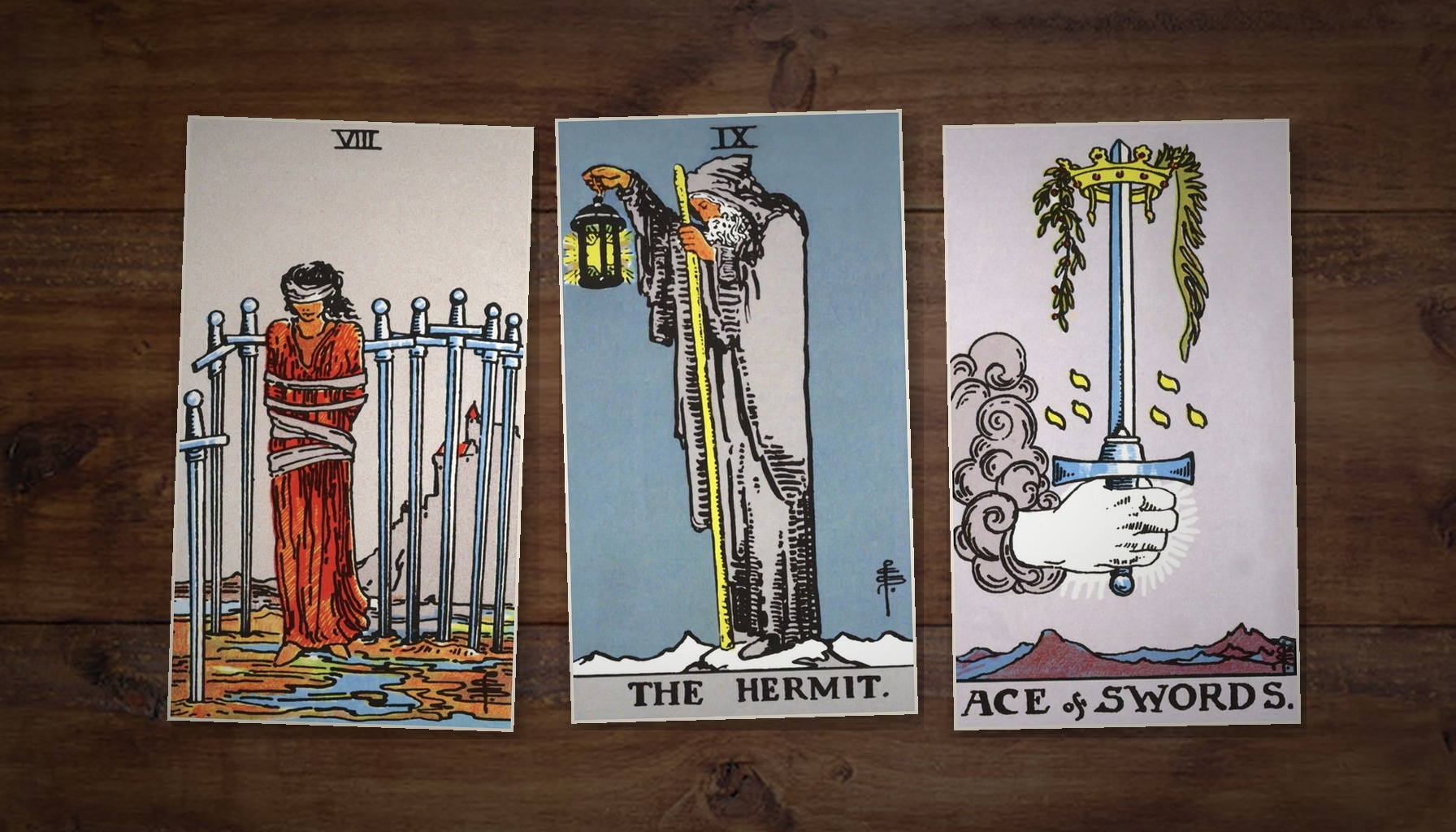
You've drafted and deleted that text seventeen times. You've opened their profile, stared at it, closed it, and opened it again. You've asked your friends, who all say the same thing. Now you're asking the cards.
Some cards are blunt about it. Here are the ones that mean put the phone down.
The Queen Who Draws the Line
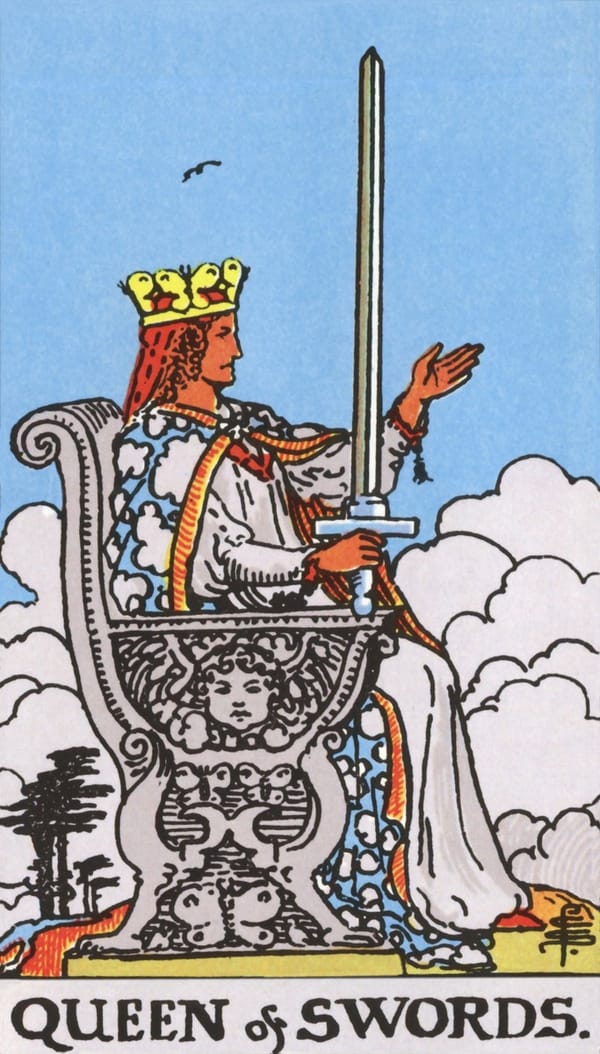
The Queen of Swords sits on a carved stone throne against an open sky. Her right hand holds a sword pointing straight up. Her left hand is raised, palm out — a gesture that stops you in your tracks. Her face is turned slightly to the side, not looking directly at whoever stands before her. She's already decided. The audience is over.
A single bird flies in the grey sky above her. The clouds are present but not stormy — this isn't an emotional decision. This is a clear-skied, clear-headed choice.
When the Queen of Swords appears in a reading about contact, she's saying: think with your head, not your ache. That raised left hand is the boundary. The sword is the commitment to enforcing it. She's not doing this because she doesn't care. She's doing this because she's looked at the evidence — like Justice but with more personal stake — and concluded that contact right now does more harm than good.
The Hermit's Mountain
The Hermit stands alone on a snowy peak, wrapped in a grey cloak, holding a lantern with a six-pointed star inside it. No one else is visible. The mountain stretches below him. He chose this altitude deliberately.
In a no-contact reading, The Hermit is less about them and more about you. You need distance to see clearly. Down in the valley — in the DMs, in the constant checking — everything is too close, too tangled. The Hermit climbs the mountain not to punish the village below but to get perspective that proximity makes impossible.
Waite's description of The Hermit emphasizes "prudence" and "the light which he can only find alone." That light in the lantern isn't for anyone else. It's for him. Your clarity about this situation will come from stepping back, not from one more conversation.
The Ace of Swords — The Clean Cut
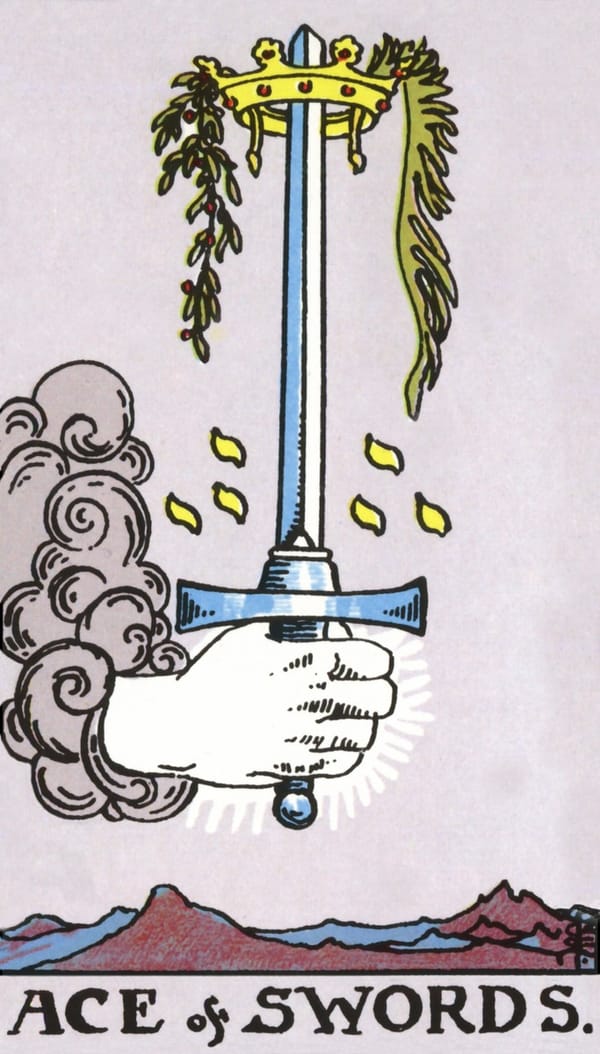
A hand emerges from a cloud gripping a sword crowned with a golden wreath. Two streamers — one red, one blue — trail from the crown. Mountains rise in the background. The sword points straight up, absolute and vertical.
The Ace of Swords is the card of a single decisive action. Not a gradual fade. Not a slow withdrawal where you respond less and less. A clean, conscious cut. One moment you're in contact. The next moment you're not. The sword doesn't saw — it severs.
This card often appears when you've been going back and forth, breaking your own boundaries, making exceptions. The Ace says: pick up the sword once. Use it once. Mean it.
The wreath on the sword means this decision, painful as it is, is a victory. Not over them. Over the part of yourself that keeps reaching for the phone.
Four of Swords — Deliberate Rest
The figure in the Four of Swords lies on a stone slab in what looks like a church, hands pressed together in prayer, three swords mounted on the wall above them and one beneath the slab. A stained glass window shows a figure blessing a kneeling person.
This card says: no contact isn't punishment. It's recovery. The figure isn't dead — they're resting. The church setting means this is sacred time, not wasted time. You're not doing nothing when you're not texting them. You're healing in a way that requires silence.
The three swords on the wall — those are the thoughts you're resting from. The constant analysis of what went wrong. The replaying of conversations. The fourth sword under the slab suggests the deepest wound is the one you've laid to rest.
Eight of Swords Reversed — Taking Off the Blindfold
Upright, the Eight of Swords shows a blindfolded woman surrounded by swords, bound and stuck. Reversed, the blindfold comes off. The bindings loosen. She realizes the swords weren't actually blocking every direction — there was always a gap to walk through.
Reversed Eight of Swords in a no-contact reading means: you've been telling yourself you can't stop reaching out. You can. The feeling that you'll die without contact, that you physically cannot go a day without checking their social media — that's the blindfold. It feels absolute. It isn't.
The psychological term for this is learned helplessness — the belief that you have no agency in a situation where you actually do. The reversed Eight of Swords is the moment that belief breaks.
What No Contact Actually Looks Like in Practice
The cards above give you the framework. Here's the practical part:
Delete the draft text. Not tomorrow. Now. The Queen of Swords doesn't postpone.
Mute, don't block — unless blocking is what you need. The Hermit doesn't destroy the path down the mountain. He just stops walking it.
Tell one person what you're doing. The Four of Swords figure is in a church — a witnessed space. Accountability helps when your resolve wavers at 11pm on a Thursday.
When you feel the urge to reach out, name what you actually want from the contact. Usually it's not information. It's relief from the discomfort of not knowing. That discomfort is the healing working. Don't interrupt it.