Three of Pentacles
What the image shows
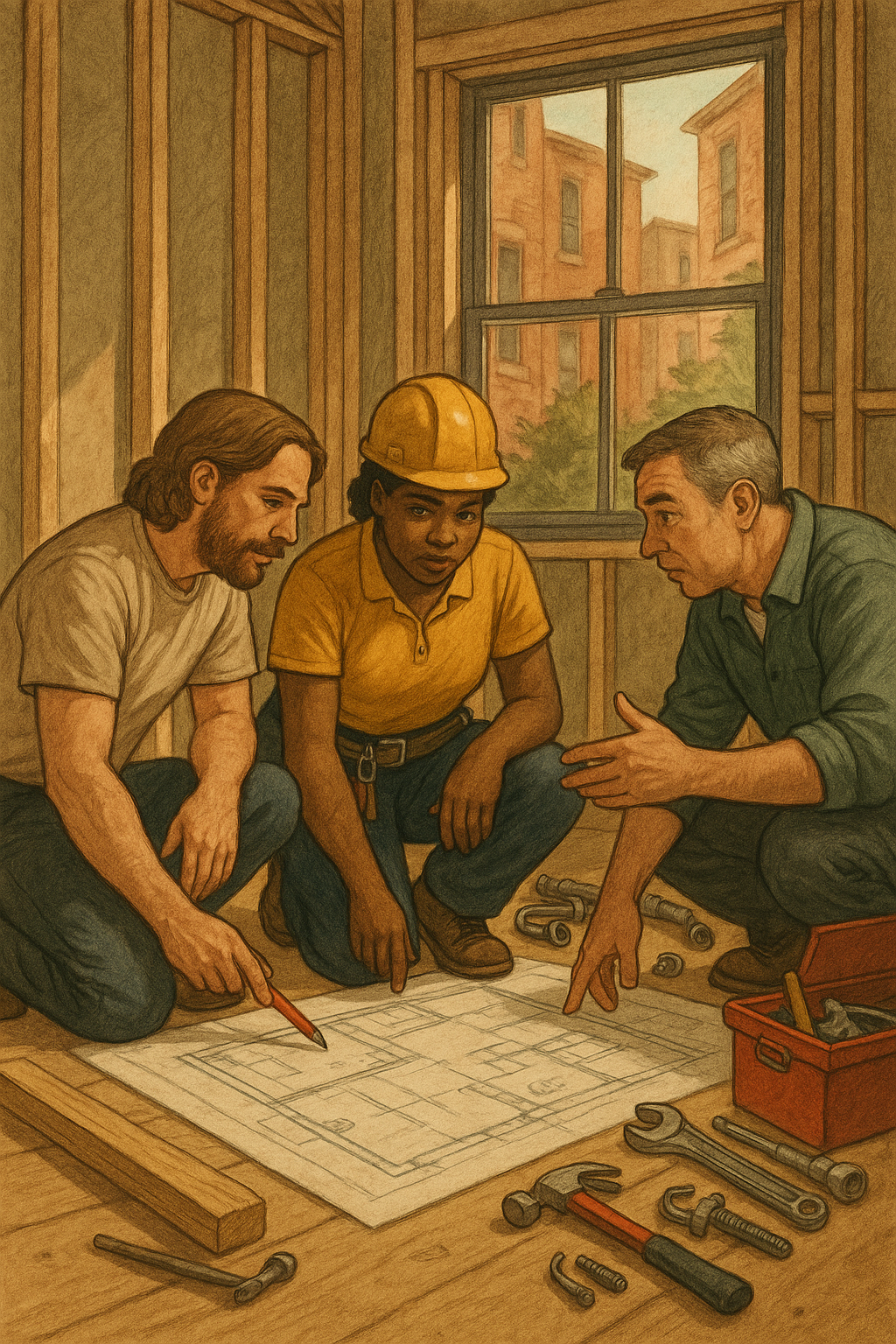
Three people crouch together on a wooden floor, huddled around architectural blueprints spread out between them. The setting appears to be a building under construction or renovation—bare wooden walls frame a large window that looks out onto brownstone buildings. The warm afternoon light suggests they've been at this for a while.
The person on the left, a younger man with shoulder-length hair and a beard, wears a simple white t-shirt and points at something specific on the plans with a pencil. In the center, someone in a yellow hard hat and matching polo shirt leans in attentively, clearly the one with technical expertise on the job site. On the right, an older man in a green work shirt gestures with an open hand as he explains something, his posture suggesting experience and authority.
Tools are scattered around them—wrenches, bolts, a hammer, a red toolbox—the practical equipment needed to turn plans into reality. Wooden boards lean against the wall, waiting to be installed. Everything about the scene says active collaboration: three people with different roles, working toward the same finished project, each bringing something necessary to the table.
The modern read
This illustration strips the Three of Pentacles down to its essential truth: good work happens when skilled people collaborate. There's no mystique here, just three workers who each know their part—someone interpreting the plans, someone with site expertise, someone with experience—figuring out how to build something together. The blueprints on the floor are the shared vision they're all working from.
Placing this card in a construction setting makes the meaning viscerally practical. You can see exactly what collaboration looks like: it's not abstract teamwork or vague cooperation. It's people with different knowledge bases literally getting on the same level (everyone's crouching, no one's standing above the others) to solve real problems. The building outside the window reminds you that this is how things actually get made—through people showing up, contributing their piece, and respecting what others bring.
How it connects to the Rider-Waite-Smith
The traditional RWS Three of Pentacles shows a stonemason working on a cathedral while a monk and an architect consult nearby, holding plans. The setting is a church interior with three pentacles carved into an archway above. The card emphasizes skilled craftsmanship, collaboration between labor and vision, and work that contributes to something larger and lasting.
This modern version keeps everything that matters: the blueprints echo the architect's plans, the worker in the hard hat parallels the craftsman, and the collaborative consultation remains central. What's shifted is the setting—from sacred architecture to secular construction—which actually broadens the card's application. You don't need to be building a cathedral for this card to apply; you just need to be building something with other people, pooling expertise to make it right.
Upright meaning
The Three of Pentacles is about skilled collaboration and work that benefits from multiple perspectives. It shows up when the job requires more than one person's expertise, and when that collaboration is actually working. This is the card of doing your part well while trusting others to do theirs.
In work: You're part of a project team where everyone has a defined role, and the combination is producing better results than any individual could achieve alone. This might be a product launch, a construction project, or a creative collaboration where writer, designer, and strategist each contribute.
In love: You and your partner are actively building something together—renovating a home, planning a wedding, raising kids—and you're functioning as a real team. You respect what each person brings and you're working from the same plan.
In money: Financial planning that involves professionals—working with an accountant, a financial advisor, or a real estate agent. You're bringing your goals; they're bringing expertise. The collaboration produces better outcomes than going it alone.
In daily life: Group projects where the group actually works. Study groups, volunteer committees, community organizing—any situation where people show up prepared, contribute their piece, and the whole becomes greater than the parts.
Reversed meaning
Reversed, the Three of Pentacles points to collaboration breaking down. Someone's not pulling their weight, expertise is being ignored, or the team has lost sight of the shared goal. This is the card of dysfunctional group dynamics.
In work: You're stuck in a team where no one listens to each other, roles are unclear, or one person's ego is derailing the project. Alternatively, you're doing skilled work that's going unrecognized—your expertise is being dismissed or your contributions aren't being credited.
In love: You and your partner are working against each other instead of together. You have different visions for the relationship, or one person is doing all the building while the other coasts. The collaboration has become one-sided.
In money: Poor professional advice, or refusing to seek expertise when you need it. This might look like ignoring your accountant's recommendations or trying to DIY something (legal work, investments) that genuinely requires professional skill.
In daily life: Group projects from hell. The study group where one person does all the work. The committee where everyone has opinions but no one follows through. The collaboration that's a collaboration in name only.