
Four of Pentacles
What the image shows
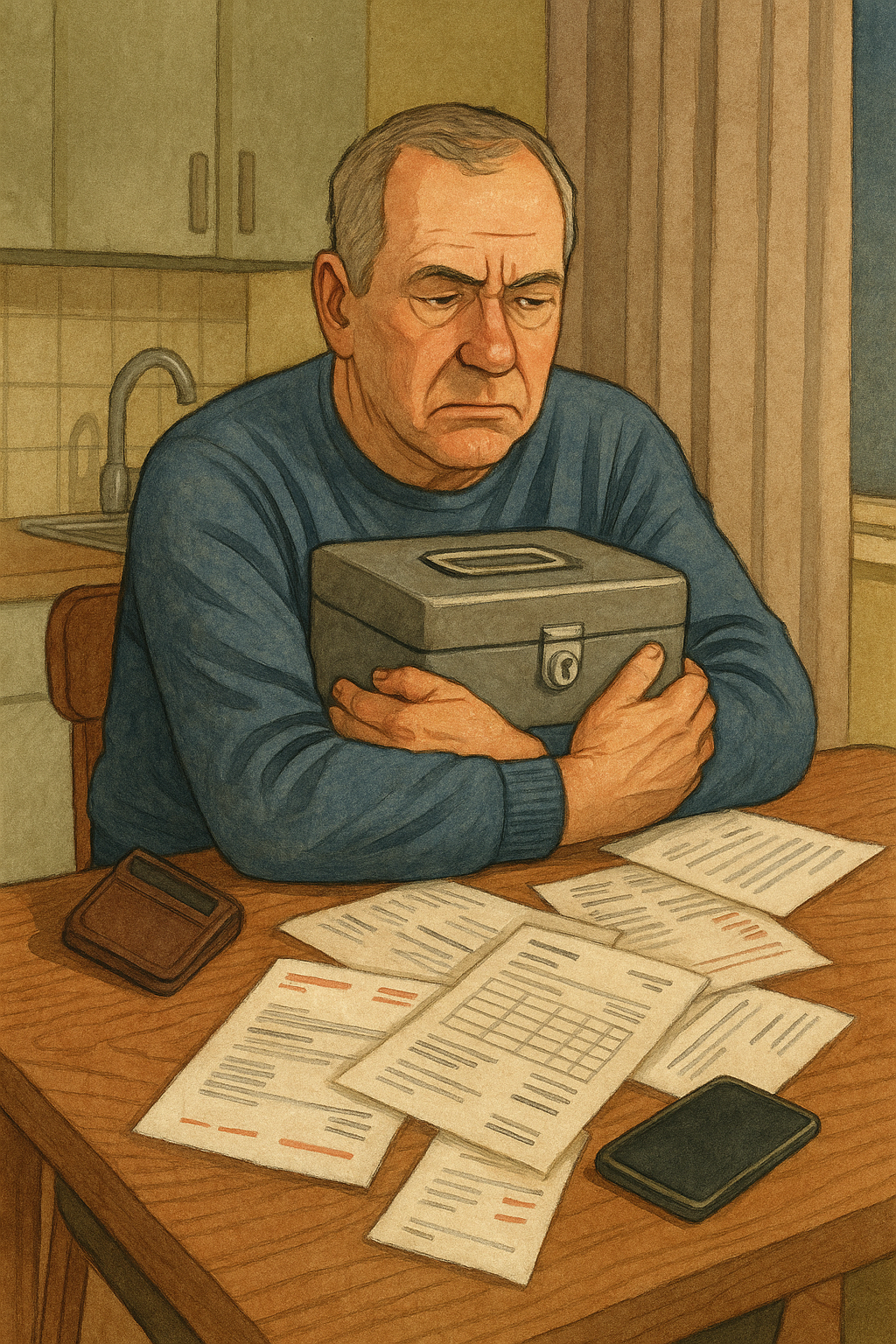
An older man sits at a kitchen table, clutching a metal lockbox against his chest with both arms wrapped protectively around it. He's wearing a plain blue sweater, and his expression is tight-lipped and furrowed—somewhere between worry and stubborn determination. The way he holds the box isn't casual; it's defensive, like someone might try to take it from him at any moment.
Spread across the wooden table in front of him are scattered documents—bills, statements, forms with tables and figures. A wallet sits to one side, a smartphone to the other. Behind him is a modest kitchen with basic cabinets and a sink. Everything about the scene reads as ordinary domestic life, but the tension is palpable.
The details tell the story: this isn't a man counting his wealth with satisfaction. This is someone white-knuckling their security, surrounded by paperwork that probably represents obligations, decisions, or pressures. The lockbox could hold savings, important documents, or cash—whatever it is, he's not letting go.
The modern read
This illustration nails the Four of Pentacles by showing what financial fear actually looks like in real life. It's not a dragon hoarding gold in a cave—it's a regular person at their kitchen table, gripping their savings like a life raft while bills pile up around them. The man's posture says everything: he's protecting what he has, but he's also trapped by that protection.
Placing this card in a domestic setting makes the message hit harder. This is about the kind of scarcity mindset that keeps people up at night, the inability to spend or share or take risks because what if something goes wrong. The scattered paperwork suggests he's managing (or avoiding) real financial pressures, but his response is to clutch tighter rather than engage. It's security that's become a prison.
How it connects to the Rider-Waite-Smith
The traditional RWS Four of Pentacles shows a figure sitting on a stone bench, holding one pentacle tight against his chest while balancing another on his head and standing on two more. He's in front of a city skyline but separate from it, isolated by his possessive stance. The image emphasizes control and containment—every coin is accounted for and protected, but the posture is rigid and closed off.
This modern version keeps the essential gesture: arms wrapped around something valuable, body language that screams "mine." The lockbox replaces the pentacles, and the kitchen replaces the stone bench, but the isolation remains. Where the RWS figure turns his back on the city, this man is alone in his kitchen with his fears. What's shifted is the specificity—we see the bills, the phone, the ordinary pressure that drives someone to grip this hard.
Upright meaning
The Four of Pentacles upright is about holding on tight—to money, to control, to stability—sometimes past the point where it serves you. It's not inherently bad; sometimes you need to protect what you've built. But it often points to a fear-based relationship with security.
In money: You've been saving aggressively but won't touch the emergency fund even for actual emergencies. You check your account balance three times a day. You feel anxious about every purchase, even necessary ones.
In work: You're doing the same job because it's stable, even though you're miserable. You won't delegate because no one does it as well as you. You hoard information or credit instead of sharing with your team.
In love: You're holding back emotionally because vulnerability feels too risky. You keep score in relationships. You won't let your partner handle shared finances or make joint decisions.
In daily life: You can't throw anything away because you might need it someday. You say no to experiences because they cost money or require letting go of control. You'd rather have security than satisfaction.
Reversed meaning
Reversed, the Four of Pentacles can swing two ways: either you're finally loosening your grip, or you've lost control entirely. Context matters. Sometimes it's liberation; sometimes it's recklessness or loss.
Financial chaos: You went from saving obsessively to spending without thinking. Or you've had something taken from you—job loss, unexpected expense, theft—and your sense of security is shattered.
Letting go (healthy): You finally donated the stuff you were hoarding. You invested in yourself or took a risk you'd been too scared to take. You trusted someone with something important.
Letting go (unhealthy): You're giving away too much—money, time, control—because you've swung to the other extreme. You can't hold boundaries. You're being financially careless or letting people take advantage of your resources.
Control slipping: You're micromanaging harder because things feel unstable, but it's not working. The tighter you grip, the more slips through your fingers.