The High Priestess
What the image shows
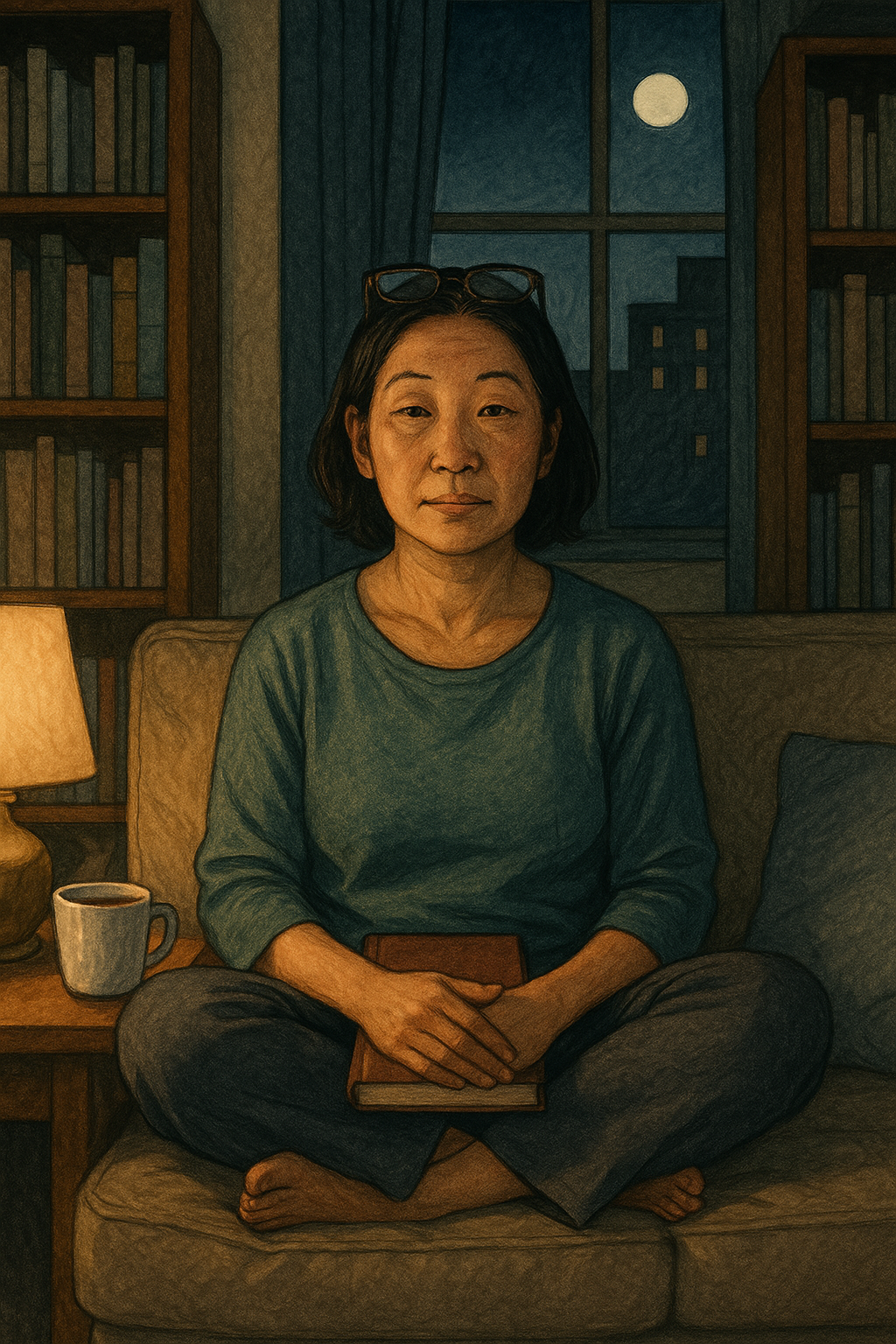
A middle-aged woman sits cross-legged on a gray couch, holding a closed book in her lap. She's barefoot, wearing a muted teal long-sleeve shirt and dark pants — comfortable clothes, nothing performative. Her glasses are pushed up onto her head, suggesting she's paused from reading. Her expression is calm, direct, and slightly knowing. She looks right at us.
Behind her, floor-to-ceiling bookshelves frame a window where a full moon hangs in a blue night sky. A city building is visible in the distance, a few windows glowing. To her left, a simple lamp casts warm light, and a white mug sits on a side table. The color palette is all deep teals, warm browns, and muted grays — quiet and contained.
The whole scene is still. She's not doing anything dramatic. She's just sitting with what she knows, completely at ease with silence and solitude. The closed book suggests knowledge she's already absorbed. The moon through the window behind her feels deliberate, like it's part of her space rather than something she's reaching for.
The modern read
This illustration says The High Priestess isn't about mystical performance or dramatic revelation. She's the person who reads widely, thinks deeply, and doesn't feel compelled to share everything she knows. She's comfortable in her own company. The setting — a private home library at night — makes her wisdom feel earned and personal, not borrowed from some external source.
Placing this card in a real-world context strips away the ceremonial robes and temple imagery. What you're left with is the core idea: someone who trusts their own understanding, who knows when to speak and when to stay quiet, and who doesn't need external validation to feel confident in what they perceive. She's not waiting for anyone to tell her she's right.
How it connects to the Rider-Waite-Smith
The traditional RWS High Priestess sits between two pillars — one black, one white — representing duality and the threshold between known and unknown. She wears a crown with lunar phases and holds a scroll labeled TORA (divine law), partially hidden by her robe. A crescent moon sits at her feet, and a veil decorated with pomegranates hangs behind her, concealing deeper mysteries.
This modern version keeps the moon — now visible through the window — and replaces the scroll with a closed book. The bookshelves serve a similar function to the pillars, framing her and suggesting accumulated knowledge. The threshold symbolism shifts from a temple doorway to something internal: the boundary between what she knows and what she chooses to share. The partial concealment remains; she's holding her knowledge close, not putting it on display.
Upright meaning
The High Priestess upright tells you to trust what you already know. Not what you can prove, not what others have confirmed — what you've quietly understood through experience and observation. This card says: you know more than you think, and you don't need to explain yourself.
In love: You sense something's off with a partner, even though they haven't said anything. Don't dismiss that. You might also be the person someone confides in because you listen without judgment.
At work: A decision feels wrong, even though the spreadsheet says it's fine. This card backs your gut. It's also about knowing when to hold your opinion until the right moment — not every meeting needs your input.
With money: You're hesitant to sign a contract or make a purchase even though you can't articulate why. Wait. Sit with it. The hesitation itself is information.
In daily life: You need solitude to think clearly. Cancel the plans, stay in, read the book. This card is permission to prioritize your inner life over your social calendar.
Reversed meaning
Reversed, The High Priestess points to ignored instincts, secrets causing harm, or complete disconnection from your own judgment. You know something, but you're refusing to acknowledge it — or you've been so busy with external noise that you can't hear yourself anymore.
In love: You've seen the red flags but keep explaining them away. Or you're holding back something important from a partner, and the distance is growing because of it.
At work: You're constantly asking for others' opinions instead of forming your own. Analysis paralysis. Or you're keeping crucial information to yourself in ways that are starting to backfire.
With money: You signed something you didn't fully read. You ignored the feeling that something was too good to be true. Now you're dealing with the fallout.
In daily life: You're overloaded with podcasts, articles, and everyone else's opinions. You haven't had a quiet moment in weeks, and you're making decisions that don't actually feel like yours.