
Ten of Wands
What the image shows
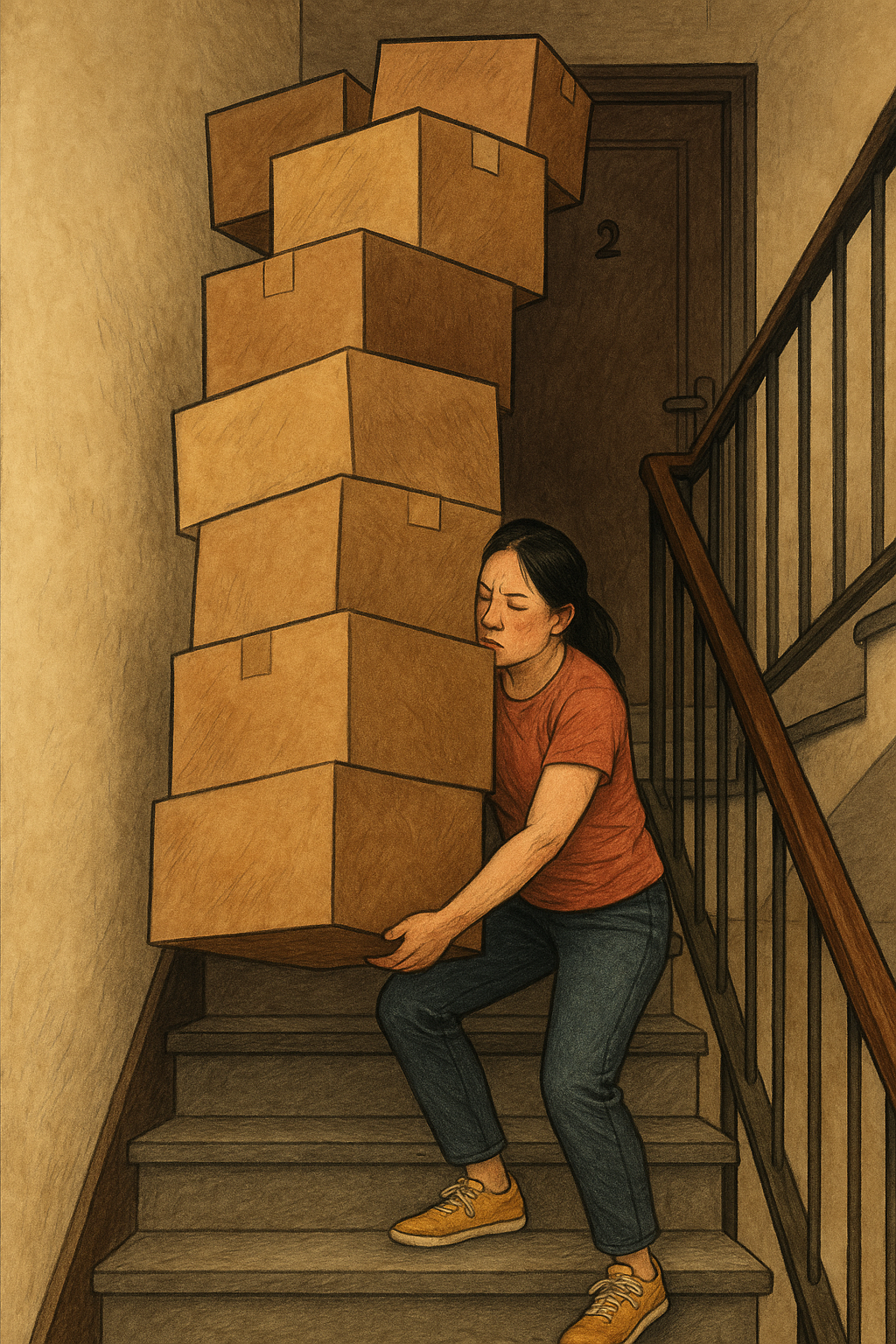
A woman in a rust-red t-shirt and jeans struggles up a narrow apartment stairwell, carrying a tower of cardboard moving boxes stacked so high she can barely see over them. Her eyes are closed, her expression strained — this is clearly exhausting work. The stack of seven or eight boxes is precarious, tilting slightly, and she's gripping the bottom box with both hands while trying to navigate the steps.
The setting is unmistakably an older apartment building: worn stairs, a wooden banister with vertical spindles, yellowish walls, and a door marked with the number 2 visible at the landing above her. She's wearing flat yellow sneakers, dressed practically for physical labor. Her dark hair is pulled back and out of her face.
What stands out is how alone she is in this task. There's no one holding the door, no one steadying the boxes from behind, no one waiting at the top to help receive them. She's doing this entirely by herself, and the sheer height of that stack makes it clear she's taken on more than one person should reasonably carry at once.
The modern read
This illustration nails what the Ten of Wands actually feels like in daily life: you're moving, you're exhausted, and instead of making four reasonable trips, you've decided to do it all in one because asking for help feels like admitting defeat. The woman isn't being forced to carry all those boxes — she chose this. That's the Ten of Wands in a nutshell. It's the burden you picked up yourself, the responsibility you didn't delegate, the "I'll just handle it" that turns into something crushing.
Placing this card in such a mundane setting strips away any romanticism about noble suffering. There's nothing heroic about struggling up stairs with too many boxes. It just looks hard, and a little bit stubborn. The illustration asks a practical question: why didn't she make two trips? Why didn't she ask someone to help? The answer usually has something to do with pride, or habit, or not believing help would actually come if she asked.
How it connects to the Rider-Waite-Smith
The traditional Rider-Waite-Smith Ten of Wands shows a figure hunched over, carrying a bundle of ten wooden staffs toward a distant town. The wands obscure their vision — they can't see clearly where they're going. Their posture is bent, strained, and the weight is obviously too much for one person. The town in the background suggests they're almost at their destination, but the journey isn't over yet.
This modern version keeps the core visual: someone carrying a burden so large it blocks their sight, moving toward a goal (getting to the apartment), doing it alone. What's shifted is the context — this isn't a symbolic journey across fields, it's a Tuesday afternoon moving into a walk-up. The wands become boxes, the distant town becomes the door at the top of the stairs. The message stays the same: you're almost there, but you've taken on too much, and your stubbornness is making this harder than it needs to be.
Upright meaning
The Ten of Wands upright means you're overloaded. You've said yes to too many things, or you've refused to share the weight with anyone else, and now you're paying for it. This card is about burden, responsibility, and the particular exhaustion that comes from doing everything yourself.
In work: You're the person who stayed late every night this month because you didn't trust anyone else to do it right. You've got three people's jobs and one person's salary.
In love: You're carrying the relationship — planning every date, initiating every conversation, managing your partner's emotions while neglecting your own.
In money: You're financially supporting people who could be contributing but aren't. Or you've stretched yourself thin covering expenses that aren't really yours to cover.
In daily life: You're the one who always hosts, always drives, always remembers birthdays, always makes the plan. And you're tired, but you keep doing it anyway because who else will?
Reversed meaning
Reversed, the Ten of Wands points to either collapse or release — and sometimes it's hard to tell which is coming. You might finally be putting down the burden, or the burden might be falling on top of you.
Dropping responsibilities: You've hit a wall and started letting things slide. Deadlines missed, calls not returned, commitments forgotten. The weight finally became too much.
Refusing to let go: Alternatively, you're gripping even harder. You know you should delegate or step back, but you won't. The reversal here is about denial — pretending you can keep this up indefinitely.
Burnout territory: This card reversed often shows up when someone is approaching or already in burnout. The work didn't lighten; the person just stopped being able to carry it.
Martyrdom without payoff: You're doing all the work and getting none of the credit, but instead of changing the situation, you're just getting bitter about it.