
Four of Swords
What the image shows
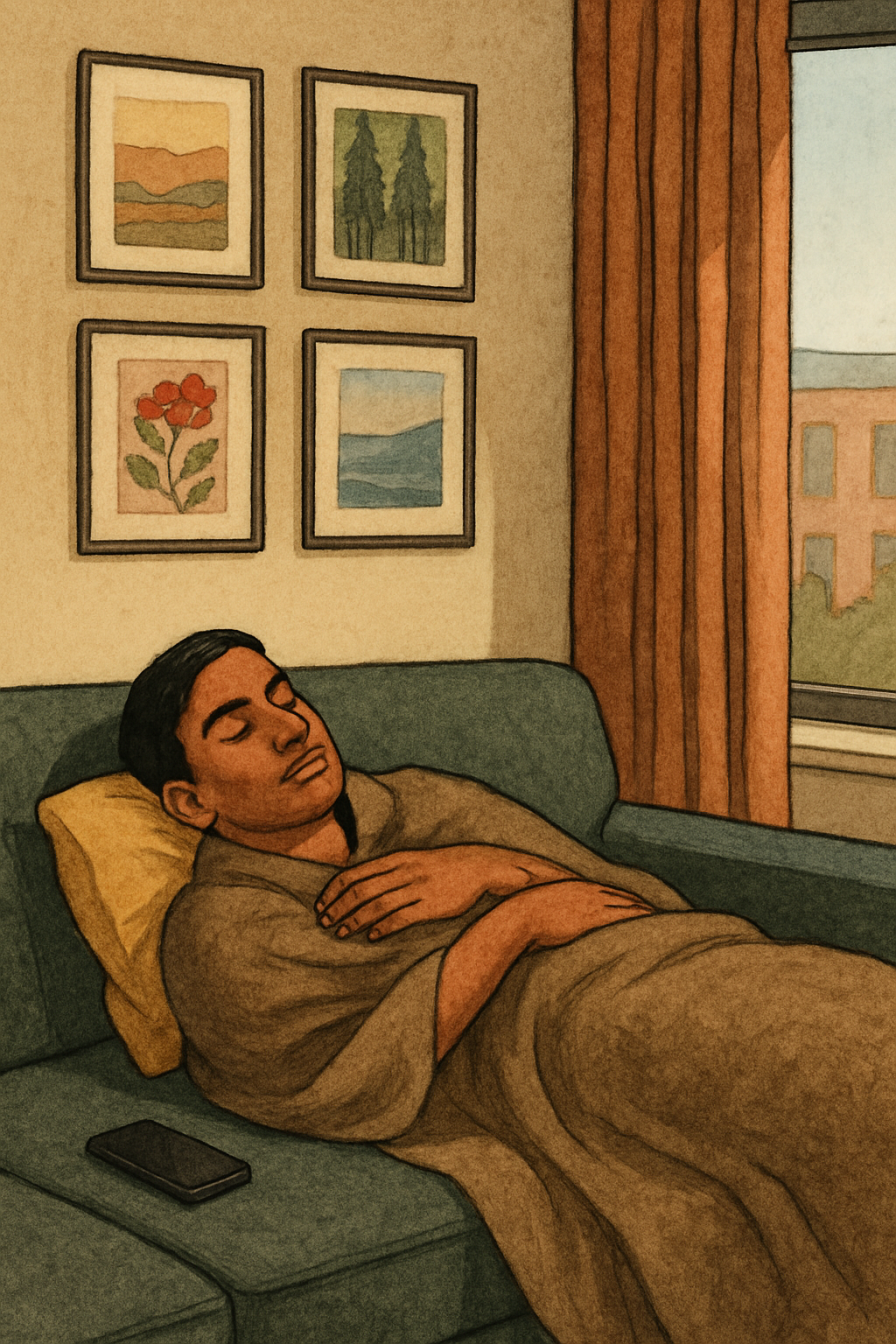
A man lies sleeping on a teal couch, covered with a brown blanket pulled up to his chest. His head rests on a yellow pillow, eyes closed, expression peaceful. One hand rests on his chest while the other is hidden beneath the blanket. He appears to be in his thirties or forties, with short dark hair, taking an afternoon nap in what looks like a living room.
The room itself feels deliberately calm. Four small framed prints hang on the cream-colored wall behind him — landscapes and botanicals in muted tones showing mountains, pine trees, flowers, and rolling hills. A window with rust-colored curtains reveals daylight and a glimpse of buildings outside. His phone sits face-down on the couch cushion beside him, deliberately set aside.
The overall feeling is one of intentional rest. This isn't someone who passed out from exhaustion or fell asleep scrolling. This is a person who chose to lie down, chose to put the phone away, and chose to close their eyes in the middle of the day.
The modern read
This illustration captures something we've largely forgotten how to do: rest without guilt. The Four of Swords here isn't about being sick or recovering from disaster — it's about the radical act of stopping before you break. The phone face-down is the key detail. This person has temporarily opted out of the constant demands of availability.
Placing this card in a living room rather than a tomb or church removes any sense of crisis. There's no sword hanging overhead, no effigy of death. Just a regular person taking a nap on their couch on what looks like a normal day. That's the point. Rest doesn't require permission from a health crisis. Sometimes you just need to lie down and check out for a while, and that's a legitimate response to life.
How it connects to the Rider-Waite-Smith
The traditional RWS Four of Swords shows a knight lying in a tomb-like position on a stone slab inside a church. Three swords hang on the wall behind him while one lies beneath the slab. A stained glass window shows a figure receiving a blessing. The image suggests sanctuary, prayer, and retreat from battle — a knight putting down his weapons and resting in a sacred space.
The modern version keeps the core concept of deliberate rest but strips away the religious and martial context. The church becomes a living room. The stone slab becomes a comfortable couch. The swords are gone entirely, but their absence is represented by the turned-off phone — the modern weapon of daily combat. What carries over is the sense of conscious withdrawal. What shifts is the message that you don't need to be a wounded warrior to deserve a break.
Upright meaning
The Four of Swords upright is a clear instruction: stop. Take a break. Rest now, before you're forced to rest later. This card shows up when you've been running on fumes and need to step back before you burn out completely.
In love: You need space to think about the relationship without constant contact. That might look like a weekend apart, or simply not texting for a day so you can hear your own thoughts.
At work: Take your vacation days. Use your lunch break to actually eat instead of working through it. If you're between jobs, don't rush into the first thing that comes along — give yourself time to recover and think.
With money: This is a holding pattern card. Don't make major financial decisions right now. Let things settle before you commit to anything big.
In daily life: Cancel plans. Stay home. Sleep in. Turn off notifications. The Four of Swords is permission to do nothing productive for a while.
Reversed meaning
Reversed, the Four of Swords points to rest that isn't happening — either because you refuse to take it or because something keeps interrupting it. This is the card of the person who says "I'll sleep when I'm dead" and then wonders why they're getting sick all the time.
In love: You can't get mental distance from relationship problems. Even when you're apart, you're obsessing, checking their social media, replaying conversations. There's no peace.
At work: You're working through illness, skipping breaks, answering emails at midnight. You've convinced yourself you're indispensable, but you're actually just headed for a wall.
With money: Financial anxiety is keeping you up at night. You can't stop checking your accounts or running worst-case scenarios in your head.
In daily life: Insomnia, restlessness, inability to relax even when you have time off. The reversal can also mean you've rested enough and it's time to get moving again — you've been on the couch too long.