
Look at His Face
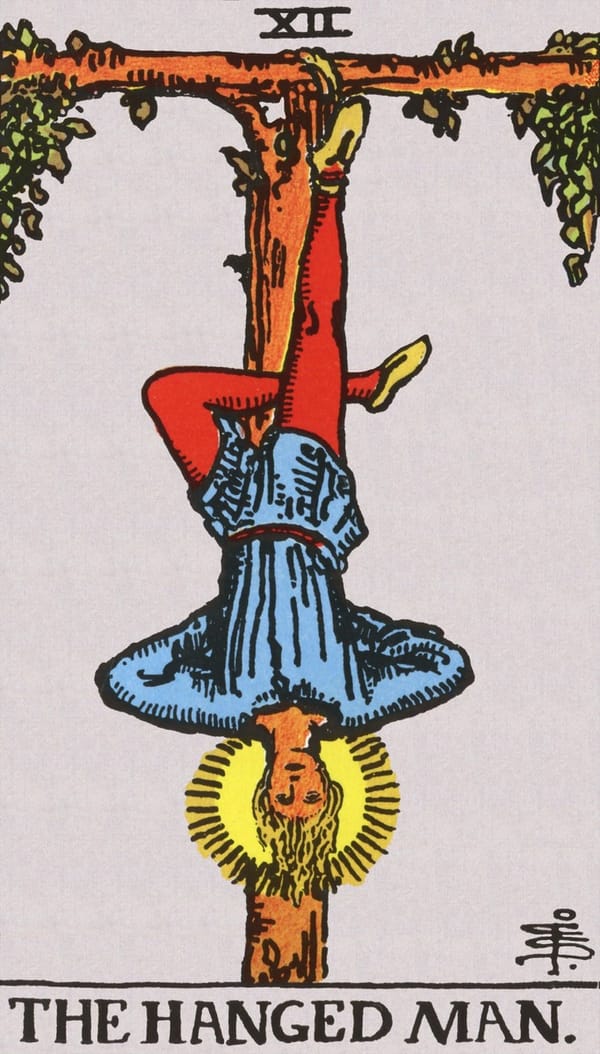
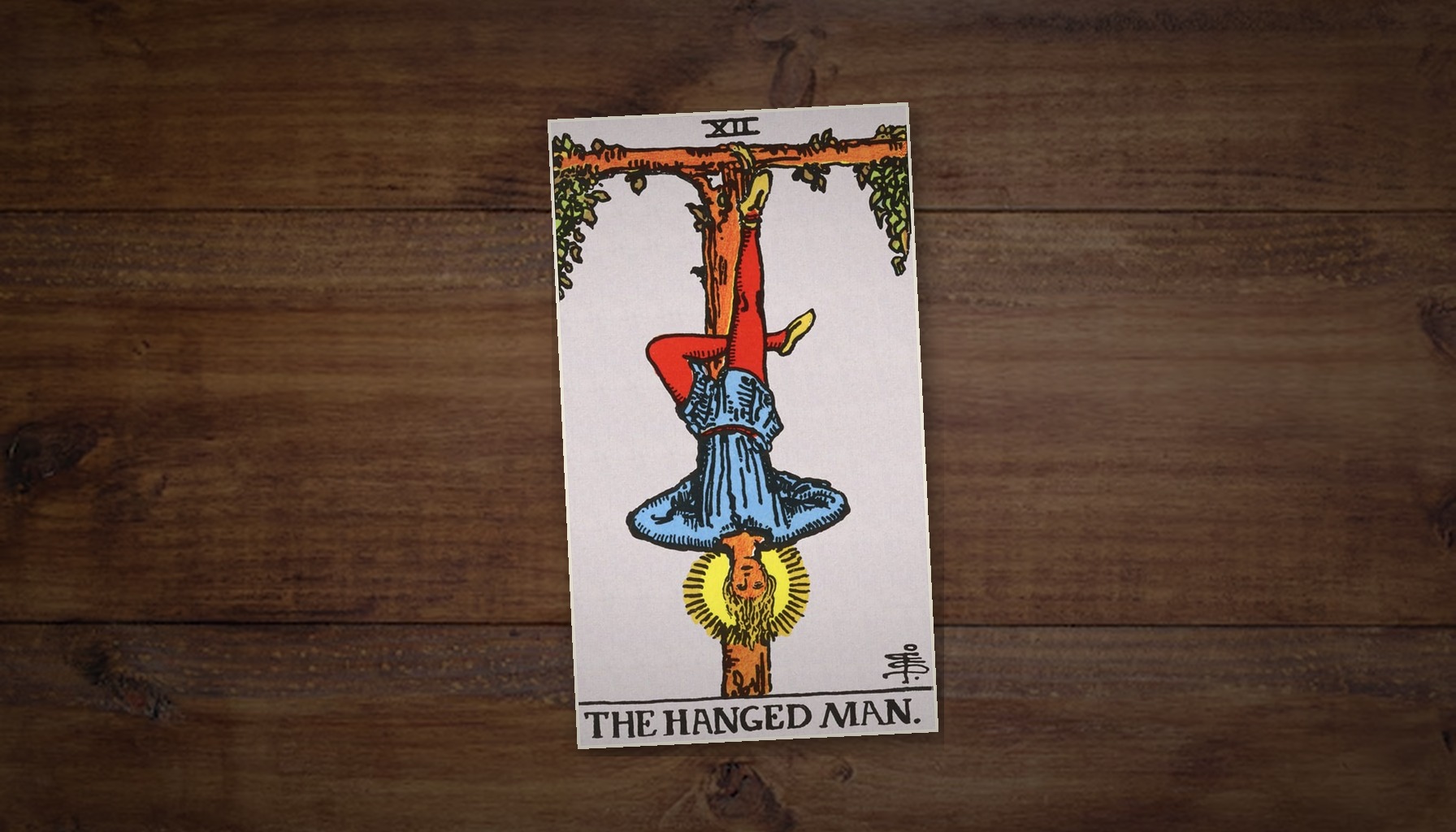
He's upside down. Suspended by one foot from a living wooden T-frame, green leaves sprouting from the horizontal beam. His other leg is bent behind the knee in a figure-four position. His arms are behind his back. And his face — this is what stops you — his face is calm. A golden halo radiates from his head. He isn't suffering. He's illuminated.
He wears a blue tunic and red leggings. Blue for peace, red for passion — the combination of someone who hasn't lost their fire but has found a way to hold it still. The tree he hangs from is alive. This isn't a gallows. It's a living structure that supports his chosen inversion.
Nothing about this card suggests struggle. He could be uncomfortable. He should be uncomfortable. But he's surrendered to the position so completely that the discomfort has transformed into something else — a view nobody else has access to.
Where The Hanged Man suspends, The Hermit as a person withdraws — both step out of the current, but for different reasons.
Waite's Pictorial Key to the Tarot from 1910 offers the original textual description, though Pamela Colman Smith's artwork carries layers of meaning that his words only begin to capture.
The Person Who Waits When Everyone Else Rushes
The Hanged Man as a person is the one in the meeting who says nothing while everyone else debates, and then, after the room has exhausted itself, says the thing that reframes the entire conversation. They didn't speak because they were processing. Not slowly — differently. They were seeing the problem from the inverted position and waiting until the insight was ready.
They're the friend who takes six months to make a decision that you could make in an afternoon. Not because they're indecisive, but because they refuse to act from the standard angle when they know there's something the standard angle misses. They'll sit with discomfort, sit with ambiguity, sit with not-knowing longer than anyone you've ever met.
If this suspension feels less voluntary than it should, tarot when stuck addresses the cards that show up when nothing is moving.
This drives other people slightly insane. "Just decide" doesn't work on the Hanged Man person. They're not stalling. They're in suspension, and they'll come down from the tree when the halo tells them it's time.
What They're Like to Be Around
The Hanged Man person has a strange relationship with time. They don't operate on the same urgency as everyone around them. Deadlines that make other people frantic seem to wash over them. They're not lazy or irresponsible — they just don't believe that speed produces better results than patience.
Being around them can feel like stepping off a treadmill. Their pace is slower, their attention more diffuse, their conversation more meandering. They notice things that people in a hurry walk past — the quality of light in the room, the thing you said that contradicted the thing you said an hour ago, the pattern in your life that you can't see because you're too close to it.
They're often described as "odd" or "different" by people who can't quite pin down what makes them unusual. It's the inversion. They're looking at the same world you are, but from a position that makes everything appear reversed, and that reversal reveals things the upright view can't.
Jung's concept of individuation — the process of becoming fully yourself — maps directly onto the Hanged Man's suspension.
Dating the Hanged Man Person
In a relationship, the Hanged Man person offers a kind of presence that most people aren't used to. They're fully there. They're not checking their phone. They're not planning the next thing. They're in this moment, hanging in this conversation, and they'll stay here as long as it takes for whatever needs to emerge.
This can feel deeply intimate or deeply frustrating, depending on what you need. If you want someone who matches your energy, makes quick plans, and moves through life at your pace, the Hanged Man person will feel like dragging. If you want someone who sees you from an angle that nobody else can, who notices the thing about you that everyone else has overlooked, they're extraordinary.
Physical affection with them tends to be unhurried. They don't rush toward anything. They let things develop at the pace they develop, and they trust that what's meant to happen will happen without being forced. This requires more patience than most people can muster early in a relationship.
The challenge: they can be infuriatingly passive. Not everything should be sat with. Not every decision benefits from six months of reflection. Sometimes the apartment needs a decision by Friday and "I'm still sitting with it" isn't an acceptable answer.
At Work
The Hanged Man person produces their best work when given time and space. They're the writer who turns in the piece late but it's better than anything you expected. The developer who stares at the code for an hour, seemingly doing nothing, and then writes the solution in ten minutes. The consultant who asks for a week to think about the problem and comes back with a perspective that changes the company's direction.
They struggle in fast-paced environments that reward visible productivity. They're not going to send you hourly updates. They're not going to look busy. They might spend what looks like an entire afternoon doing nothing, and then produce an insight that saves the project.
They're excellent at any work that requires seeing what others can't: research, therapy, investigative work, creative direction, strategic planning. Their inverted perspective is a genuine asset, as long as the environment gives them space to use it.
The Halo and the Hanging
The golden halo around his head means the inversion is working. Something is illuminated that wasn't visible before. The Hanged Man person's willingness to be uncomfortable, to look foolish, to wait when waiting seems unproductive — it isn't passivity. It's a method. And the halo proves it works.
But the shadow side is real: some Hanged Man people get stuck in the suspension. They hang from the tree indefinitely, waiting for an insight that never comes, using patience as an excuse for inaction. The living tree stops being a place of transformation and becomes a hiding place.
The perspective shift this person embodies is what eventually leads to The World as a person — completion born from a changed vantage point.
If you love a Hanged Man person, don't try to cut them down. They need to come down on their own. But you can stand beneath the tree and tell them what you see from the ground — because sometimes, the inverted view is so compelling that they forget the ground is where you actually have to live.
To find out which Major Arcana card is yours from birth, try the birth card calculator.