

Look at the Chains
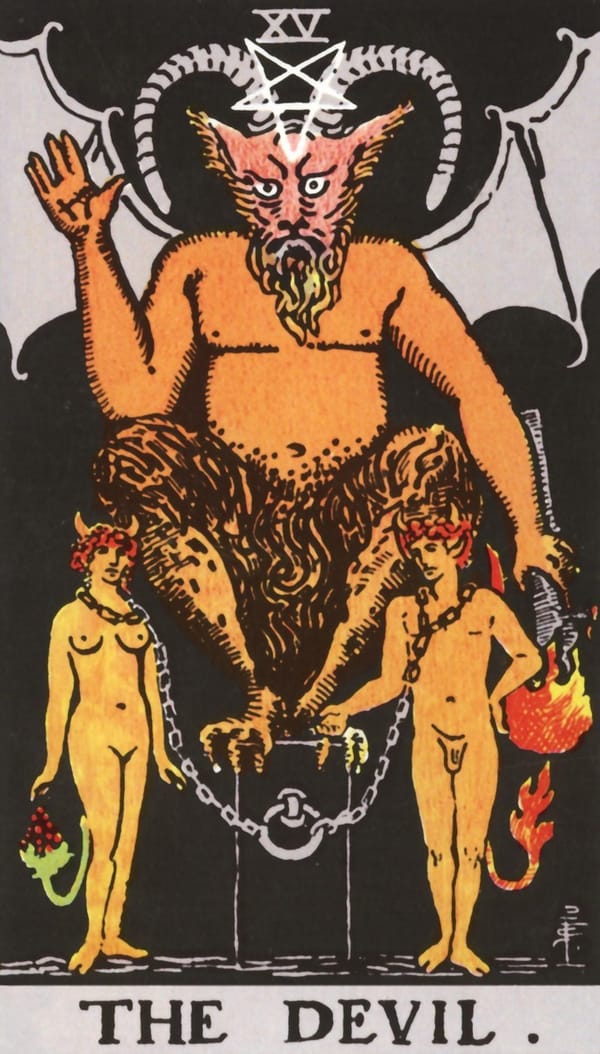
The chains are loose. That's the first and most important thing in this card. Two naked figures stand at the base of a black pedestal, chains around their necks, and the chains are large enough to slip over their heads. They are not trapped. They are staying.
Above them, on the pedestal, the Devil crouches — a bat-winged, goat-headed creature with an inverted pentagram above its head. One hand is raised in a gesture that mockingly mirrors the Hierophant's blessing. A torch burns in the other hand, pointed downward. The figure has a hypnotic quality. It's ugly, but you can't look away. It knows you can't look away.
The two chained figures are starting to change. Small horns are growing from their heads. Tails are sprouting — one with fruit, one with fire. The longer they stay, the more they become like the thing that holds them. That's the mechanism. Not force. Transformation through proximity.
For another powerful pairing, see The Lovers and The Devil.
The original 1910 meaning appears in Waite's Pictorial Key to the Tarot, but much of what makes this card powerful comes from choices Pamela Colman Smith made in the artwork that Waite never commented on.
The Person You Can't Stop Thinking About
The Devil as a person is the one who lives in your head rent-free. They're not necessarily cruel. They might be charming, exciting, intoxicating — the most alive person in any room they enter. They make you feel things at a volume that your normal life doesn't reach.
This is the ex you keep going back to even though every friend in your life has told you to stop. The business partner whose deals always seem slightly off but too lucrative to question. The friend who introduces you to experiences that feel incredible in the moment and terrible in the aftermath.
They don't hold you captive. Look at the chains. They make captivity feel like a choice, and then they make the choice feel inevitable. "You could leave, but you won't, because where else will you feel like this?" That's the Devil person's unspoken pitch. And they're often right.
What They're Like Up Close
The Devil person has an intensity that's immediately different from everyone else in the room. They hold eye contact a beat too long. They stand a little too close. They say the thing that everyone else was thinking but nobody was going to say. They make boundaries feel like suggestions and rules feel like things that apply to other people.
They're fun. Genuinely, dangerously fun. They suggest the third drink, the late-night detour, the risky decision that part of you wants to make. They're the friend who texts "come out" at midnight on a Wednesday and you go, even though you have work in the morning, because being around them feels like being freed from the constraints of your regular life.
The problem is that the freedom isn't free. You wake up the next day with consequences. They don't. Or they seem not to. The Devil person often appears to be immune to the fallout of the lifestyle they promote, which makes you wonder if you're just not doing it right. You are. They're just better at hiding the cost, or they've been paying it so long they've stopped noticing.
This reversal often signals the beginning of breaking codependency patterns — seeing the chains for what they are.
Dating the Devil Person
Relationships with a Devil person are intense, consuming, and rarely moderate. The chemistry is immediate and overwhelming. The physical connection runs hot. The early phase feels like an addiction because, in some sense, it is — the neurochemistry of intense attraction looks a lot like the neurochemistry of substance dependence.
They'll make you feel seen in a way that seems profound but might actually be manipulation. They notice your insecurities and they position themselves as the cure. They know exactly what you need to hear because they've been studying you, not out of love but out of instinct.
The healthy version of Devil energy in a relationship is passion that both partners control rather than being controlled by. Wild, intense, consuming — but chosen, not compelled. The unhealthy version is the relationship where you keep saying "this is the last time" and it never is.
If you're currently dating someone who makes you feel like you can't think clearly, check the chains. See if you can slip them off. If you can but won't, ask yourself what's growing on you.
At Work
The Devil person at work is the one who gets results through sheer force of personality. They close the deal that shouldn't have closed. They persuade the client that should have walked. They make the impossible pitch and somehow pull it off.
They thrive in roles where charisma is currency: sales, entertainment, high-stakes negotiation, entrepreneurship. They can read what people want and reflect it back to them with uncanny precision.
The risk is obvious. They cut corners. They push ethical boundaries. They make promises that future-you will have to keep. Working with them feels exhilarating until the bill comes due, and the bill always comes due.
The Inverted Pentagram
The pentagram above the Devil's head is upside down — spirit below matter, the physical overriding the spiritual. The Devil person has inverted the order. Pleasure over purpose. Sensation over meaning. The immediate over the lasting.
This isn't always wrong. Sometimes the spiritual gets so heavy that you need someone to drag you back into your body, into pleasure, into the physical reality of being alive. The Devil person can be medicine for people who have been too careful, too controlled, too afraid to enjoy anything.
But medicine at the wrong dose is poison. And the Devil person often doesn't know the right dose, or doesn't care.
If you love a Devil person, the most important thing you can do is keep your hands on the chains. Know they're there. Know they're loose. And know that staying is a choice you're making, not a fact of your situation.


