

Look at What's Pulling the Chariot
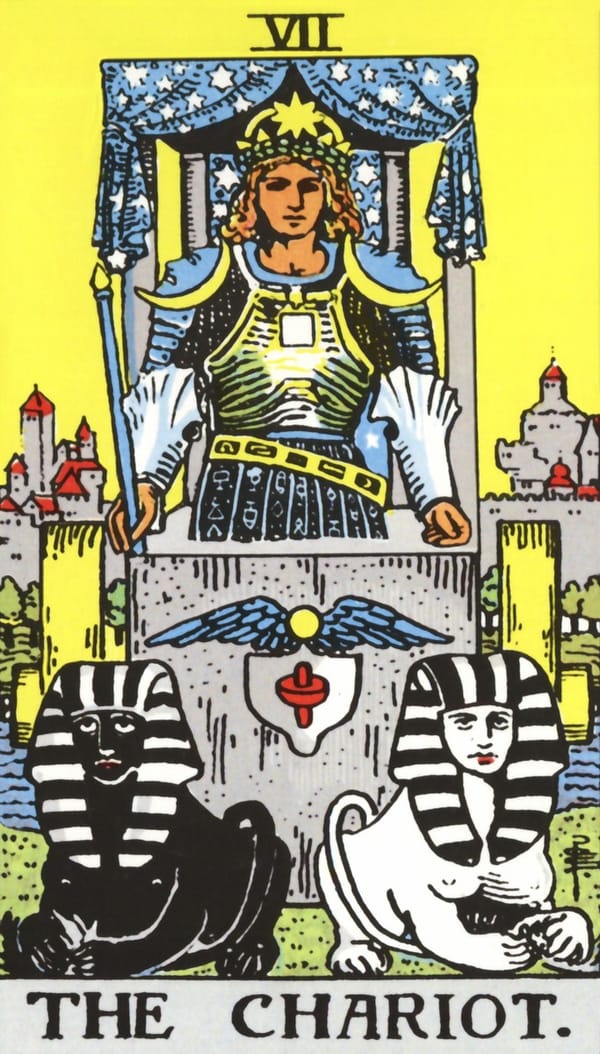
Two sphinxes crouch at the front of the chariot — one black, one white. They're not in motion. They're sitting, almost at rest, and they're facing slightly different directions. There are no reins in the driver's hands. No visible connection between the figure standing in the chariot and the two powerful creatures in front of it.
This is the critical detail. The Chariot person doesn't control their opposing forces through physical means. They do it through will. Through the sheer intensity of knowing where they're going and refusing to let anything — including their own internal contradictions — pull them off course.
The figure stands in full armor beneath a canopy covered in stars. A six-pointed star crowns their head. On the chariot's front panel, a winged sun. Behind them, a walled city they've already left. They're not defending a position — they've moved past defense into forward motion. And the city behind them looks peaceful, settled, comfortable. They left comfort behind on purpose.
For another powerful pairing, see Ace of Wands and The Chariot.
For the original 1910 interpretation, see Waite's Pictorial Key to the Tarot — though artist Pamela Colman Smith packed the image with symbolism that Waite himself didn't fully explain.
The Person Who Decided and Never Stopped
The Chariot as a person is someone who made a choice — maybe at 19, maybe at 30, maybe last Tuesday — and the entire force of their being is now pointed at that choice. They're the one who said "I'm going to medical school" and then worked three jobs to pay for it. The one who said "I'm leaving this town" and was gone within six months.
This isn't the same as ambition. Ambitious people want things. The Chariot person has moved past wanting into moving. They've already left the walled city. They're not talking about what they want to do — they're doing it, and the speed at which they're traveling makes it hard for other people to keep up.
They're the friend who trains for marathons while the rest of you are still debating gym memberships. The coworker who finishes projects ahead of deadline and then asks for more. The person at the party who seems slightly distracted because part of them is always thinking about the next mile, the next goal, the next checkpoint.
What They're Like to Be Around
Exhilarating and exhausting, often simultaneously. The Chariot person's momentum is contagious — being around them makes you want to get your own life moving. But their pace is relentless. They don't coast. They don't take unproductive weekends. Even their rest has a purpose: recovery for the next push.
They have difficulty sitting still with open-ended time. A lazy Sunday makes them anxious. An evening with no plans feels like a waste. They're not joyless — they can laugh, celebrate, enjoy a good meal — but there's always a part of them that's calculating how this connects to where they're going.
They don't complain much. Not because things don't bother them, but because complaining feels like standing still, and standing still feels like dying. They'll absorb a setback, recalibrate, and keep moving before you've even finished saying "I'm sorry that happened."
When reversed, the Chariot's discipline collapses into control issues issues — gripping tighter because everything feels like it's slipping.
Dating the Chariot Person
In a relationship, the Chariot person needs a partner who can either match their pace or hold their own ground firmly enough that the forward motion doesn't sweep them away. They're not going to slow down for you. They might adjust the route, but the speed stays.
They show love through progress. They want to build something with you — a life, a home, a plan that moves forward together. They're less interested in "just seeing where things go" and more interested in "here's what we're building and here's the timeline." This can feel incredibly secure or incredibly pressured, depending on what you need.
The challenge is making space for the parts of a relationship that don't have a destination. Sitting in silence together. Processing a fight without immediately solving it. Being still without that stillness meaning something is wrong. The Chariot person's black-and-white sphinxes represent the contradictions they're holding together through will — and sometimes, in love, the contradictions need to be felt rather than controlled.
At Work
This is someone you want leading a project that needs to happen fast. They'll drive it forward, clear obstacles, maintain focus, and deliver. They don't need motivation from management. They are the motivation. Their energy pulls the team forward the way the sphinxes pull the chariot — not because they're forced but because the direction is clear and the will is unquestionable.
They make excellent entrepreneurs, program managers, attorneys, surgeons — any role where sustained, directed intensity produces results. They're less suited for roles that require waiting, diplomacy, or slow consensus-building. They'll sit in the collaborative meeting, but they're thinking about execution the whole time.
Their weakness at work is the same as their strength: they don't stop. They push through burnout, through team fatigue, through the point where reflection would serve better than action. They can pull a team across a finish line and then wonder why everyone seems angry and depleted.
The Two Sphinxes
The black and white sphinxes are the most important element in understanding the Chariot person. These represent everything inside them that pulls in opposing directions: discipline and desire, logic and emotion, responsibility and freedom. The Chariot person doesn't resolve these tensions. They harness them.
This is why they seem so driven — the energy that other people spend on internal conflict, the Chariot person converts into momentum. But it's not effortless. Look at his face in the card. He's focused, but there's tension in that focus. Holding two powerful creatures in alignment without reins requires constant attention. The moment he looks away, the sphinxes might finally turn in the directions they've been straining toward.
If you love a Chariot person, help them stop the chariot occasionally. Not by blocking their path — that will only make them push harder — but by giving them a reason to pause that feels like a choice, not a failure. The walled city behind him was beautiful. Sometimes the person in the chariot needs someone to remind them what they left behind, and why stopping isn't the same as losing.
To find out which Major Arcana card is yours from birth, try the birth card calculator.