
Look at the Man Walking Away
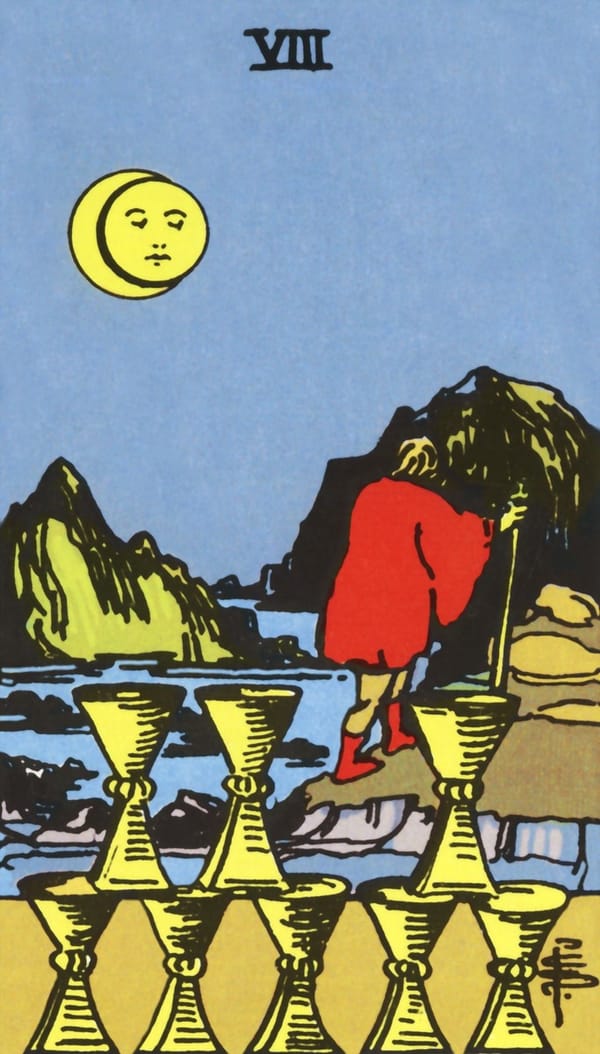
A figure wrapped in a red cloak walks away from eight golden cups stacked in two rows: five on the bottom, three on top, with a visible gap where a ninth cup could sit. The figure leans on a walking stick, heading toward jagged mountains across what appears to be rocky, wet terrain, maybe a riverbank or tidal flat. Above, an eclipsed moon hangs in the sky, a crescent overlapping a full circle, casting a dim, uncertain light.
He's leaving at night. Under a half-hidden moon. He didn't announce this departure. He didn't throw a going-away party. He just got up and walked.
Now reverse the card. He turns back. The mountains are behind him now. He's facing those eight cups again, still holding his walking stick, still wearing the cloak he packed for the journey. But his feet are moving in the wrong direction.
The original 1910 meaning appears in Waite's Pictorial Key to the Tarot, but much of what makes this card powerful comes from choices Pamela Colman Smith made in the artwork that Waite never commented on.
The Departure That Never Happens
The Eight of Cups reversed shows up when you're supposed to walk away but you don't. Maybe it's the job that's been draining your soul for two years. The relationship where you keep having the same fight. The city where you complain about everything but never actually move.
Look at the gap in the cups. The top row has space for one more, but it's empty. That missing cup is the fulfillment that isn't there. Upright, the figure sees the gap and decides: what's here will never be complete. I need to find what's missing somewhere else. Reversed, you see the gap and think: maybe if I stay longer, the missing cup will appear on its own.
Fear Disguised as Loyalty
The eclipsed moon in the card casts just enough light to see the path but not enough to illuminate what lies ahead. That half-darkness is why leaving feels so terrifying. You can see the cups clearly. They're right there, solid and golden and familiar. The mountains are dim, barely outlined against the sky.
Sometimes staying feels noble. You tell yourself you're being loyal to your company during tough times. You're giving your partner another chance to change. You're not a quitter.
But the figure in the card already made his assessment. He counted the cups. He noticed the gap. He picked up his stick. Reversed, he's putting the stick down. He's unpacking the cloak. He's telling himself the eclipsed moon is a sign to wait rather than a light to travel by.
Walking away triggers its own form of grief process, even when the leaving is voluntary.
The Comfort of Familiar Misery
Look at the cups again. They're neatly arranged, organized, stable. They represent an emotional situation you understand. Five on the bottom, three on top, that gap you've memorized. You know exactly what this arrangement gives you and what it lacks.
Leaving requires admitting you don't know what comes next. At least your current problems are predictable. You know exactly how your boss will disappoint you next week. You can anticipate which conversation will trigger that same argument.
The Eight of Cups reversed captures this strange comfort we find in situations we've outgrown. The mountains look cold and unfamiliar. The rocky terrain under the figure's feet is wet and uneven. Of course you turned back. The cups are dry and stable and countable.
When Hope Becomes Procrastination
The walking stick in the figure's hand is important. It's a tool for the journey. He brought it because he intended to travel rough ground. Reversed, he's leaning on it while standing still. The tool for departure has become a prop for staying.
This card often appears when you're using hope as an excuse to avoid action. Maybe your startup will finally get funding. Maybe your partner will realize they want what you want. Maybe the ninth cup will appear and complete the arrangement.
Hope isn't wrong. But the Eight of Cups reversed suggests you're hoping instead of choosing. The figure could stand there indefinitely, stick in hand, cloak on shoulders, moon overhead, waiting for the cups to rearrange themselves.
The Cost of Staying Too Long
Every night the figure stands facing those cups instead of walking toward the mountains is a night closer to dawn. And the eclipsed moon won't wait. The specific light that allows this journey, the half-dark clarity that shows you both what you have and what you lack, won't last forever.
The opportunity cost isn't just time. It's the person you're not becoming while you wait for circumstances to change. The mountains represent a version of your life that only exists on the other side of departure.
Moving from Reversed to Upright
The path forward isn't always dramatic. Sometimes it's as simple as finally having the conversation you've been putting off. Setting the boundary you've been afraid to set. Putting your weight on the walking stick and taking one step toward the mountains instead of back toward the cups.
The Eight of Cups reversed transforms into its upright position when you stop waiting for the eclipsed moon to become a full sun and start walking in the light you have. The cups will still be there if you need to come back. But you won't know what's beyond those mountains until you walk away.


