Two of Swords
What the image shows
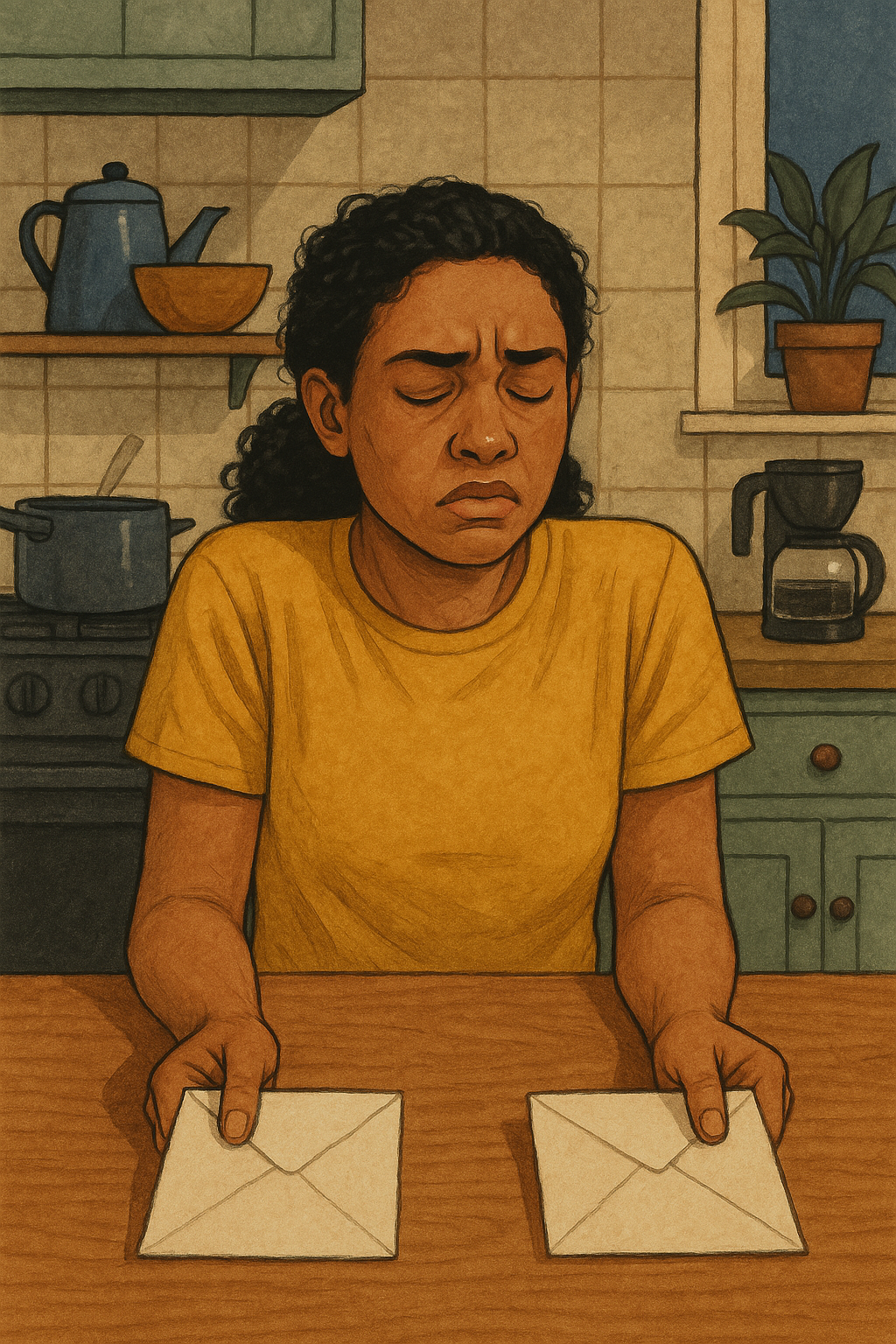
A woman sits at a wooden kitchen table, eyes closed, face tight with discomfort or concentration. She's wearing a plain yellow t-shirt, and her dark curly hair falls past her shoulders. Her hands rest on two sealed envelopes, one under each palm, positioned symmetrically in front of her. She's not opening either one.
The setting is an ordinary kitchen — tiled walls, a stovetop with a pot on it, a coffee maker, a blue teapot on a shelf, a potted plant by the window. Warm afternoon light comes in from somewhere off-frame. Everything about the scene is domestic and familiar, which makes her visible tension stand out more. This isn't a dramatic moment. It's a quiet one, the kind that happens when you're alone with a decision you don't want to make.
The envelopes could be anything — job offers, medical results, letters from two different people. What matters is that she has information available to her and she's choosing not to look at it yet. Her closed eyes and pained expression suggest she already knows, on some level, what's inside.
The modern read
This illustration nails the Two of Swords by making it completely ordinary. There's no blindfold, no swords, no dramatic seascape — just a woman in her kitchen avoiding her mail. That's what this card actually looks like in real life. It's the moment before you check your bank balance, before you read the text you know is bad news, before you open the results.
By grounding it in a real kitchen with real envelopes, the image strips away any mystique and shows the card for what it is: avoidance dressed up as deliberation. She's not meditating on her options. She's bracing herself. The symmetry of the two envelopes mirrors the traditional crossed swords, but here it's about paralysis, not protection. She has all the information she needs to decide. She just doesn't want to.
How it connects to the Rider-Waite-Smith
The traditional RWS Two of Swords shows a blindfolded woman sitting before a body of water, holding two crossed swords over her chest. The blindfold suggests willful ignorance or blocked perception. The crossed swords indicate a stalemate — two opposing forces held in tension. The water behind her represents the emotions she's refusing to engage with. The moon often appears, hinting that intuition is present but being ignored.
This modern version keeps the core elements: a woman, two objects held in balance, and a deliberate refusal to see. The envelopes replace the swords as tools of information and decision. Her closed eyes are the new blindfold — self-imposed, not forced. What's shifted is the context. Instead of a mythic figure on a stone bench, we get someone in her own kitchen, which makes the avoidance feel more personal and more relatable. The emotional stakes are implied through her expression rather than symbolized by water.
Upright meaning
The Two of Swords upright means you're stuck between two options and you're avoiding making a choice. You might be telling yourself you need more time or more information, but really, you already know enough. You're just not ready to deal with the consequences of deciding.
In love: You're dating two people and won't commit to either, or you're in a relationship and ignoring a problem because addressing it means a hard conversation. You keep saying "I don't know what I want" when you do know — you just don't want to say it out loud.
At work: Two job offers sit in your inbox. You keep weighing pros and cons instead of accepting that both have trade-offs and you need to pick one. Or you're avoiding a conflict with a coworker by pretending it doesn't bother you.
With money: You haven't opened your credit card statement in three months. You know it's bad. Looking at it means making a budget, cutting expenses, having a real plan. Easier to keep the envelope sealed.
In daily life: You've been putting off a medical appointment, a difficult phone call, or a decision about where to live. The longer you wait, the more the indecision becomes its own choice.
Reversed meaning
Reversed, the Two of Swords points to one of two things: either the stalemate breaks and you finally make a choice, or you dig in deeper and the avoidance becomes truly damaging.
In love: You've been on the fence about a relationship for months, and now you're finally ready to end it — or you've avoided the conversation so long that your partner makes the decision for you. The reversal can also mean you're lying to yourself about what you want, and that denial is starting to affect your mental health.
At work: You kept delaying a decision and now the opportunity is gone. The job went to someone else. The project moved forward without your input. Or you finally confronted the situation you'd been avoiding and it wasn't as bad as you feared.
With money: The bill went to collections because you never opened it. Or you finally sat down, faced the numbers, and started dealing with the debt. Reversed can go either way — breakthrough or breakdown.
In daily life: You made a choice under pressure and now you're second-guessing it. Or you've been so locked in indecision that you've started to feel numb, disconnected, unable to engage with anything because everything feels like too much.