The Star
What the image shows
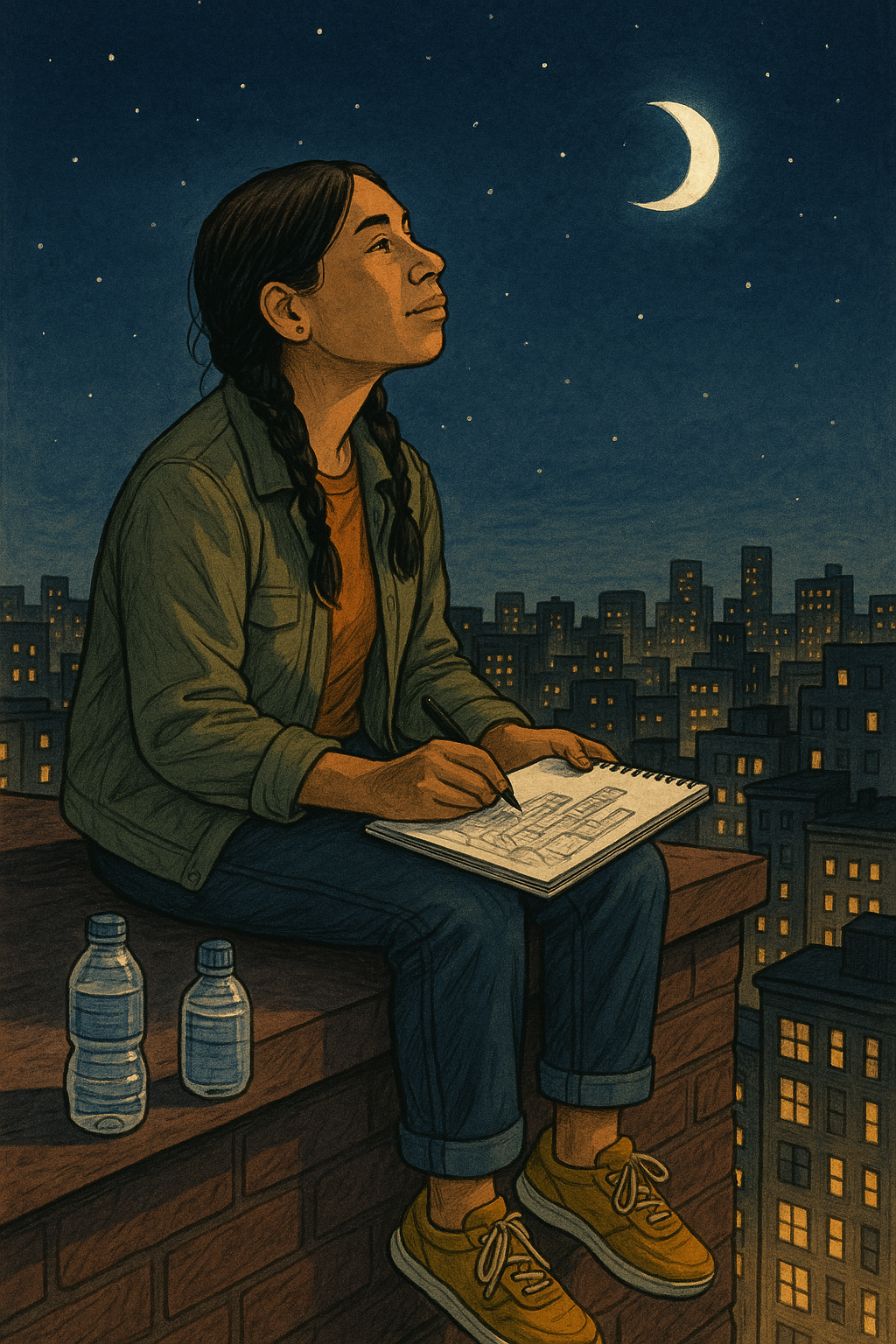
A young woman sits on the edge of a rooftop, her legs dangling over the side of the building. She wears a sage-green utility jacket over an orange t-shirt, dark jeans cuffed at the ankles, and mustard-yellow sneakers. Her dark hair is pulled back in a long braid. She holds a spiral-bound sketchbook in her lap and a pen in her hand, though she's not looking at her work—her face is tilted upward, gazing at the night sky.
The sky is a deep, saturated blue scattered with stars, and a bright crescent moon hangs in the upper right corner. Behind her, a dense cityscape of apartment buildings stretches out, windows glowing with warm yellow light. Two plastic water bottles sit beside her on the rooftop ledge. The overall feeling is quiet and solitary—a stolen moment of stillness above the hum of the city.
The details matter here: she's actively creating something (the sketchbook shows what looks like architectural drawings or city plans), but she's paused to look up. She's not escaping the city—she's part of it, perched right on top of it, but she's found a way to breathe.
The modern read
This illustration reframes The Star as something you do for yourself, not something that happens to you. The traditional card often feels passive—receiving healing, being blessed. Here, the woman has climbed to a rooftop, brought her supplies, and made space for both creative work and quiet contemplation. Hope isn't landing in her lap; she's actively seeking it out.
Placing The Star in an urban setting also grounds it in reality. This isn't a remote oasis or a magical spring—it's a city rooftop with water bottles and apartment buildings. The message is clear: renewal doesn't require escape. You can find perspective and peace in the middle of your actual life, with the noise still below you and the work still in your hands.
How it connects to the Rider-Waite-Smith
The traditional Rider-Waite-Smith Star shows a naked woman kneeling beside a pool of water under a night sky dominated by one large eight-pointed star surrounded by seven smaller ones. She pours water from two jugs—one into the pool, one onto the land—symbolizing the flow between conscious and unconscious, the replenishment of both inner and outer resources. A bird (often identified as an ibis) sits in a tree behind her. The scene is peaceful, open, and exposed.
The modern version keeps the core elements: the night sky with stars and a crescent moon, the water (here practical bottles rather than ceremonial jugs), and the posture of openness and upward gaze. What shifts is the vulnerability—this woman is clothed, seated, and in control of her environment. The water isn't being poured out; it's there for sustenance. The emphasis moves from mystical replenishment to practical self-care and creative restoration. Both versions are about hope and renewal, but this one puts the figure in charge of creating that moment for herself.
Upright meaning
The Star upright is about recovery, clarity, and finding your footing after something hard. It's the card that shows up when you're past the worst of it and can finally see forward again. Not everything is fixed, but you've stopped drowning.
In love: You've worked through a rough patch and things feel lighter. Or you're dating again after heartbreak and actually enjoying it instead of just going through the motions. Trust is rebuilding.
At work: You finally have a clear sense of what you want professionally. Maybe you finished a brutal project and now feel creative again, or you're applying for jobs with actual optimism instead of desperation.
With money: Financial stress is easing. You're not rich, but you can see the path to stability. You're making a plan and it feels achievable.
In daily life: You're sleeping better. You made time for something you love—sketching, running, cooking—and it reminded you who you are outside of your obligations. Small things feel good again.
Reversed meaning
The Star reversed points to lost hope, disconnection, or refusing to let yourself heal. Something is blocking your ability to see past the current difficulty. You might be stuck in cynicism or just too exhausted to believe things can improve.
In love: You're going through the motions but don't really believe the relationship can get better. Or you've convinced yourself you'll never find someone, so why try.
At work: Burnout has flattened you. You used to care about this job or this career path, and now you feel nothing. The creative spark is gone and you're not doing anything to get it back.
With money: Financial anxiety has become your whole worldview. Even when things improve slightly, you can't feel it. You're stuck in scarcity mode.
In daily life: You've stopped doing the things that restore you. No time for hobbies, no quiet moments, no looking up. You're just grinding through days and wondering why you feel empty.