
Six of Cups
What the image shows
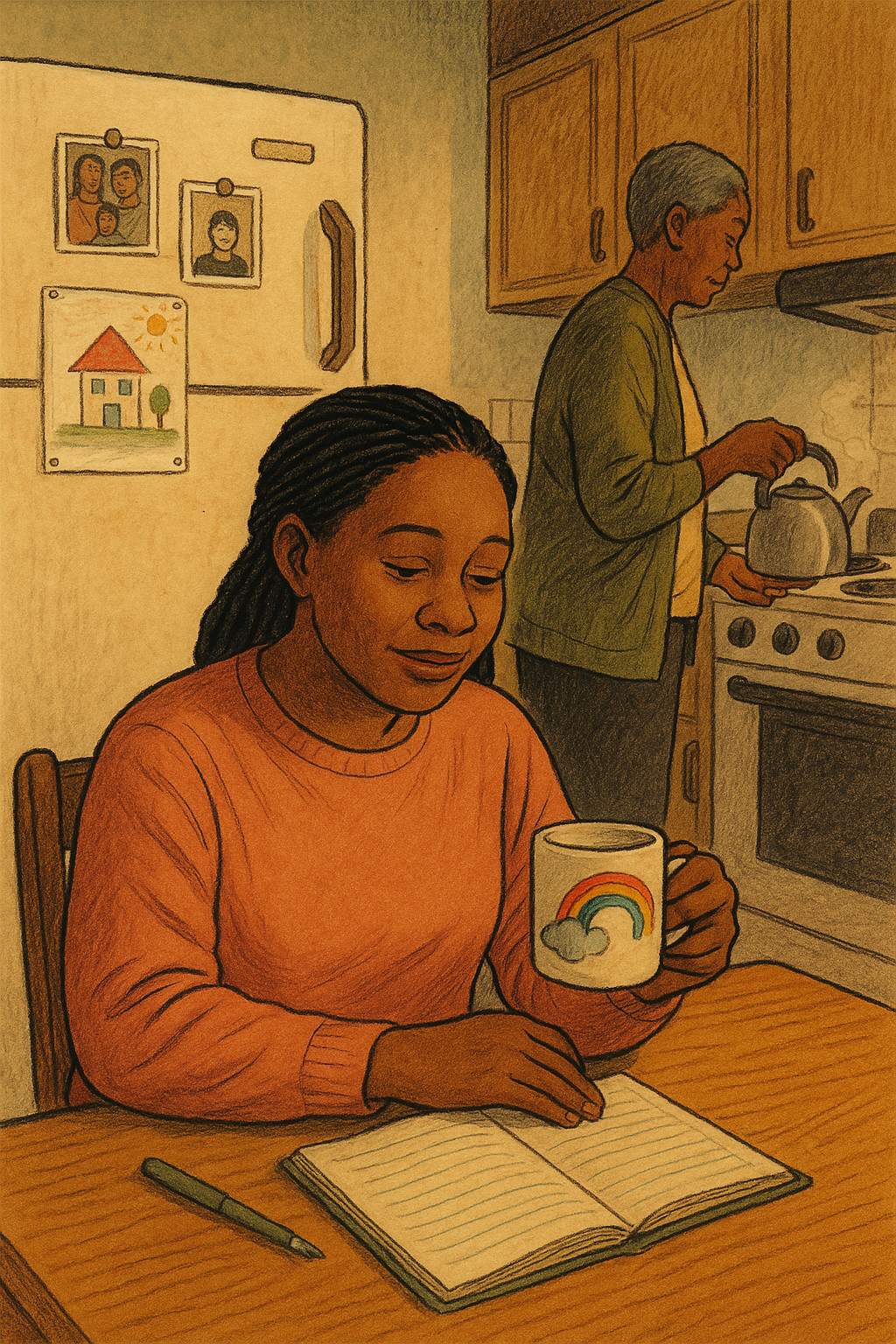
A young woman sits at a kitchen table, wearing a coral-colored sweater, her long braids falling past her shoulders. She's looking down at an open notebook with a pen beside it, holding a white mug decorated with a rainbow. Her expression is soft, a small smile on her face—she looks content, maybe a little nostalgic, like she's remembering something good while she writes.
Behind her, an older person in a green cardigan stands at the stove, pouring from a kettle. The kitchen is lived-in and warm: wooden cabinets, a refrigerator covered with family photos and a child's drawing of a house with a sun. The light has that golden, late-afternoon quality that makes everything feel safe and unhurried.
The scene is quiet and domestic. Nothing dramatic is happening—just two people sharing space in a family kitchen, one generation caring for another. The rainbow mug and the child's drawing are small details that suggest a long history here, layers of memory built into the room itself.
The modern read
This illustration frames the Six of Cups as something you can actually touch: the comfort of a childhood home, a grandparent making tea while you sit at the same table where you did homework as a kid. It's not about sentimentality for its own sake—it's about the real, physical places and people that shaped who you are.
By putting this card in a kitchen instead of a garden, the image says that nostalgia isn't just dreamy memory. It's showing up, being present with the people who raised you, and finding that those connections still hold. The notebook suggests she might be processing something, maybe journaling about the past or writing down family stories. The Six of Cups here is active remembering, not passive daydreaming.
How it connects to the Rider-Waite-Smith
The traditional RWS Six of Cups shows two children in front of a stone house, one offering a cup filled with flowers to the other. The scene is safe, enclosed, and clearly nostalgic—the architecture suggests the past, and the children represent innocence, gifts given freely, and memories of simpler times. A guard walks away in the background, implying protection without intrusion.
This modern version keeps the core feeling: safety, generational connection, the sweetness of the familiar. The cups become the rainbow mug and the family photos—small objects that carry emotional weight. The older figure at the stove replaces the guardian in the background, still protective but now actively nurturing. What shifts is the specificity. This isn't a generic "childhood" scene—it's a particular kitchen, a particular relationship. The card becomes less symbolic and more felt.
Upright meaning
The Six of Cups upright points to the past in a good way—memories, people, or places from earlier in your life that still matter. It's about comfort, familiarity, and the gifts that come from your personal history.
In love: An ex reaches out and you realize you're not over them—or you are, and the closure feels clean. You and your partner visit your hometown together and it brings you closer. You meet someone who feels immediately familiar, like you've known them longer than you have.
At work: A former colleague refers you for a job. You return to a field you left years ago and find you still love it. A mentor from early in your career offers advice that lands differently now that you have experience.
With money: Family helps you out during a rough patch. You inherit something small but meaningful. You find old savings bonds or a check you forgot to cash.
In daily life: You reconnect with a childhood friend. You visit your parents and feel genuinely glad to be there. You pull out old photos and feel grateful instead of sad.
Reversed meaning
Reversed, the Six of Cups warns that the past has too much grip on you. You're stuck, romanticizing what was, or you can't move forward because you keep looking back. Sometimes it points to unresolved childhood stuff that's bleeding into present decisions.
In love: You keep comparing every new partner to an ex who wasn't that great anyway. You're stuck in a relationship that worked ten years ago but doesn't fit who you are now. You idealize "how things used to be" instead of dealing with how things are.
At work: You refuse to learn new systems because the old way was better. You're coasting on past accomplishments instead of building new skills. You keep returning to jobs or industries that have already shown you they're not a good fit.
With money: You bail out a family member who never pays you back, again. You can't let go of a house or possession that's costing more than it's worth because of sentimental attachment.
In daily life: You're avoiding your family because the memories are too painful to process. You keep going back to the same places, same routines, same people—not because they serve you, but because change feels impossible.