Queen of Cups
What the image shows
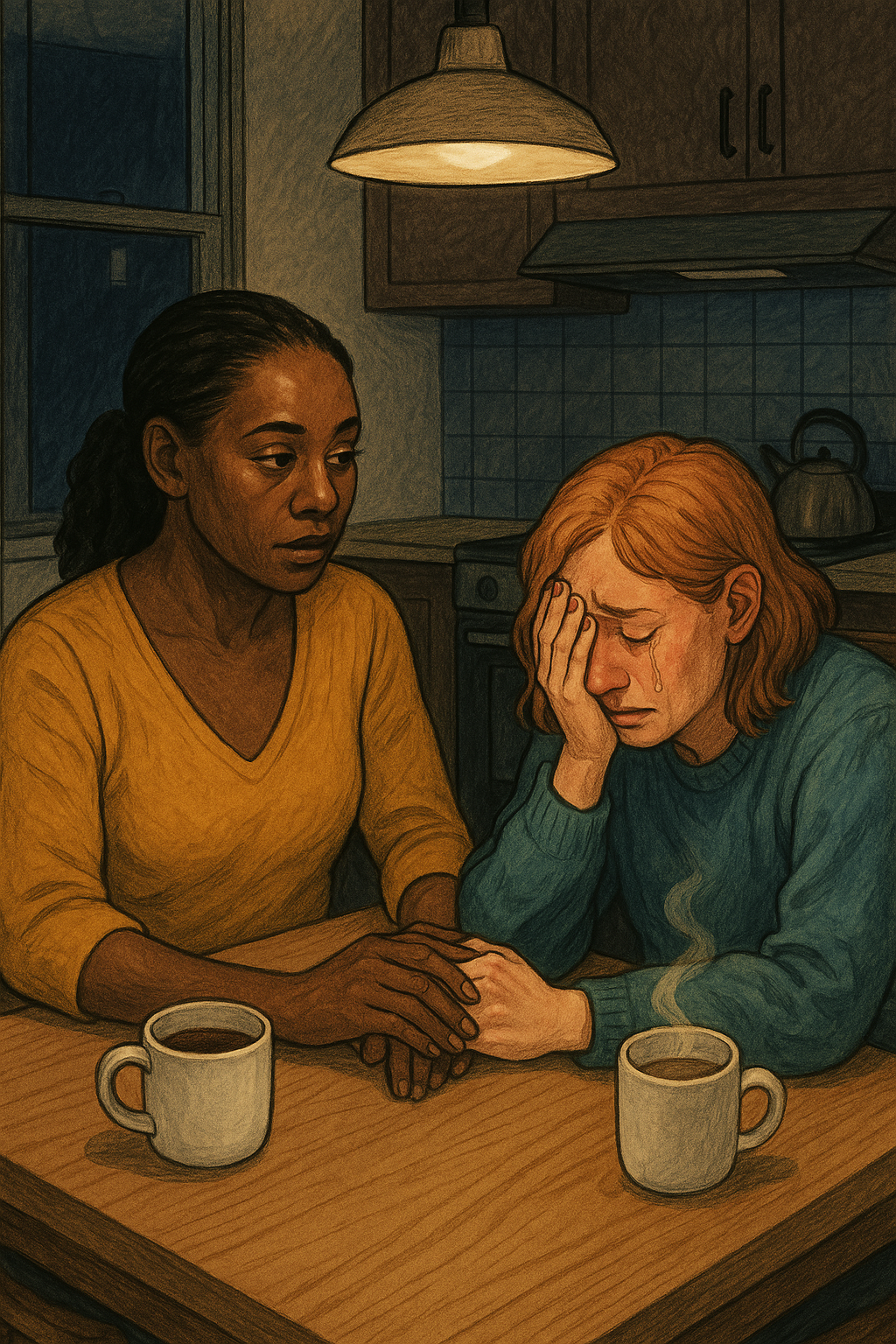
Two women sit at a kitchen table late at night, the window behind them showing darkness outside. One woman in a mustard yellow sweater holds the hand of another woman in a teal turtleneck who is crying, her free hand pressed against her face. The crying woman has tears visible on her cheek, her eyes closed, clearly in the middle of something painful. The other woman watches her with a steady, compassionate gaze—not fixing, not rushing, just present.
The setting is an ordinary kitchen with tile backsplash, cabinets, a range hood, and a kettle on the stove. Two white mugs sit on the wooden table between them, one still steaming. The overhead lamp casts warm light on the scene, creating an intimate circle in the otherwise dim room. Everything about this image says "I'm here, take your time, I'm not going anywhere."
The details matter: the hand-holding across the table, the untouched coffee, the late hour. This is someone who showed up when called, who knows that presence is more valuable than advice.
The modern read
This illustration strips the Queen of Cups down to her essential function: emotional holding. She's not doing anything dramatic. She's not solving the problem. She's sitting in a kitchen at what looks like 2 AM, holding someone's hand while they fall apart. That's the whole card—the ability to be present with difficult emotions without flinching, fixing, or fleeing.
Placing this in a real kitchen makes the Queen of Cups feel achievable rather than aspirational. She's not a mystical figure on a throne; she's the friend you can call when everything goes sideways. The illustration argues that emotional intelligence isn't about special powers—it's about showing up with coffee and patience when someone needs you.
How it connects to the Rider-Waite-Smith
The traditional RWS Queen of Cups sits on a throne at the water's edge, holding an elaborate covered chalice she studies intently. Her cup is closed and ornate—she holds deep emotional knowledge but keeps it contained. Water and shells surround her, linking her to the unconscious and intuition. She's alone, contemplative, almost merged with the sea behind her.
The modern version keeps the core meaning—emotional depth and the capacity to hold feelings—but makes it relational. Instead of gazing at her own cup, this Queen is actively using her gifts for someone else. The mugs on the table echo the traditional chalice, but now they're practical vessels shared between two people. The contained, inward Queen becomes an outward act of emotional caretaking.
Upright meaning
Queen of Cups upright is about emotional maturity and the ability to create safe space for feelings—yours and other people's. This is someone who can sit with discomfort without panicking, who listens more than they talk, who trusts their gut.
In love: You're the partner people feel safe crying in front of. You might be supporting someone through grief, illness, or a rough patch—and doing it without keeping score. Or you've finally found someone who actually gets you on an emotional level.
At work: You're the one coworkers come to with problems, the person who notices when someone's struggling before anyone else does. Could point to roles in counseling, HR, healthcare, or any job where reading people matters.
With money: Making financial decisions based on how they'll affect your emotional wellbeing and relationships, not just the numbers. Might mean turning down a higher-paying job because it would wreck your mental health.
Daily life: Trusting your instincts about people and situations. Having the kind of friendships where you can actually be honest. Being someone others turn to in a crisis.
Reversed meaning
Reversed, the Queen of Cups points to emotional overwhelm, poor boundaries, or feelings that have gotten stuck. The gift for feeling deeply becomes a liability—either you're drowning in other people's problems or you've shut down entirely to protect yourself.
In love: You're absorbing your partner's moods like a sponge and losing yourself in the process. Or you've become so guarded after being hurt that you can't let anyone in. Codependency lives here.
At work: Taking on everyone's emotional labor until you're burned out. The coworker who spends all day managing other people's feelings and then has nothing left. Could also mean ignoring your gut about a bad situation because you don't want to make waves.
With money: Making financial decisions from a place of fear or emotional reactivity. Spending to fill an emotional void. Lending money you can't afford because you can't say no.
Daily life: Ignoring your own needs because you're too busy caretaking everyone else. Passive-aggressive behavior because you won't say what you actually feel. Using alcohol, food, or other numbing strategies to avoid dealing with emotions.