
Four of Cups
What the image shows
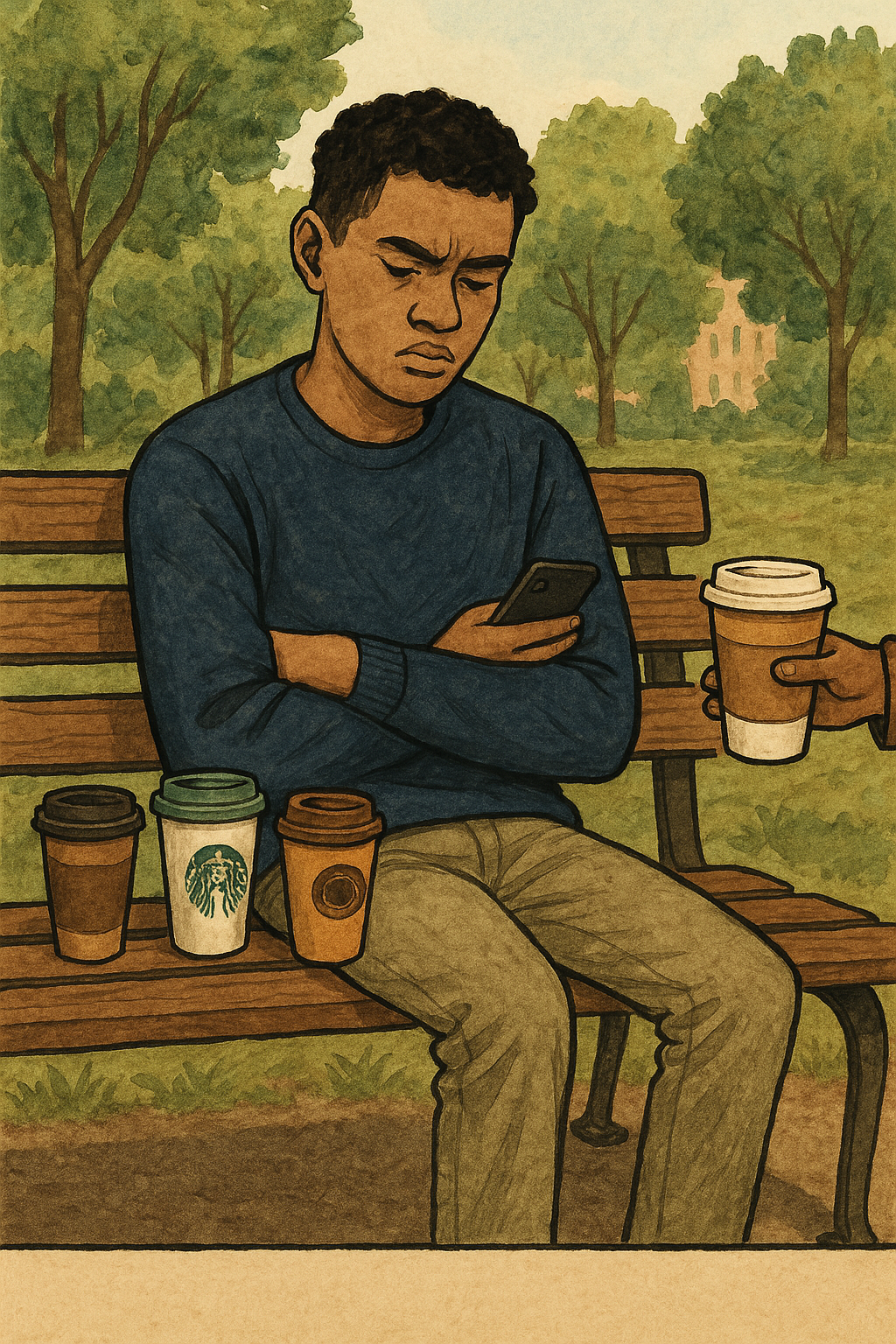
A young man sits on a wooden park bench, arms crossed tightly over his chest, staring down at his phone with a furrowed brow and a distinctly unimpressed expression. He's wearing a plain navy blue long-sleeve shirt and olive pants — casual, unremarkable, the kind of outfit you throw on without thinking. The setting is a lush green park with trees in full leaf and what looks like a building visible in the background.
Three coffee cups sit on the bench beside him — one clearly from Starbucks, the others from different cafes. Someone off-frame is extending a fourth cup toward him, but he's not looking at it. He's not even acknowledging the offer. His body language is closed off, his attention locked on whatever's on his screen, completely disengaged from both the coffees already there and the one being handed to him.
The detail that hits hardest is the contrast: he's surrounded by what most people would consider small pleasures — good coffee, a beautiful day in the park, someone actively trying to offer him something — and he looks miserable. Or at least deeply checked out.
The modern read
This illustration nails the Four of Cups as a portrait of emotional unavailability disguised as boredom. The man isn't in crisis. He's not struggling. He's just... not present. He has options in front of him — represented by those three cups — and someone is literally reaching out to give him more, and he can't be bothered. His phone has become a shield, a way to avoid engaging with what's actually in front of him.
Placing this card in a park, with its disposable coffee cups and smartphone, makes the message uncomfortably familiar. This is how we all check out sometimes — scrolling instead of connecting, dismissing offers of help or company because we're too stuck in our own heads to notice them. It's not dramatic rejection. It's passive disengagement, and that's often harder to recognize in yourself.
How it connects to the Rider-Waite-Smith
The traditional RWS Four of Cups shows a young man sitting under a tree, arms crossed, staring at three cups on the ground in front of him. A mysterious hand emerges from a cloud, offering a fourth cup, but he doesn't see it — or won't look at it. The posture suggests contemplation, but also withdrawal. He's so focused on what he already has (or doesn't want) that he misses what's being offered.
This modern version keeps the core elements: the crossed arms, the three cups, the fourth being offered, and the complete lack of interest. What shifts is the setting and the reason for the withdrawal. Instead of mysterious contemplation, we get the more mundane (and more relatable) version — someone numbing out with their phone, using distraction as a way to avoid engaging with life. The cloud becomes someone's hand; the mystical becomes ordinary. The message stays the same: something good is right there, and you're refusing to see it.
Upright meaning
Four of Cups upright is about apathy, emotional withdrawal, and missing opportunities because you're too checked out to notice them. It's the card of "meh" — not active misery, but a refusal to engage with what's available.
In love: Your partner keeps trying to plan dates or have conversations and you can't summon the interest. Or you're single and friends keep trying to set you up, but everyone seems boring before you've even met them.
At work: You're offered a new project or a chance to learn something, and you shrug it off without really considering it. You're not unhappy enough to quit, but you're not engaged enough to try.
With money: You know you should be doing something — opening that investment account, making that budget — but you can't make yourself care enough to start.
In daily life: Someone invites you out and you say no without thinking, then spend the evening scrolling your phone and feeling vaguely dissatisfied.
Reversed meaning
Reversed, Four of Cups can go two ways: either you're finally waking up and re-engaging with life, or you're sinking deeper into withdrawal and actively rejecting what's offered.
The positive flip: You suddenly realize you've been sleepwalking through your life. You say yes to the invitation, take the meeting, actually look up from your phone and notice what's in front of you.
The negative spiral: You're not just passively checked out — you're actively pushing things away. Your partner offers to talk and you shut them down. A friend extends help and you reject it with irritation. You know something's being offered and you don't want it.
Blocked gratitude: You can't see what you have. You're so focused on what's missing that the good stuff becomes invisible.
Deeper depression: Sometimes this reversal points to something more serious than boredom — actual depression that needs attention, not just a mood to push through.