
Five of Wands
What the image shows
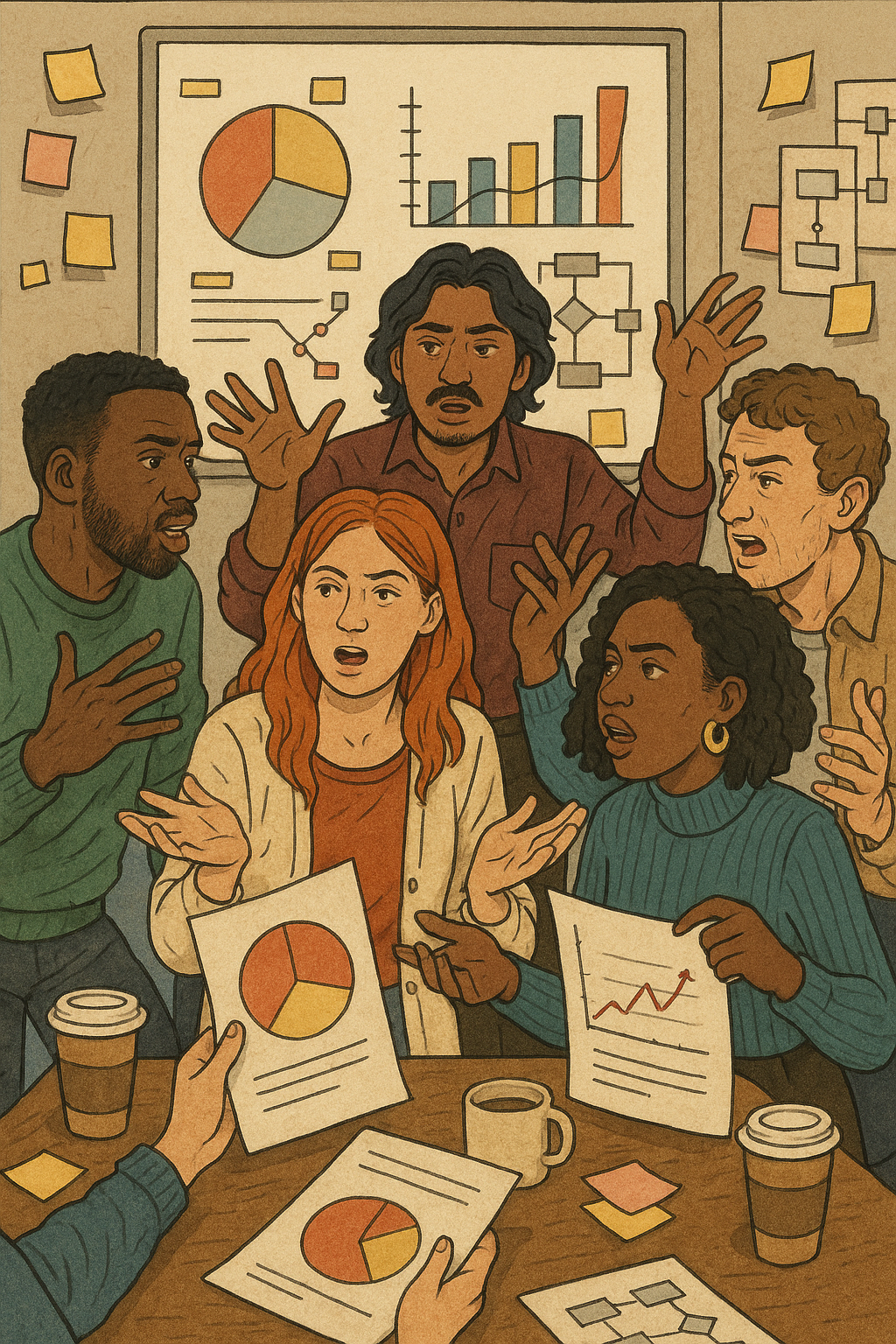
Five people crowd around a table in what looks like a meeting room or startup workspace, and every single one of them is talking at once. Nobody is listening. The woman in the center with long red hair has her palms up in exasperation, caught between two colleagues thrusting pie charts and line graphs at her. Behind her, a man in a brown button-down shirt has both hands raised, trying to get a word in or possibly trying to calm things down—it's hard to tell which.
The table is cluttered with coffee cups, sticky notes, and printed reports covered in charts. A whiteboard behind them displays more graphs, flowcharts, and diagrams, with additional sticky notes plastered on the walls around it. The man on the left in a green sweater is gesturing emphatically while speaking, and the man on the right in the tan jacket looks like he's mid-interruption. The woman in the teal sweater holds up her own report, clearly making her own competing point.
The overall mood is controlled chaos—this isn't a screaming match, but it's five people who all believe their perspective is the right one, and none of them are willing to pause long enough to hear anyone else out. The coffee cups suggest they've been at this for a while.
The modern read
This illustration nails what the Five of Wands actually looks like in most people's lives: not a literal fight with sticks, but a meeting where everyone has a different vision and nobody's facilitating. It's the group project where five people all want to lead. It's the family planning session where everyone has the "right" answer. The conflict here isn't violent or even hostile—it's just friction from too many opinions colliding without structure.
Placing this card in a work setting makes the Five of Wands feel less abstract and more immediately recognizable. This is competition that isn't necessarily destructive, but it's exhausting. These people probably all have valid points buried in their charts and graphs. The problem isn't that they're wrong—it's that nobody has figured out how to synthesize their ideas or establish whose call it actually is. That's the Five of Wands in a nutshell: everyone's got fire, nobody's got coordination.
How it connects to the Rider-Waite-Smith
The traditional RWS Five of Wands shows five young men in a chaotic scuffle, each holding a wooden staff or wand. They're all swinging at different angles, and it's unclear whether they're actually fighting each other or just flailing without coordination. There's no clear winner, no obvious sides—just a tangle of competing efforts. The background is bare, putting all focus on the messy human conflict.
This modern version keeps the core elements: five people, everyone actively engaged, nobody dominating, no resolution in sight. The wands become reports and presentations—tools of persuasion rather than physical weapons, but weapons nonetheless. What shifts is the stakes feel more relatable. The RWS version can seem like play-fighting or training; this version captures the real frustration of being stuck in unproductive conflict. The coffee cups and cluttered table add exhaustion to the mix—these people have been battling it out for a while, and they're no closer to agreement.
Upright meaning
The Five of Wands upright means you're in the middle of competition, disagreement, or clashing perspectives. This isn't necessarily bad—sometimes friction produces better ideas—but right now, it's chaotic and unresolved. Everyone has an agenda. Nobody's in charge.
In love: You and your partner keep having the same argument without resolution. You're both trying to "win" instead of understand. Or you're dating and juggling multiple options, unable to commit because everyone seems equally viable.
At work: Too many cooks in the kitchen. A project has five stakeholders with five different visions, and meetings go in circles. You might be competing for a promotion against colleagues you actually like, which makes things awkward.
With money: You're getting conflicting financial advice—your parents say one thing, your friend says another, you read something different online. Or you and a partner can't agree on spending priorities.
In daily life: Scheduling conflicts pile up. Everyone in your household wants something different for dinner, vacation plans, or weekend activities. You're juggling competing demands on your time and nothing fits together smoothly.
Reversed meaning
Reversed, the Five of Wands points to conflict that's either been suppressed, avoided, or has escalated into something genuinely harmful. The healthy friction of the upright card curdles into something less productive.
Avoiding necessary conflict: You're keeping the peace at your own expense. That conversation you need to have with your roommate about chores? You keep dodging it. The disagreement with your boss about your workload? You swallow it and seethe instead.
Escalation: What started as healthy debate has turned personal. A work rivalry has become genuinely hostile. A family disagreement about holiday plans has devolved into people not speaking to each other.
Internal conflict: You can't make a decision because you're arguing with yourself. Every option has a loud advocate in your head and you're paralyzed.
Pointless competition: You're competing over something that doesn't actually matter, or you've "won" a fight that cost you more than you gained. You got the last word, but you lost the relationship.