Ace of Cups
What the image shows
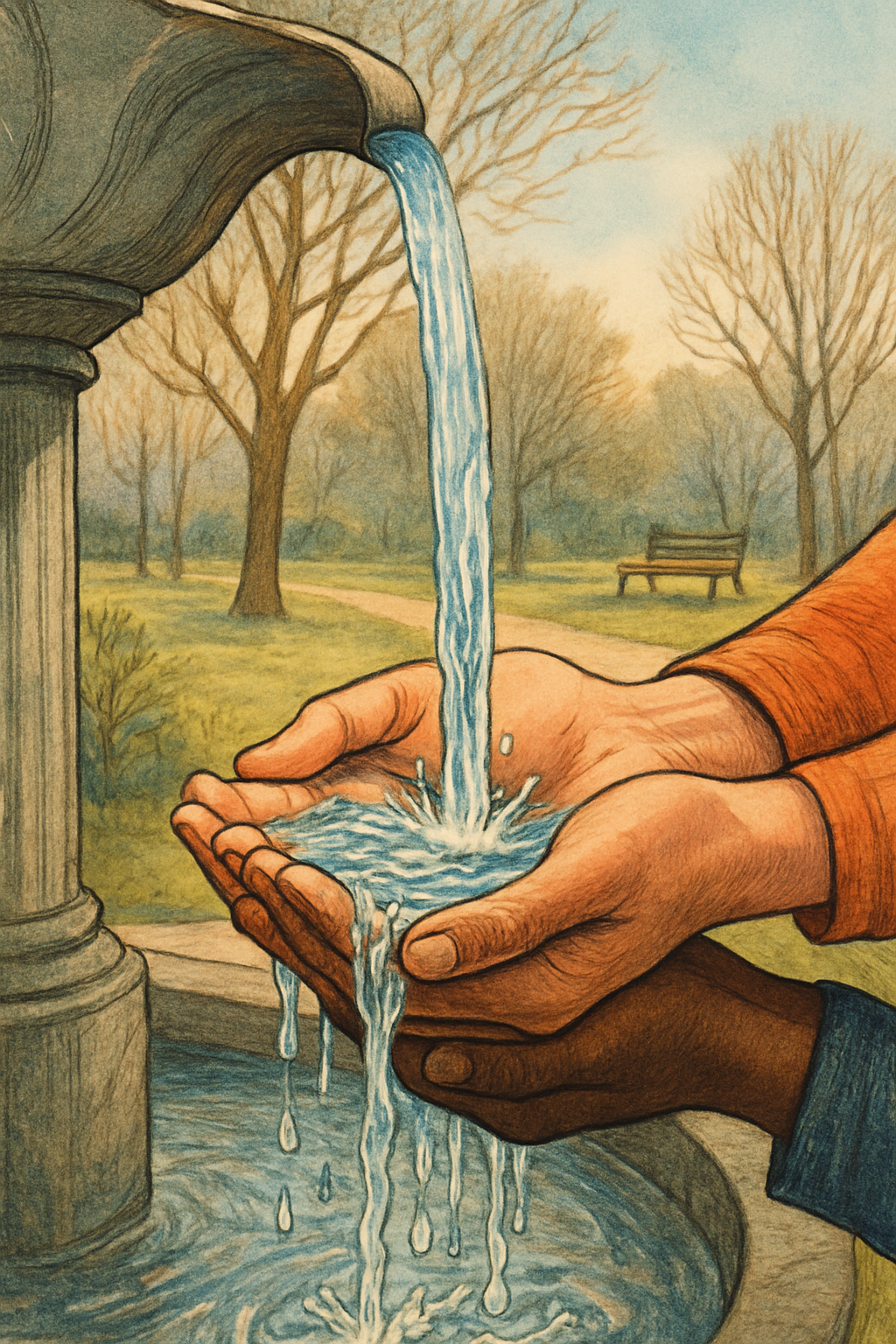
A pair of weathered hands cups beneath a stream of water pouring from an old stone fountain in what looks like a public park. The hands are catching the water, letting it pool in the palms while some spills through the fingers and drips down into the basin below. The person wears an orange long-sleeved shirt pushed up at the wrists, and you can see a hint of denim at the edge of the frame.
The setting is late autumn or early spring — bare trees stand in the background against a pale sky with soft clouds. A park bench sits empty on a winding path through green grass. The fountain itself has a classical column design, grey stone with fluting. The whole scene has a colored pencil texture, warm and slightly grainy, with careful attention to how light moves through water.
The focus is entirely on this simple act: someone stopping at a public fountain to feel water in their hands. There's no one else around. It's quiet and unhurried.
The modern read
This illustration strips the Ace of Cups down to its most essential gesture — receiving something that can't be held onto. Water flows, pools briefly, and escapes. The person isn't trying to keep it all; they're just letting themselves experience it. That's what emotional openness actually looks like in practice: not a permanent state, but a moment of allowing.
Placing this in a public park makes the point that these moments of receptivity happen in ordinary life, not in some special ritual space. You're walking through your day, you stop, you let something in. The empty bench and bare trees suggest solitude without loneliness — being alone with your own capacity to feel. The fountain is public infrastructure, freely available. The card is saying: this is already here for you, if you'll just put your hands out.
How it connects to the Rider-Waite-Smith
The traditional RWS Ace of Cups shows a golden chalice held by a hand emerging from a cloud. The cup overflows with five streams of water, a dove descends carrying a communion wafer marked with a cross, and lotus flowers float on a body of water below. It's loaded with religious symbolism — grace being offered from the divine, the Holy Spirit, spiritual nourishment. The imagery is vertical and hierarchical: something from above comes down to you.
This modern version keeps the core action (water being received) but removes the supernatural framing. There's no hand from heaven — instead, there's civic infrastructure and human hands. The dove and wafer are gone; the spiritual becomes the everyday. What carries over is the sense of abundance (the water keeps flowing), the gesture of open receptivity, and the implication that you don't earn this, you just accept it. What shifts is the source: it's no longer about divine grace but about your own willingness to be present and feel something.
Upright meaning
The Ace of Cups upright is about emotional beginnings and genuine receptivity. Something is being offered — love, connection, creative inspiration, compassion — and you're in a position to receive it. Your job is to stay open rather than guarded.
In love: A promising first date where you actually feel something instead of going through the motions. Someone tells you they care about you and you let that land instead of deflecting. You're ready to be vulnerable with a new person.
At work: A project sparks genuine enthusiasm. You connect with a colleague on a real level. Creative work flows without forcing it. You feel emotionally invested in what you're doing.
With money: Receiving an unexpected gift or financial help with no strings attached. Feeling gratitude for what you have rather than scarcity about what you don't.
In daily life: A conversation that leaves you feeling understood. Crying at a movie because you let yourself. Noticing beauty in small things. Being moved by something and not brushing past it.
Reversed meaning
Reversed, the Ace of Cups points to blocked emotions, refused offers, or emotional unavailability. The water is still there, but your hands are closed or pulled away. You're not letting yourself feel or receive.
In love: Pushing someone away when they try to get close. Going on dates while emotionally checked out. Telling yourself you don't need connection when you actually do. Rejecting affection because it feels uncomfortable.
At work: Creative block because you're afraid of producing something real. Shutting down emotionally to get through a toxic environment. Unable to muster enthusiasm for anything.
With money: Refusing help when you need it. Guilt about receiving. Feeling like you don't deserve good things.
In daily life: Emotional numbness as a coping mechanism. Keeping yourself too busy to feel. Avoiding art, music, or experiences that might crack you open. Staying in your head to avoid your heart.